











Bitcoin casinos sit in a grey zone for Canadian players. Deposits clear in minutes, withdrawals can land faster than a bank wire, and some sites run games you can verify yourself. You also give up the consumer protection of a provincial regulator, and every coin you send is final. This guide covers both sides: which sites from our reviews are worth your time, how to move Bitcoin in and out safely, and the maths behind volatility, fees and wagering.
- Who this guide is for: adults (19+, check your province’s minimum) who already hold Bitcoin or plan to buy some.
- What you will get: a shortlist, a legal overview by province, a step-by-step deposit and withdrawal walkthrough, and worked examples in CAD.
- What you will not get: promises of profit. Gambling is entertainment with a built-in house edge.
Quick Picks: Our Top Bitcoin-Friendly Casinos
The table below lists the operators from our database that lean hardest into crypto, plus a few with large welcome packages that are worth a look if their cashier lists Bitcoin on the day you sign up. Ratings are our own editorial scores out of 100. Promotions are copied exactly from our data sheets. Always open the site’s terms before you deposit, because offers change.
| Casino | Our rating | Headline offer | Stand-out feature |
|---|---|---|---|
| Stake | 94 | Rakeback + VIP Reloads | 3.5% Rakeback From Bronze |
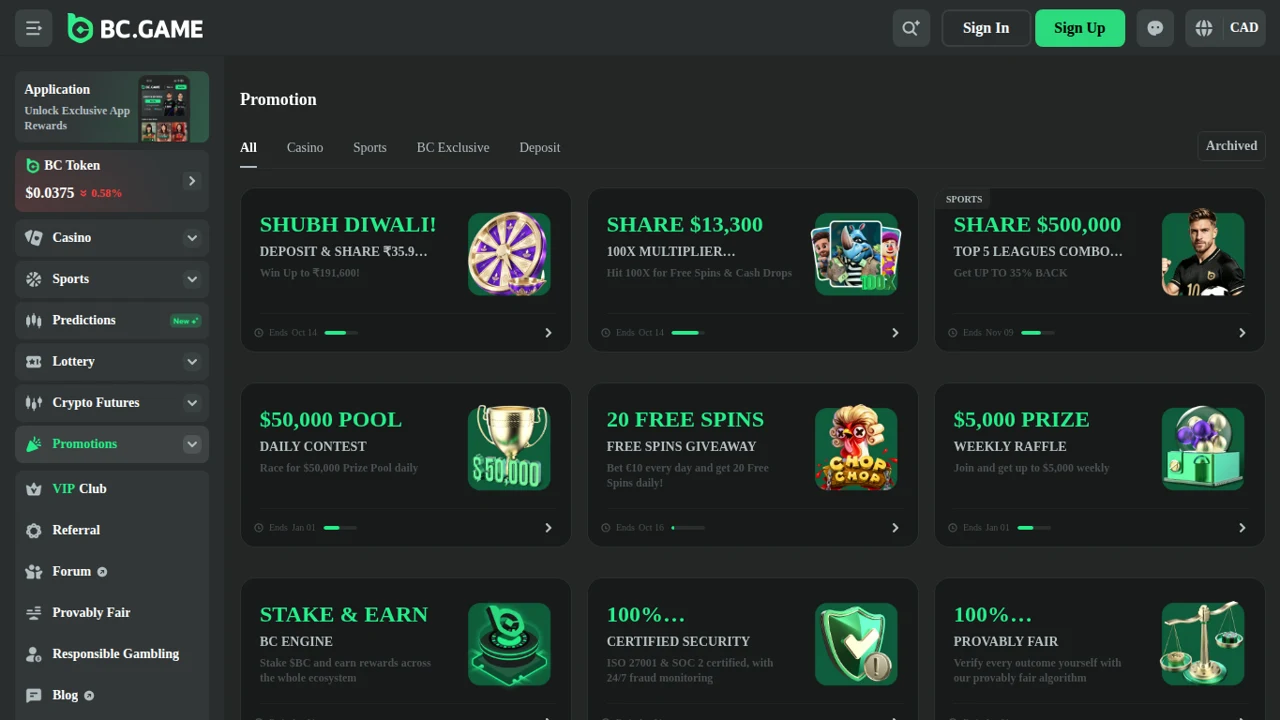
| BC.Game | 93 | Crypto Welcome Bonus | Provably Fair Originals |
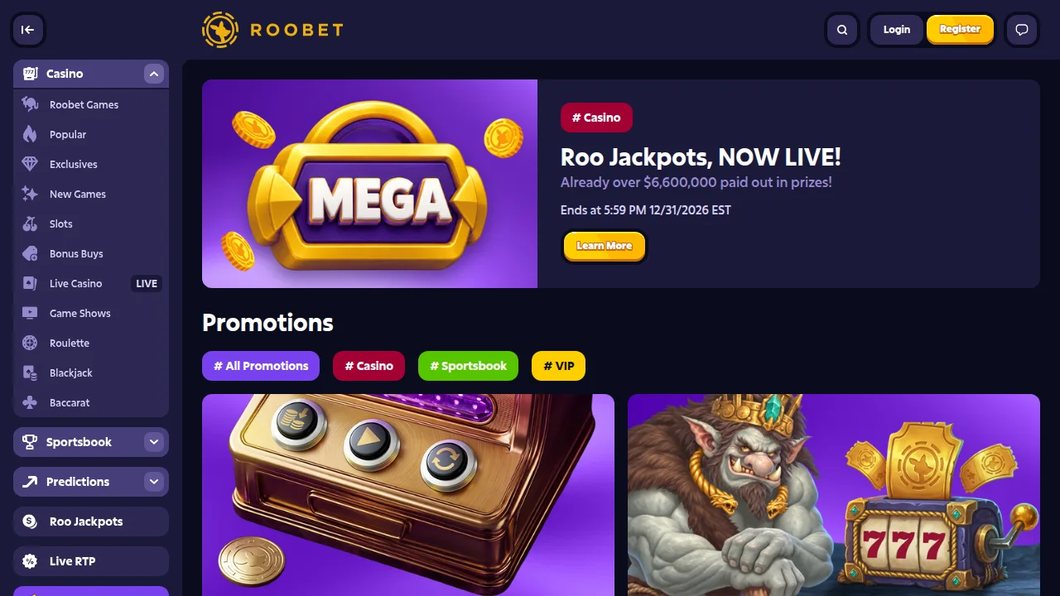
| Roobet | 92 | VIP Cashback Perks | Interac In and Out |
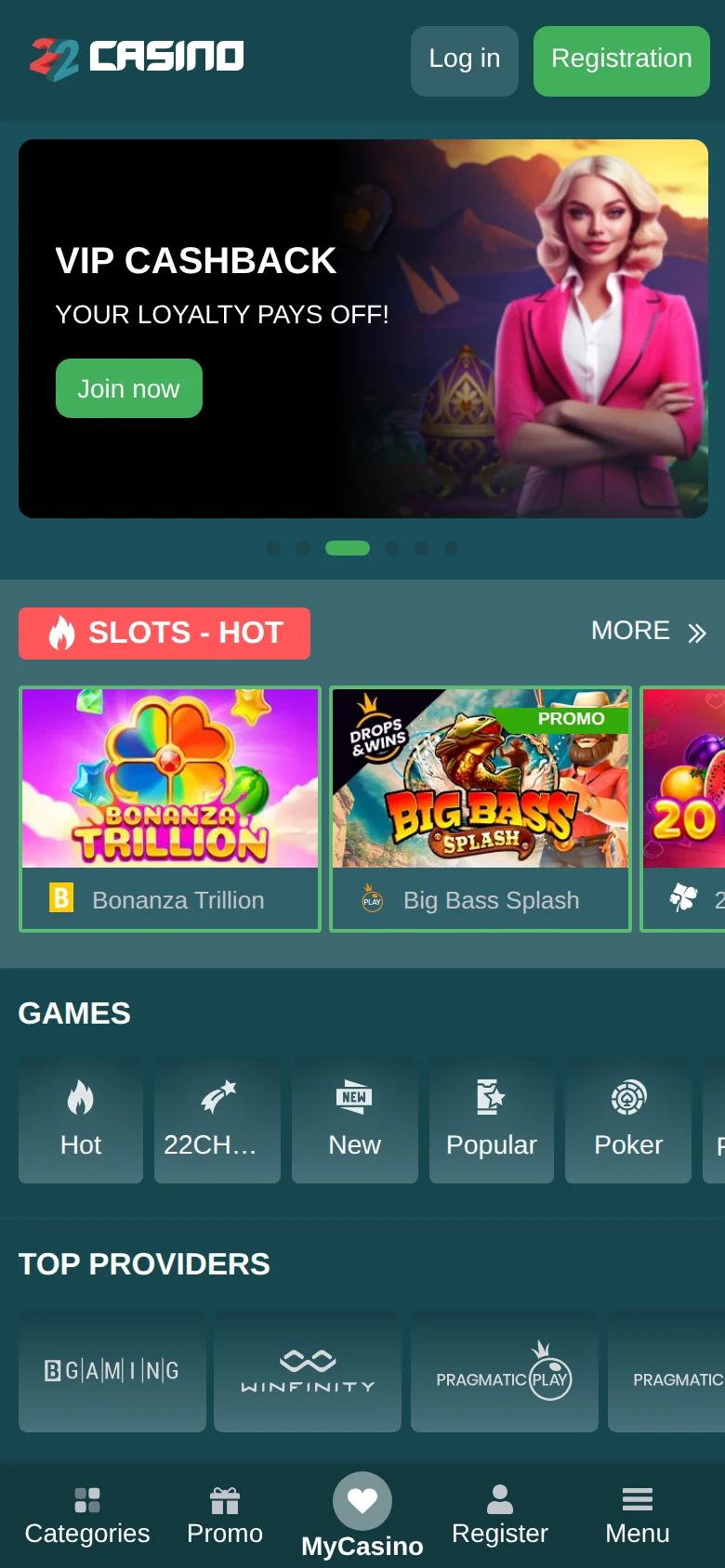
| 22Casino | 91 | Up to C$2,360 + 150 FS | Kahnawake licence No. 01056 |
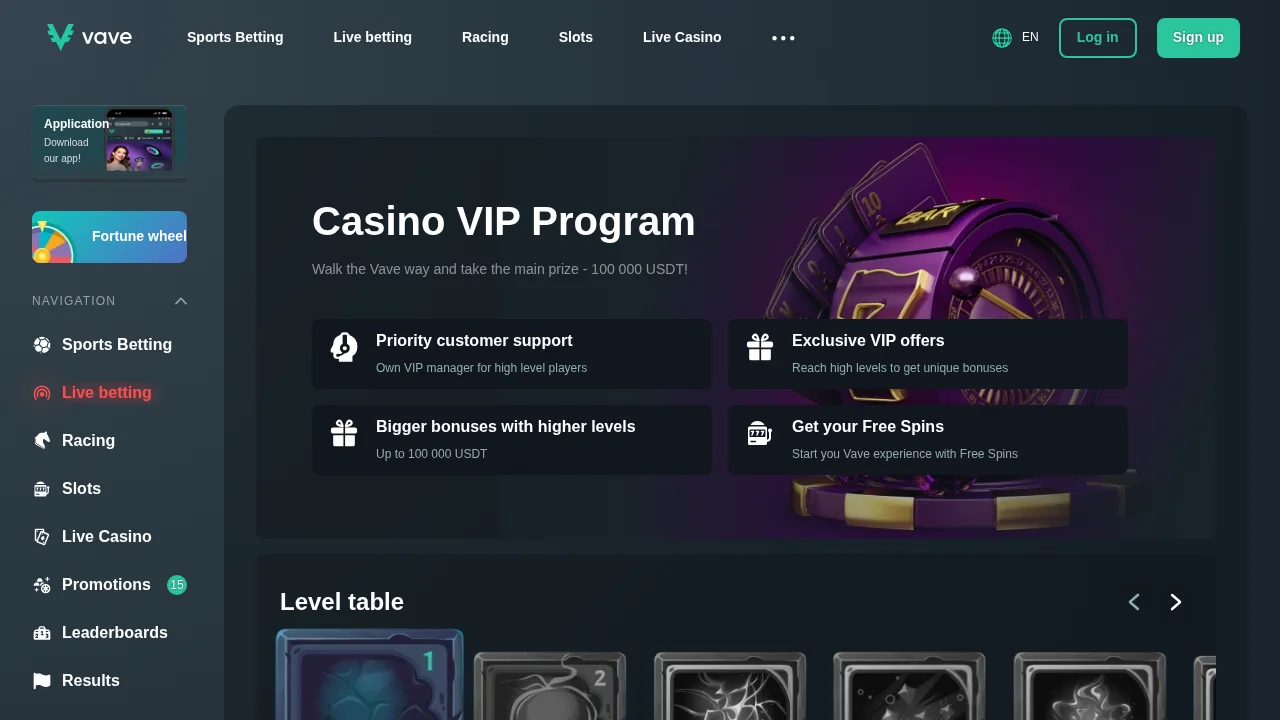
| Vave | 90 | – | Crypto-only, 8 coins |
| Rolling Slots | 85 | Up to C$5,800 + 750 FS | 100-level loyalty programme |
How to Read This Shortlist
A high rating does not mean a casino suits everyone. Stake and BC.Game are built around crypto from the ground up. Vave goes further and accepts crypto only. Roobet stands out because it also supports Interac, which helps if you want a fiat fallback. 22Casino and Rolling Slots appear for their welcome packages and loyalty structure. Our data sheets do not confirm which coins they accept, so verify Bitcoin support in the cashier first.
- Pure crypto experience: Vave, BC.Game, Stake.
- Crypto plus Interac flexibility: Roobet.
- Big welcome package: Rolling Slots, 22Casino (confirm Bitcoin first).
- Published licence number in our data: 22Casino.
Offers to Check Further Down the List
Several other casinos in our database publish large welcome packages. We have not confirmed Bitcoin support at these sites, so treat them as candidates to research, not ready-made crypto picks. The amounts below are copied from our records.
| Casino | Rating | Offer | Feature |
|---|---|---|---|
| Need for Spin | 86 | Up to C$4,500 + 550 FS | Daily Bonus Map Rewards |
| Winshark | 84 | Up to C$3,945 + 300 FS | 139 game providers |
| Wild Tokyo | 82 | Up to C$4,500 + 700 FS | Daily Bonus Calendar |
| Golisimo | 83 | Up to $3,750 + 300 FS | Interac Deposits From C$10 |
| Casino Days | 88 | Up to C$2,000 + 100 FS | – |
Is Bitcoin Gambling Legal in Canada?
There is no federal online gambling regulator in Canada. The Criminal Code (R.S.C. 1985, c. C-46), section 207, lets each province “conduct and manage” gambling within its borders. The result is a patchwork. Bill C-218 (2021) legalised single-event sports betting, but it did not create a national licensing system for online casinos. Whether a site is legal for you depends on where you live, not on the coin you use to pay.
- Federal level: Criminal Code s. 207 hands control to the provinces.
- Provincial level: each province runs or licenses its own gambling.
- Bitcoin: no special gambling rule. The same provincial framework applies whatever the payment method.
Ontario: The Only Open, Regulated Online Market
Ontario is the only province with an open, regulated online casino market. The AGCO sets standards and iGaming Ontario manages the market, with 49 operators taking part. If you live in Ontario, a site registered with the AGCO comes with dispute routes, responsible gambling tools and audited games. Bitcoin is not among the payment methods you usually see on Ontario-regulated sites. Their cashiers focus on Interac e-Transfer, cards, iDebit/Instadebit, PayPal, Apple Pay, MuchBetter and bank transfer.
Pro tip: If you are in Ontario and the protections of a regulated market matter more to you than crypto speed, use an AGCO-registered site and fund it with Interac. Several brands in our database, such as bet365 Casino, 888 Casino and Jackpot City Casino, are AGCO-registered. You can still turn Bitcoin into CAD on an exchange first and deposit the dollars.
The Other Provinces and Territories
Outside Ontario, the legal online offer is the provincial operator’s own platform. Offshore casinos, including most Bitcoin casinos, accept Canadian players, but no provincial regulator licenses them. Ontario’s rules do not carry over to other provinces. Use the table to find your provincial body.
| Province / region | Gambling body |
|---|---|
| Ontario | AGCO + iGaming Ontario (OLG runs the provincial lottery) |
| Alberta | AGLC + Alberta iGaming Corporation |
| British Columbia | BCLC |
| Quebec | Loto-Québec |
| Manitoba | Manitoba Liquor & Lotteries |
| Saskatchewan | SaskGaming |
| New Brunswick, Nova Scotia, PEI, Newfoundland and Labrador | Atlantic Lottery Corporation |
Where Offshore Bitcoin Casinos Fit
Most dedicated Bitcoin casinos operate from outside Canada under foreign or Kahnawake licences. In our data, 22Casino lists Kahnawake licence No. 01056 and Quatro Casino lists Kahnawake licence 00972. For many other crypto brands, our sheets do not record a licence number. When a site does not publish its licence clearly, take that as a warning sign. Practically, offshore play means:
- No provincial complaint process if a withdrawal is refused.
- Terms written under foreign law, which can differ sharply from Canadian consumer norms.
- Responsible gambling tools that vary from excellent to barely there.
- Crypto payments that cannot be reversed or charged back.
Minimum Age
Plan on 19+. Most provinces set the minimum at 19, so confirm the rule where you live. Reputable crypto casinos still ask for identity documents before larger withdrawals, even though Bitcoin itself is pseudonymous. If you are under age, the account can be closed and the winnings voided.
Taxes on Winnings and on Crypto
Canada generally does not tax casual, recreational gambling winnings. Professional gamblers can be treated differently. Bitcoin adds a second layer: the Canada Revenue Agency treats crypto as a commodity, so selling or spending coins that have changed in value can be a taxable event in its own right. We do not publish rates or amounts here. Speak to a tax professional if your crypto activity is significant.
- Keep a log of every deposit and withdrawal: date, coin amount and CAD value.
- Note what you originally paid for the coins you send to a casino.
- Save exchange statements showing your CAD conversions.
How We Rate Bitcoin Casinos
Our ratings are editorial and based on our own testing and data sheets. We do not rank by bonus size alone, because a large package with harsh terms is often worth less than a small, clean one. For crypto sites in particular, we weight payout reliability and transparency heavily, since you lose chargeback protection the moment you send coins.
| Criterion | What we check | Why it matters for Bitcoin |
|---|---|---|
| Licensing & transparency | Published licence, company details, clear terms | There is no provincial regulator to fall back on offshore |
| Crypto cashier | Coins accepted, minimums, confirmation handling | Determines speed and cost |
| Withdrawal process | Verification rules, limits, review times | Withdrawals are where disputes start |
| Bonus terms | Wagering, game weighting, max bet, expiry | Decides whether a bonus has real value |
| Game fairness | Provably fair titles, known studios | Lets you verify outcomes |
| Player protection | Deposit limits, cool-offs, self-exclusion | Crypto makes fast, impulsive deposits easy |
Red Flags That Lower a Score
Some problems cost a site points straight away. Others keep it off our list entirely. These are the patterns we watch for most closely at crypto casinos:
- No licence information, or a licence number that cannot be checked with the issuing authority.
- “Maximum cashout” caps hidden in the bonus terms.
- Verification requested only after a large win, never at sign-up.
- Bonus terms that change without notice or are missing from the site.
- No deposit limits or self-exclusion tools at all.
What We Do Not Reward
We do not raise a score because a site advertises “instant” withdrawals without explaining its review process. We do not reward flashy jackpot tickers either. A Bitcoin casino earns points by being predictable: the same rules apply on a $20 win and a $20,000 win, and the cashier does what the terms say.
Step-by-Step: How to Play at a Bitcoin Casino from Canada
This walkthrough assumes you are starting from CAD in a Canadian bank account. If you already hold Bitcoin in a wallet you control, skip to step three. Work slowly the first time. A Bitcoin transaction sent to the wrong address is gone for good.
- Set up a wallet you control.
- Buy Bitcoin with CAD on a Canadian-registered exchange.
- Vet the casino before you register.
- Create your account and set limits.
- Copy the deposit address and send a test amount.
- Send the main deposit and wait for confirmations.
- Play, tracking your balance in CAD.
- Withdraw to your own wallet, then convert to CAD if needed.
Step 1: Set Up a Wallet You Control
Some exchanges let you send coins directly to a casino. Many prefer you to withdraw to a personal wallet first, and some restrict gambling-related transfers. A self-custody wallet puts you in charge. Software wallets on your phone are convenient. Hardware wallets suit larger balances. Whichever you pick, the recovery phrase is everything.
- Write the recovery phrase on paper and store it offline.
- Never type it into a website, and never share it with “support”.
- Set a PIN and enable biometric lock on mobile wallets.
Step 2: Buy Bitcoin with CAD
Use an exchange registered to operate in Canada and fund it with Interac e-Transfer or a bank transfer. Card purchases usually cost more. Compare the total cost, including the trading fee and the spread (the gap between the buy and sell price). The spread is often bigger than the advertised fee. Buy only what you plan to gamble, plus a small buffer for network fees.
- Interac e-Transfer: the usual route for funding a Canadian exchange account.
- Bank transfer: slower, but suits larger amounts.
- Card: fast, but may carry higher fees, and some banks block crypto purchases.
Step 3: Vet the Casino Before You Register
Spend ten minutes on due diligence before you send a single satoshi. Find the licence statement, usually in the site footer, and check it against the regulator’s register where possible. Read the withdrawal section of the terms, not just the bonus page. Check whether Bitcoin appears in the cashier for Canadian accounts, because coin lists sometimes vary by country.
- Licence number visible and checkable?
- Bitcoin listed for both deposits and withdrawals?
- Verification requirements spelled out?
- Minimum withdrawal stated in the terms?
- Responsible gambling tools available in the account settings?
Step 4: Register and Set Limits First
Use your real details. A fake name can void a withdrawal once the casino asks for ID. Before depositing, open the responsible gambling page and set a deposit limit. Crypto makes topping up almost effortless, and that is exactly why a limit belongs in place before your first session.
Pro tip: Set your casino deposit limit in CAD terms, then cap the amount of Bitcoin you move to your “gambling wallet” each month. Two separate limits, one at the casino and one in your own wallet, give you a speed bump that a single in-casino setting cannot.
Step 5: Copy the Address and Send a Test Deposit
In the casino cashier, choose Bitcoin and copy the deposit address it generates. Paste it into your wallet, then check the first and last several characters against the cashier screen. Clipboard malware that swaps addresses does exist. Send a small test amount first. Once it arrives, send the rest.
- Bitcoin addresses typically start with “bc1”, “1” or “3”.
- Do not send Bitcoin to an address meant for another coin.
- Check whether the casino sets a minimum deposit, since amounts below it may not be credited.
- Some cashiers generate a fresh address each time, so do not reuse an old one without checking.
Step 6: Wait for Confirmations
A Bitcoin transaction is recorded on the blockchain in blocks, and the casino credits your account after a set number of confirmations. Timing depends on network congestion and the fee you chose. A low fee during a busy period can leave a deposit pending for a long time. Your wallet usually shows a recommended fee. Use it unless you are in no hurry.
- Higher fee: faster inclusion in a block.
- Lower fee: cheaper, but slower when the network is busy.
- Pending too long? Check the transaction ID on a public block explorer before you contact support.
Step 7: Play with a CAD Mindset
Many crypto casinos show balances in BTC, mBTC or satoshis. Small decimals make it easy to lose track of real value. Switch the display to a fiat equivalent if the site offers it, or convert as you play. Decide your session budget in dollars and stop when it is gone.
| Unit | Equals | Where you see it |
|---|---|---|
| 1 BTC | – | Exchange balances |
| 1 mBTC | 100,000 satoshis | Casino bet sizes |
| 1 satoshi | – | Fees, micro-bets |
Step 8: Withdraw to Your Own Wallet
Request the withdrawal to a wallet address you control, and check it twice. The first withdrawal often triggers identity verification, so have your ID and proof of address ready. Once the coins arrive, you can hold them or send them back to your exchange and sell for CAD. That sale may be a taxable disposal, so record the value on the day.
- Complete verification before you need to withdraw, not after a big win.
- Check whether a bonus is still active. Many sites block withdrawals until wagering is complete.
- Screenshot the withdrawal request and save the transaction ID.
Worked Examples in CAD
Bitcoin adds variables a dollar deposit does not have. The examples below use round, illustrative numbers to show how the maths works. They are not quotes of any real fee or price.
Example 1: Volatility Can Beat the House Edge
You buy $500 of Bitcoin and deposit it. You play for an hour and break even in BTC terms, so your coin balance is exactly what you deposited. Meanwhile, the Bitcoin price falls 10%. When you withdraw and sell, you get about $450. You “broke even” at the tables and still lost $50. The reverse can happen too, which is why crypto gambling is effectively two bets at once.
| Scenario | BTC result at casino | BTC price move | Approx. CAD back |
|---|---|---|---|
| A | Break even | −10% | $450 |
| B | Break even | +10% | $550 |
| C | +20% in BTC | −20% | about $480 |
| D | −20% in BTC | +10% | about $440 |
Example 2: Wagering Requirements in Plain Numbers
Wagering (rollover) tells you how much you must bet before bonus funds become withdrawable. Take a generic $100 bonus at 35x on the bonus only: you need $3,500 in bets. If wagering applied to deposit plus bonus on a $100 deposit, the target would double to $7,000. On the same $100 bonus amount, that is $3,000 of turnover.
- Bonus-only 35x on $100: $3,500 in bets.
- Deposit + bonus 35x on $100 + $100: $7,000 in bets.
- 30x on $100 bonus: $3,000 in bets.
Example 3: Estimating the Expected Cost of Clearing a Bonus
Expected loss is roughly turnover multiplied by the house edge. A slot with a 96% return to player has a 4% edge. Clearing $3,500 of turnover on that slot costs about $140 on average. On a $100 bonus, that is a negative expected value of roughly $40, before variance. Lower wagering, or games with higher RTP that still count 100%, flips the picture. That is why the terms matter more than the headline amount.
| Turnover | Game RTP | Expected cost | Net vs $100 bonus |
|---|---|---|---|
| $3,500 | 96% | ~$140 | ~−$40 |
| $3,000 | 96% | ~$120 | ~−$20 |
| $3,000 | 97% | ~$90 | ~+$10 |
Example 4: Network Fees on Small Deposits
Network fees are charged per transaction, not as a percentage of the amount. With an illustrative fee of $4, a $20 deposit loses 20% to fees before you place a bet. A $200 deposit loses 2%. Add the exchange spread on buying and selling, and small, frequent deposits become expensive. Batch your deposits, or choose a cheaper network if the casino supports one.
- $20 deposit, $4 fee: 20% overhead.
- $100 deposit, $4 fee: 4% overhead.
- $200 deposit, $4 fee: 2% overhead.
Example 5: How Rakeback Adds Up
Rakeback returns part of the casino’s theoretical edge on your bets. Stake advertises 3.5% rakeback from its Bronze VIP level. Rakeback schemes usually calculate this on the house edge of your wagers, not on the stake itself, so check Stake’s terms for the exact base. Illustratively, if $1,000 of slot bets at a 4% edge generate $40 of theoretical loss, 3.5% of that is about $1.40. It helps over time, but it is not a profit engine.
Pro tip: Before you chase VIP status for its rakeback or reloads, work out the turnover the next tier requires. Multiply it by the house edge of your usual games. If the expected loss to reach the tier dwarfs what the perks return, play at your normal pace and treat VIP as a bonus, not a goal.
Stake: Best for Rakeback and VIP Reloads
Stake is one of the best-known crypto-first casinos and tops our ratings at 94. Rather than a traditional matched welcome bonus, our data highlights its rakeback and VIP reload structure, with 3.5% rakeback from the Bronze level. That suits steady, regular players more than bonus hunters. The casino is built for crypto deposits and withdrawals, so Bitcoin sits at the centre of the cashier.
- Rating: 94/100.
- Offer: Rakeback + VIP Reloads.
- Feature: 3.5% Rakeback From Bronze.
Who Stake Suits
Stake fits players who prefer ongoing value to one-off welcome packages. If you dislike long wagering requirements, a rakeback model avoids the “bonus balance” trap. Every eligible bet simply earns its share back. It is less suited to occasional players, since rakeback and reloads scale with activity.
- Good for: regular crypto players and table-game fans who avoid wagering terms.
- Less good for: players chasing a single large welcome match.
What to Check Before Joining
Our data sheet does not record a licence number for Stake, so read the footer and terms on the site you access from Canada. Availability can vary by region. Check the VIP terms for how rakeback is calculated and how often it is paid.

- 15 VIP Levels to Obsidian
- CAD Cards C$5 to C$3,000
- Interac e-Transfer Payouts
BC.Game: Best for Provably Fair Originals
BC.Game is a crypto-native casino rated 93 in our reviews. Its headline offer is a Crypto Welcome Bonus. Our data does not list a fixed amount or wagering figure, so check the live terms in your account before you opt in. Its stand-out feature is the in-house Provably Fair Originals: games whose outcomes you can check with cryptographic seeds.
How Provably Fair Works
Provably fair games combine a server seed (hashed and shown to you before the bet), your own client seed and a counter called a nonce. After the round, the casino reveals the unhashed server seed. You can then recompute the result yourself. If the hash matches and the maths reproduces the outcome, the casino could not have changed it after your bet.
- Change your client seed now and then. It is your input into the randomness.
- Use the built-in verifier, or an independent one, to check a handful of rounds.
- Remember that provably fair proves honesty, not profitability. The house edge still applies.
BC.Game Bonus: What We Know
Our sheet records the offer only as “Crypto Welcome Bonus”. We will not quote amounts or rollover we have not verified. Before activating it, find the wagering multiplier, the game weighting, the maximum bet while wagering and any expiry date. Then run the maths from Example 3 above.

- 1000+ Slots & Live Casino
- Fee-Free VIP Withdrawals
- 24/7 Live Support
Vave: Best Crypto-Only Casino
Vave, rated 90, accepts only cryptocurrency, with 8 coins supported according to our data. Because the offer is denominated in Bitcoin, its value in CAD moves with the market. We do not convert it to a dollar figure, as any number would be out of date within hours.
- Rating: 90/100.
- Feature: Crypto-only, 8 coins.
What Crypto-Only Means for You
A crypto-only cashier means no Interac, no cards and no bank transfers. Every deposit and withdrawal runs through a wallet. That keeps things simple if you already hold coins. If you are new to crypto, it adds the exchange step from our walkthrough. Check the current list of 8 coins in the cashier. If you hold more than one, compare network costs before you deposit.
- Pros: crypto-native cashier with no fiat processing in the middle.
- Cons: no fiat fallback, and full exposure to coin price swings.
Reading a BTC-Denominated Bonus
“Up to” is the key phrase. The maximum is usually spread over several deposits or reached only at large deposit sizes. A bonus priced in BTC also changes in CAD value as you wager, which affects how much it is really worth.
Roobet: Best for Crypto with an Interac Backup
Roobet scores 92. Our data highlights VIP Cashback Perks and “Interac In and Out”, which is unusual among crypto-focused casinos. For Canadians, that dual setup is practical. You can deposit Bitcoin when it suits you and fall back on Interac if you would rather avoid exchange conversions for a particular session.
- Rating: 92/100.
- Offer: VIP Cashback Perks.
- Feature: Interac In and Out.
Why Interac Support Matters on a Crypto Site
Mixing methods lets you sidestep the volatility problem from Example 1 when you want to. If you plan a short session, depositing CAD via Interac means your balance is not exposed to Bitcoin price moves. Check the casino’s rules on withdrawing to a different method than you deposited with. Many sites require you to withdraw via the same route first.
- Deposit and withdraw by the same method where possible.
- Check whether cashback is paid in crypto or fiat.
Understanding Cashback Perks
Cashback returns a share of net losses over a period, often as bonus funds with their own terms. Our data does not give Roobet’s rates, so check the VIP page for the percentage, the qualifying period and whether the cashback has wagering attached. Cashback with no wagering is worth considerably more than the same figure with rollover.
22Casino: Best for a Published Licence Number
22Casino, rated 91, is the only brand in this shortlist with a licence number in our data: Kahnawake licence No. 01056. Its welcome package is listed as Up to C$2,360 + 150 FS. Our sheet does not list the coins it accepts, so confirm Bitcoin in the cashier before relying on it for crypto play.
The Kahnawake Licence in Context
The Kahnawake Gaming Commission operates from the Mohawk Territory of Kahnawà:ke in Quebec and has licensed online gaming for years. A Kahnawake licence is not the same as AGCO registration in Ontario, and it does not make a site provincially regulated. It does give you a named authority and a licence number you can look up, which beats a vague “licensed and regulated” line in a footer.
- Licence: Kahnawake No. 01056 (per our data).
- Check: search the number on the regulator’s site.
Making Sense of C$2,360 + 150 FS
Packages of this size are usually split across several deposits. The free spins tend to come in batches on selected slots. Our data does not record the wagering or spin values, so read the terms for each stage. Using the maths in Example 2, work out the total turnover before you commit to every deposit in the sequence.

- 24/7/365 live chat support
- 10% extra on crypto deposits
- Self-exclusion up to 5 years
Rolling Slots: Best for Long-Term Loyalty
Rolling Slots scores 85 and carries one of the largest packages in our database: Up to C$5,800 + 750 FS. Its distinguishing feature is a 100-level loyalty programme. As with 22Casino, our data does not confirm its crypto coin list, so check the cashier for Bitcoin before you plan around it.
Is a Huge Package Worth It?
The bigger the “up to” figure, the more deposits and turnover it usually takes to unlock. Treat C$5,800 as the ceiling, not the expectation. Most players will only claim the first stage or two. Decide your total deposit budget first, then see which stages fit inside it. Bonuses claimed beyond your budget are not value.
- Claim only the stages that fit your planned spend.
- Check the maximum bet while wagering. Breaching it can void winnings.
- Note the expiry on each stage’s free spins.
How a 100-Level Loyalty Ladder Works
Long loyalty ladders award points for play and unlock rewards at set levels. The early levels come quickly. The later ones take serious volume. Apply the pro tip from Example 5: price the turnover for the next level against what it unlocks. Rewards that arrive as bonus funds carry their own terms, so read them before counting them as cash.

- 15,000+ games claimed
- Daily cashback 5%, VIP 7%
- 24/7 live chat and email
Bitcoin vs Interac and Other Canadian Methods
Bitcoin is not automatically the best way to fund a casino account from Canada. The standard Canadian payment mix (Interac e-Transfer, Debit/Credit card, iDebit/Instadebit, PayPal, Apple Pay, MuchBetter and bank transfer) has advantages of its own. The comparison below is general. Exact limits and timings depend on each casino.
| Factor | Bitcoin | Interac e-Transfer | Cards |
|---|---|---|---|
| Value stability | Volatile | Stable CAD | Stable CAD |
| Reversibility | Irreversible | Generally final | Chargeback possible |
| Availability at Ontario-regulated sites | Not typical | Widely offered | Widely offered |
| Bank blocks | Exchange step may be restricted | Rare | Some banks block gambling |
| Extra steps | Exchange + wallet | None | None |
When Bitcoin Makes Sense
Bitcoin earns its place in a few specific situations. Outside them, a CAD method is usually simpler and cheaper.
- You already hold Bitcoin and accept price exposure.
- Your bank blocks card payments to gambling sites.
- You want to play provably fair crypto originals that only take coins.
- The casino processes crypto withdrawals faster than fiat ones.
When CAD Methods Are Smarter
If you live in Ontario, a regulated site with Interac gives you protections no offshore crypto site can match. Elsewhere, short sessions, small deposits and tight budgets all favour CAD. You skip the volatility, the network fees and the extra tax record-keeping. Use Bitcoin when it solves a real problem, not because it is fashionable.
Common Mistakes Canadian Players Make with Bitcoin Casinos
Most crypto-casino losses that have nothing to do with the games come from a handful of avoidable errors. Each one below is something we see regularly. Fixing it usually takes less than a minute.
- Sending to the wrong network or coin. Bitcoin sent to an address for a different asset can be lost permanently.
- Skipping the test deposit. A small first transfer catches address errors cheaply.
- Ignoring network fees on tiny deposits. See Example 4.
- Accepting a bonus without reading the max-bet rule. One oversized spin can void everything.
- Delaying verification. Upload your ID early so it does not hold up a withdrawal.
- Forgetting tax records. Log every conversion back to CAD.
Mistake: Trusting “Instant” Marketing
Blockchain transfers can be quick, but the casino’s internal review often is not. “Instant withdrawals” usually means “fast once approved”. The approval step, including first-time verification and checks on bonus play, is where the waiting happens. Read the cashier terms for stated review times rather than the homepage slogan.
Mistake: Chasing Losses with Fast Top-Ups
Crypto removes the friction of bank approvals, so a frustrated player can reload in seconds. That speed is a risk. Set the deposit limit from Step 4 and keep your main holdings in a separate wallet. If you notice yourself topping up to win back losses, stop the session.
Pro tip: Keep a single-line log for each session: date, CAD value deposited, CAD value withdrawn. After a month, the total tells you the true cost of your entertainment, including volatility and fees. That number is far more honest than any in-casino balance.
Responsible Gambling Help in Canada
Support services are provincial, just like gambling regulation. There is no single national helpline. In Ontario, contact ConnexOntario at 1-866-531-2600 or text 247247. If you live in another province, look up your own provincial service. Do not rely on the Ontario line elsewhere.
- Ontario: ConnexOntario, 1-866-531-2600 (text 247247).
- Other provinces: check your provincial gambling body’s responsible gambling page for the local helpline.
- At any casino: use deposit limits, cool-off periods and self-exclusion in your account settings.
Tools Worth Turning On Today
Even if you feel fully in control, these settings cost nothing and protect you on the nights when judgement slips.
- Daily, weekly or monthly deposit limits.
- Session time reminders.
- Loss limits, where offered.
- Cool-off periods for a break of days or weeks.
- Full self-exclusion if gambling stops being fun.
Set these tools before your first deposit, not after a bad session. On crypto sites, limits are often counted in the coin rather than in dollars. A limit that felt sensible in CAD can drift when the Bitcoin price moves, so recheck your figures whenever the market jumps or drops sharply.
Where to Get Help in Your Province
Gambling in Canada is regulated by each province, and support services are organised the same way. There is no single federal helpline. Use the service for the province you live in.
| Province | Service | How to reach it |
|---|---|---|
| Ontario | ConnexOntario | Phone 1-866-531-2600 · Text 247247 |
If you live outside Ontario, find your own province’s helpline through your provincial health services or the responsible gambling pages of your provincial lottery corporation. Do not rely on the Ontario number, because services do not carry over between provinces.
Signs It Is Time to Pause
- You deposit again within minutes of a loss to “win it back”.
- You buy more Bitcoin specifically to keep a session going.
- You hide your wallet balance or casino activity from people close to you.
- You stop converting your results to CAD because the real number feels uncomfortable.
- You play past the time you planned, or late at night when you meant to stop.
- Gambling money starts to come out of rent, bills or savings.
If two or more of these sound familiar, use a cool-off period now and contact your provincial helpline. A break costs nothing, and the casino will still be there if you decide to return.
Bitcoin Security Checklist for Canadian Players
A Bitcoin transaction cannot be reversed. No bank will refund you and no chargeback is available. Most of the protection you would get with a card payment has to come from your own habits instead.
Protecting Your Wallet
- Write your seed phrase on paper. Never store it in a screenshot, a cloud note or an email draft.
- Use a PIN or biometric lock on the wallet app, separate from your phone’s unlock code.
- Keep gambling funds in their own wallet. Do not use the wallet where your long-term savings sit.
- Update the wallet app only through the official app store or the developer’s own site.
- Check the first and last characters of every address you paste. Clipboard malware swaps addresses silently.
Protecting Your Casino Account
- Turn on two-factor authentication with an authenticator app rather than SMS where you can.
- Use a unique password that you do not use on any other site.
- Whitelist your withdrawal address if the casino lets you, so payouts can only go to that address.
- Review your login history from time to time and log out of devices you no longer use.
- Use a separate email address for casino accounts so phishing attempts are easier to spot.
Phishing and Fake Support
Fake support agents are one of the most common ways crypto players lose money. They reach out on social media, in Telegram groups or through look-alike live chat windows, and they usually ask for one of three things.
| Request | What it really means | Your response |
|---|---|---|
| “Send us your seed phrase to verify your wallet” | They want to empty your wallet | Refuse. No genuine casino ever needs it. |
| “Pay a fee to unlock your withdrawal” | Advance-fee scam | Stop and contact support only through the casino’s own site. |
| “Deposit to this new address, the old one is broken” | Address substitution | Only use the address shown in your logged-in cashier. |
Managing Volatility: Keeping Score in CAD
When you play in Bitcoin, two separate things affect your result: what happens at the tables and what happens to the coin’s price. The worked examples earlier covered how volatility can outweigh the house edge. This section covers the practical habits that keep your session results honest.
Logging Your Entry and Exit Value
Write down the CAD value of every deposit when you send it and of every withdrawal when it reaches your wallet. The illustrative log below shows why this matters.
| Event | Coin amount | CAD value at the time |
|---|---|---|
| Deposit | – | $500 |
| Withdrawal (casino balance unchanged) | – | $450 |
| Session result in coin | Break-even | -$50 in CAD |
In coin terms the session broke even. In dollar terms it lost $50 because the price fell. The reverse can happen too, and that is exactly why a lucky price move should not be mistaken for gambling skill.
Shortening Your Exposure Window
- Buy Bitcoin right before you deposit rather than days in advance.
- Withdraw promptly after a session instead of leaving a balance on the casino.
- Convert back to CAD on your exchange when you want to lock in a result.
- Avoid “holding for the price to recover” with gambling money. That turns a game budget into an investment bet.
Stablecoins as a Middle Ground
Some crypto casinos accept stablecoins, which are tokens designed to track a fiat currency. They reduce price swings during a session, but they bring their own considerations: which network you use, the issuer behind the token, and whether your exchange supports a CAD exit. Check the casino’s cashier for the exact list of supported coins and networks before you buy anything.
Records Worth Keeping
- Exchange purchase and sale confirmations.
- Transaction IDs (hashes) for every deposit and withdrawal.
- Screenshots of your casino transaction history, taken every month.
- Bonus terms as they stood on the day you claimed the offer.
Crypto transactions can have tax consequences apart from the gambling itself. Good records let an accountant work out your position quickly if you ever need advice.
Withdrawals: What Happens After You Click “Request Payout”
A crypto withdrawal is fast once it is broadcast to the network. Most of the waiting usually happens before that, inside the casino. Knowing the stages helps you tell a normal delay from a real problem.
The Stages of a Crypto Payout
- Request: you submit the amount and your wallet address.
- Pending review: the casino checks bonus status, wagering progress and account flags.
- Verification: identity documents may be requested, especially on larger amounts.
- Approval: the payout is signed and broadcast.
- Network confirmations: the transaction is confirmed on the blockchain.
- Arrival: funds appear in your wallet and you can move them to an exchange.
KYC on Crypto Sites
Accepting Bitcoin does not mean a casino never asks for ID. Many crypto-friendly operators keep the right to request documents at any point, and that usually happens at withdrawal time. Have these ready:
- Government photo ID such as a passport or driver’s licence.
- Proof of address dated within the last few months.
- Occasionally, proof that you own the wallet or the source of your funds.
Why a Withdrawal Gets Stuck
| Cause | What you will typically see | What to do |
|---|---|---|
| Active bonus with wagering left | Withdraw button disabled or a warning | Finish wagering or forfeit the bonus |
| Missing documents | Status stays “pending” | Upload clear, uncropped files |
| Network congestion | Transaction ID shown but few confirmations | Track the hash on a block explorer |
| Wrong network selected | Funds never arrive | Contact support immediately with the hash |
| Withdrawal below the minimum | Request rejected | Check the cashier’s minimum first |
Bonus Clauses to Read Before You Claim
The wagering multiple is the number everyone looks at. The clauses below are where most bonus disputes actually start, and they are often buried in the general terms rather than the promotion page.
Maximum Bet While Wagering
Most bonuses cap the stake you can place while the bonus is active. Going over the cap, even once, can give the casino grounds to void your winnings. Find the limit before your first spin and set your bet size to stay well under it.
Game Weighting
- Slots usually count fully toward wagering.
- Table games and live dealer often count partially or not at all.
- Some high-RTP slots and crypto originals may be excluded entirely.
Expiry Windows
Bonuses and free spins come with deadlines. A large package with a short expiry can be impossible to clear at a sensible stake. Divide the total wagering by the days available to see how much you would need to bet each day.
Maximum Cashout and Restricted Countries
Some offers cap what you can withdraw from bonus winnings. Others exclude specific provinces or countries altogether. Confirm that your province can claim the offer before you deposit.
| Clause | Where to find it | Why it matters |
|---|---|---|
| Max bet | Bonus terms, general terms | Breaching it can void winnings |
| Game weighting | Bonus terms table | Decides how fast you clear wagering |
| Expiry | Promotion page | Unfinished wagering is forfeited |
| Max cashout | Bonus terms | Caps the upside of a big win |
| Eligible regions | General terms | Your province may be excluded |
More Casinos on Our Canadian List
The operators below are on our site but were not covered in the crypto reviews above. Their welcome offers are shown as they appear in our brand data. Our data does not confirm Bitcoin support for these brands, so check each cashier for the coins and CAD methods available in your province before you sign up.
TonyBet: Large Welcome Offer with 30x Wagering
In Ontario, TonyBet appears in our data with AGCO registration OPIG1239101 and 43 slot providers. The Ontario site operates under provincial rules, so promotions there may differ.
- Best for: players who want a large package with a stated wagering multiple.
- Check first: which version of the site serves your province.


- Kahnawake licence No. 00902
- VIP cashback up to 10%
- Sportsbook and Omaha poker
Kingmaker: Casino and Sportsbook in One Account
Kingmaker lists a $750 Welcome Bonus and combines a casino and a sportsbook under one login. That suits players who split their budget between slots and single-game bets, which have been legal in Canada since Bill C-218 in 2021.
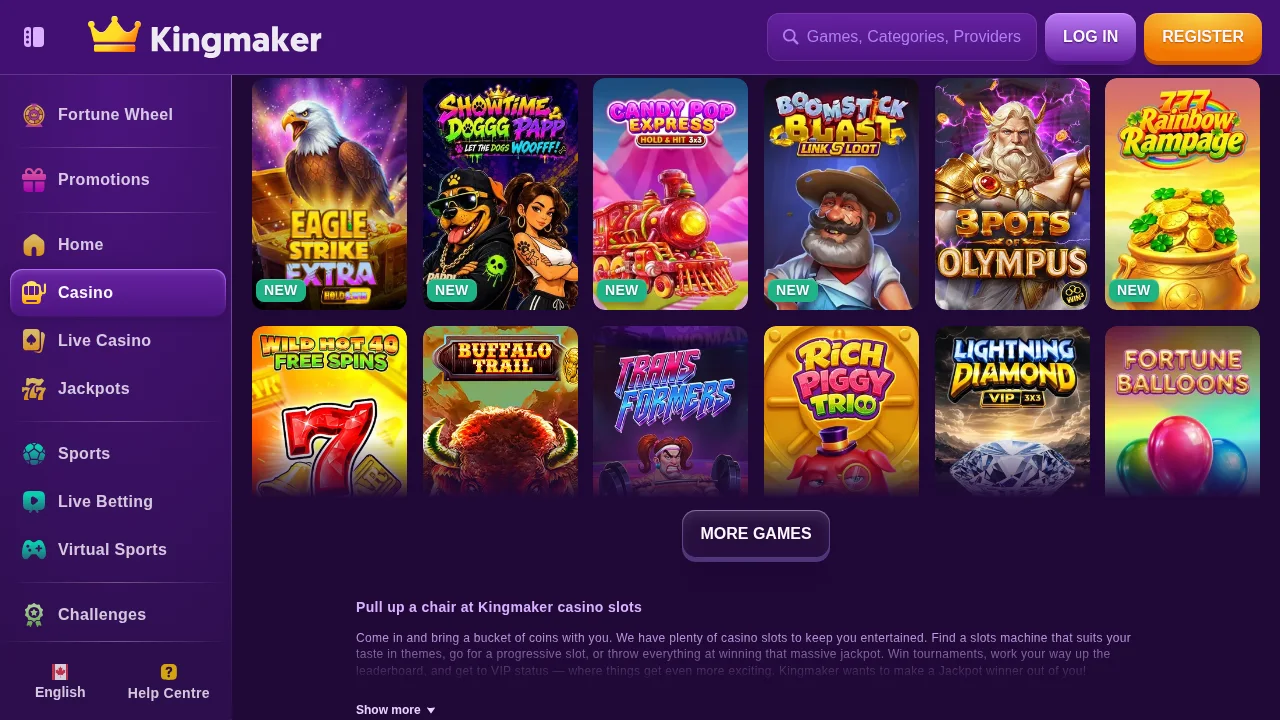
- Best for: one wallet for both casino and sports.
- Check first: whether the welcome bonus applies to casino play or sports, and what its wagering is.

- 24/7 Live Chat & Email
- 5-Level VIP With Cashback
- CAD Account Currency
Need for Spin: Daily Bonus Map Rewards
Need for Spin advertises Up to C$4,500 + 550 FS, and its standout feature is the Daily Bonus Map, a progression system that hands out rewards as you return. Packages this large are usually spread across several deposits, so read the terms for each stage.
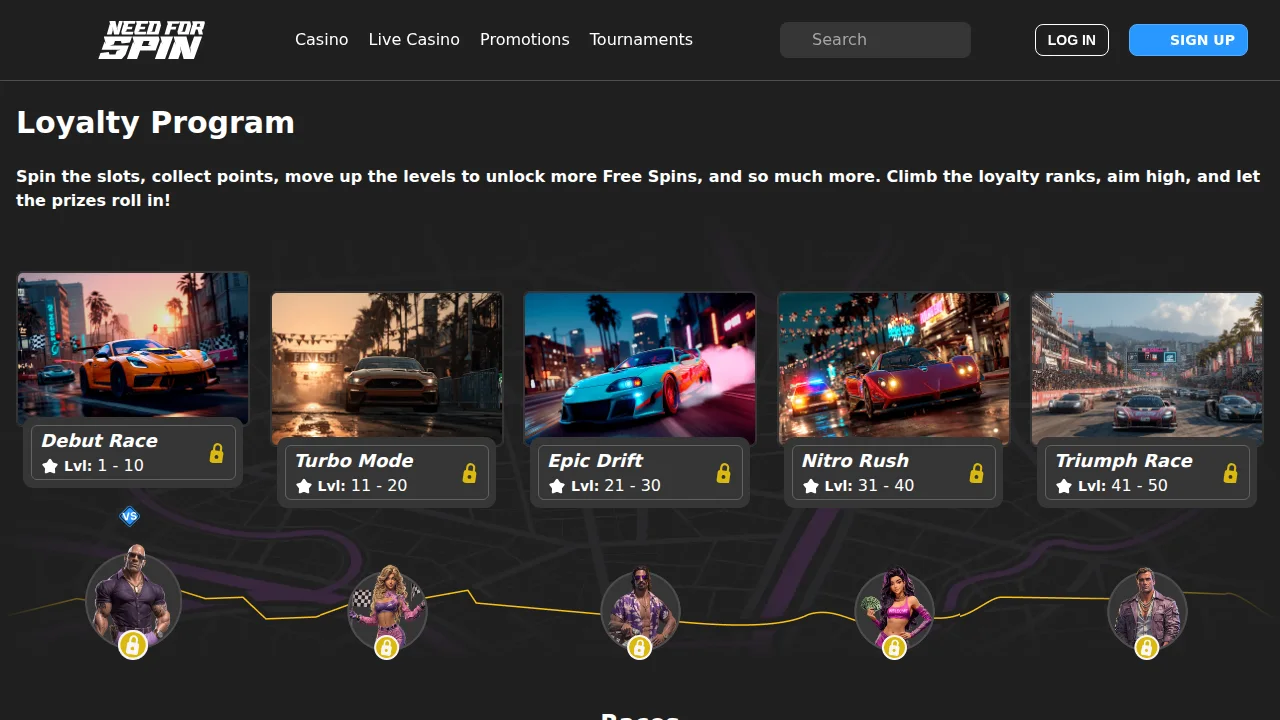
- Best for: players who enjoy gamified, day-by-day rewards.
- Watch out: daily rewards can nudge you to log in more than you planned.
Winshark: 139 Game Providers
Winshark lists Up to C$3,945 + 300 FS and a library from 139 game providers, one of the widest selections on our list. A huge lobby is great for variety, but use the provider filter to find games with published RTP figures.
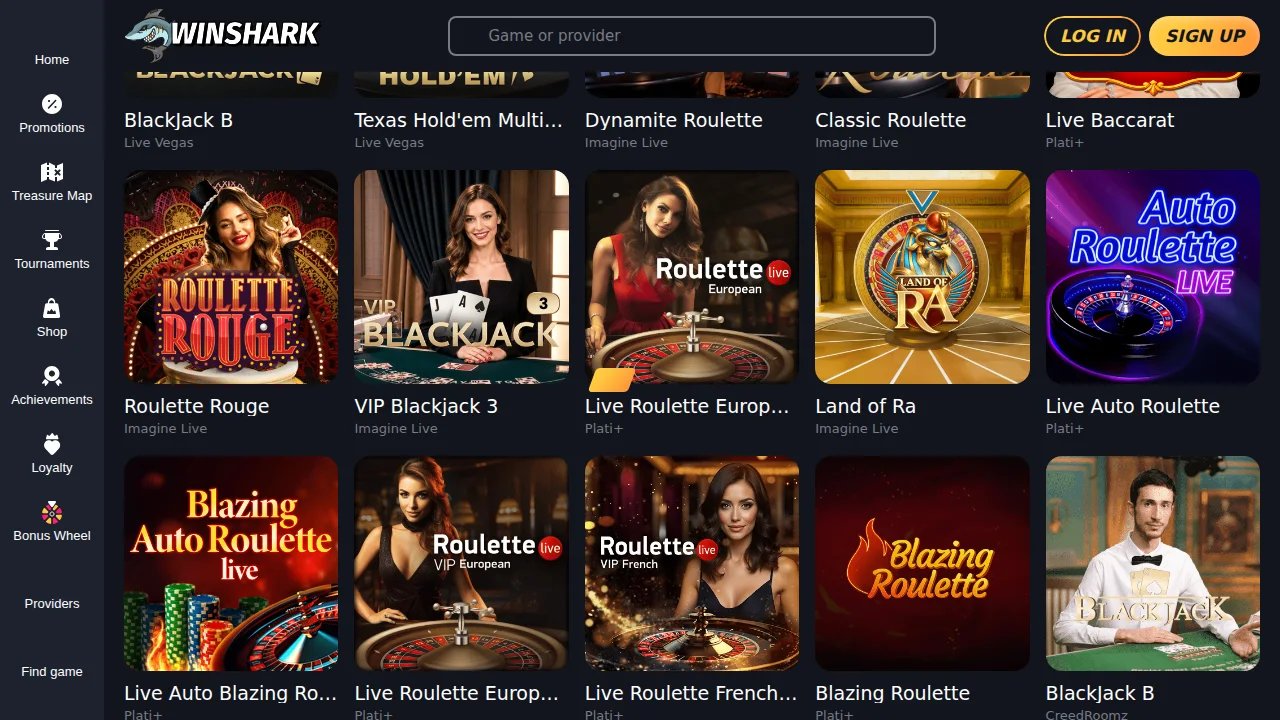
- Best for: variety seekers and live casino fans.
- Check first: live casino weighting toward any bonus wagering.

- Weekly cashback up to 15%
- Wednesday and weekend reloads
- Curaçao GCB OGL/2024/589/0556
Casino Days: Wagering on the Bonus Only
When wagering applies only to the bonus, your deposit does not count toward the requirement, and on the same bonus amount that makes the total turnover lower than a deposit-plus-bonus formula.
- Best for: players who compare wagering formulas carefully.
- Check first: the stage-by-stage split of the package.

- Interac Payouts From C$10
- 6,500+ Games, 1,000+ Live
- iOS and Android Apps
Side-by-Side Comparison
| Casino | Rating | Welcome offer (our data) | Key feature |
|---|---|---|---|
| TonyBet | 89 | Up to C$2,500 + 250 FS | – |
| Casino Days | 88 | Up to C$2,000 + 100 FS | – |
| Kingmaker | 87 | $750 Welcome Bonus | Casino + Sportsbook in one |
| Need for Spin | 86 | Up to C$4,500 + 550 FS | Daily Bonus Map rewards |
| Winshark | 84 | Up to C$3,945 + 300 FS | 139 game providers |
| Golisimo | 83 | Up to $3,750 + 300 FS | Interac deposits from C$10 |
| Wild Tokyo | 82 | Up to C$4,500 + 700 FS | Daily Bonus Calendar |
Ontario Players: Regulated Brands on Our List
In Ontario, the legal online market is the one overseen by the AGCO and iGaming Ontario. The brands below appear in our data as AGCO-registered or Ontario-regulated. Our data does not confirm crypto payments on these Ontario sites. Expect Canadian methods such as Interac e-Transfer, debit and credit cards, iDebit/Instadebit, PayPal, Apple Pay, MuchBetter and bank transfer, and confirm what each cashier offers.
What Our Data Shows
| Brand | Status in our data | Notable feature |
|---|---|---|
| bet365 Casino | AGCO-registered in ON | 2-hour payout target |
| 888 Casino | AGCO-regulated Ontario | 888 Exclusive live tables |
| Jackpot City Casino | AGCO-registered in ON | Visa payouts in 1–24 hours |
| Spin Casino | AGCO-regulated Ontario | C$10 deposits, all methods |
| Betway Casino | AGCO-registered | Own Betway Studio live tables |
| Royal Panda | AGCO-registered in ON | Royal Panda Exclusive tables |
| Ruby Fortune Casino | AGCO-registered in ON | Regulated in Ontario |
| Royal Vegas Casino | Ontario-regulated | 24/7 support in EN & FR |
| Sports Interaction | AGCO-registered in ON | Casino + sportsbook |
Why Ontario Residents Might Choose These Instead
- Complaints go to a provincial regulator rather than an overseas licensing body.
- Deposits and withdrawals stay in CAD, so there is no price risk on the coin.
- Responsible gambling tools follow Ontario’s provincial standards.
- Payout targets such as bet365’s 2-hour aim are published up front.
Among these, bet365 Casino stands out for its stated payout target, which matters if fast access to your winnings is the main reason you were considering Bitcoin.

Testing a Site with a Small CAD Deposit
If you are unsure about any casino, a small CAD deposit is a cheap way to test its cashier, support and withdrawal process before you commit larger sums or send crypto. These low-entry offers come from our brand data:
| Casino | Entry offer | Feature |
|---|---|---|
| Zodiac Casino | 80 Chances for C$1 | C$1 first deposit |
| Captain Cooks Casino | 100 Spins for $5 | Casino Rewards VIP points |
| Grand Mondial | 150 Spins for C$10 | C$15M+ progressive jackpots |
| Yukon Gold Casino | 150 Spins for $10 | Mega Moolah jackpots |
What a Test Deposit Should Tell You
- How quickly support answers a simple question.
- Whether verification is requested before or after your first withdrawal.
- How long a small payout takes from request to arrival.
- Whether the bonus terms you read match what the account actually shows.
Your Final Pre-Deposit Checklist
Run through this list every time you try a new Bitcoin casino. It takes about ten minutes and covers the problems we see most often.
- ☐ I know which province I am in and what the legal option is there.
- ☐ I am of legal gambling age in my province.
- ☐ The casino’s licence details are published and I have checked them.
- ☐ I have read the withdrawal terms, minimums and verification policy.
- ☐ My deposit, loss and session limits are set.
- ☐ My wallet is secured and my seed phrase is stored offline.
- ☐ I have the correct coin and network selected in the cashier.
- ☐ I sent a small test deposit first.
- ☐ I have noted the CAD value of my deposit.
- ☐ I know my max bet if I accept a bonus.
Frequently Asked Questions
Is it legal to play at a Bitcoin casino from Canada?
Under the Criminal Code (R.S.C. 1985, c. C-46), section 207, the provinces conduct and manage gaming. Ontario runs the only open, regulated online market, through the AGCO and iGaming Ontario. Elsewhere, the legal online option is the provincial operator, such as BCLC, Loto-Québec or Atlantic Lottery Corporation. Offshore Bitcoin casinos are not licensed by any province, so you have no provincial regulator to turn to if something goes wrong.
What age do I need to be?
We apply 19+ throughout this guide. Gambling age is set at the provincial level, so check the rule for your province, and expect any reputable casino to ask for proof of age before it pays out.
Are my Bitcoin casino winnings taxed?
Recreational gambling winnings and crypto transactions are treated as separate issues in Canada, and your situation depends on your circumstances. We do not quote rates. Keep full records of every purchase, deposit and withdrawal, and ask a qualified accountant if your activity is frequent or large.
How fast are Bitcoin withdrawals really?
The blockchain step is usually the quick part. The total time depends mostly on the casino’s internal review, any identity checks, and how busy the network is. Treat “instant” as a best case rather than a guarantee, and judge a site by its published processing terms.
Can I use Interac at a crypto casino?
Some crypto-friendly sites support Canadian fiat methods too. In our data, Roobet’s listed feature is Interac In and Out. For any other site, check the cashier for your province before you register.
What does “provably fair” mean?
It is a cryptographic system that lets you check, after each round, that the result was not changed once you placed your bet. It proves the outcome was not manipulated. It does not mean the game has no house edge.
What if I send Bitcoin on the wrong network?
Contact casino support immediately with the transaction hash. Recovery is sometimes possible but never guaranteed. To prevent this, always match the coin and network exactly to what the cashier shows, and send a small test amount first.
Which casinos publish a licence number?
In our data, 22Casino lists Kahnawake licence No. 01056 and Quatro Casino lists Kahnawake licence 00972. TonyBet’s Ontario entry shows AGCO registration OPIG1239101. A published number lets you check the licence directly with the authority that issued it.
Is a bigger welcome bonus always better?
No. Wagering multiple, max bet, game weighting, expiry and max cashout decide what a bonus is actually worth. A smaller offer with fair terms often beats a large package you are unlikely to clear.
Can I bet on single sports games as well?
Yes. Bill C-218, passed in 2021, made single-event sports betting legal in Canada, with the provinces deciding how it is offered. Several brands on our list, including Kingmaker and Sports Interaction, combine a casino with a sportsbook.
Do Bitcoin casinos work on mobile?
Most crypto casinos run in a mobile browser, and wallet apps make it easy to scan a deposit QR code. Use the same security habits on your phone: a locked wallet app, two-factor authentication and a bookmarked casino URL.
Will I have to verify my identity?
Often, yes, especially when you withdraw. Even crypto-first casinos usually reserve the right to ask for ID and proof of address. Uploading documents early helps avoid delays when you want to cash out.
Where can I get help if gambling becomes a problem?
In Ontario, contact ConnexOntario at 1-866-531-2600 or text 247247. In other provinces, use your own provincial helpline, and turn on the cool-off or self-exclusion tools in your casino account.
Final Verdict
Bitcoin can make deposits and withdrawals quick and flexible, but it moves more of the responsibility onto you. Choose sites that publish their licence and payout terms, keep your results in CAD, and treat every bonus clause as part of the price.
- For rakeback and VIP value: start with Stake.
- For verifiable game results: look at BC.Game’s provably fair originals.
- For a crypto-only experience: consider Vave.
- For crypto with an Interac fallback: Roobet fits the brief.
- For a published offshore licence number: 22Casino lists Kahnawake No. 01056.
- For Ontario residents: AGCO-registered brands keep you within provincial rules.
Whatever you choose, set your limits first, send a test deposit, and stop when the session stops being fun.
Choosing a Wallet for Casino Use: Custodial vs Self-Custody
Your wallet choice affects every deposit and withdrawal. Canadian players usually choose between two models, and each one changes how much control you have, how fast you can move funds, and what can go wrong.
Custodial wallets
A custodial wallet is one where a third party, usually the exchange where you bought your Bitcoin, holds the private keys for you. You log in with a username, password and two-factor code, and the platform signs transactions on your behalf. This is convenient. You can buy Bitcoin with Canadian dollars and send it to a casino from the same screen.
The trade-off is that you do not fully control the coins. Exchanges can freeze withdrawals, ask questions about where funds are going, or block transfers to addresses they classify as gambling-related. Some Canadian-registered platforms have compliance policies on outgoing transfers. A deposit can be delayed or refused before it ever leaves the exchange. Read your exchange’s terms on gambling transactions before you rely on it as your only route.
Self-custody wallets
A self-custody wallet, whether a mobile app, desktop software or hardware device, gives you the private keys or a recovery phrase. Nobody can freeze it, and nobody can recover it for you either. If you lose the recovery phrase or send coins to the wrong address, the funds are gone.
Many experienced players use both models in sequence:
- Buy Bitcoin in CAD on a registered Canadian exchange.
- Withdraw to a self-custody wallet you control.
- Send only your planned gambling budget from that wallet to the casino.
- Withdraw winnings back to the self-custody wallet, then to the exchange if you want to convert to CAD.
This setup separates your casino activity from your exchange account. It also gives you a clean record of what you sent and received, and it means you never deposit more than you meant to just because the exchange balance was sitting there.
Features worth having
- Custom fee selection: lets you choose between a faster, more expensive transaction and a slower, cheaper one.
- Address labelling: so you can tag each casino deposit address and avoid mix-ups.
- Transaction export: a CSV or similar download makes record-keeping far easier at tax time.
- Lightning support (optional): only useful if the casino accepts Lightning deposits, which many do not.
Buying Bitcoin in Canada: On-Ramps and What to Expect
Before you can deposit Bitcoin at a casino, you need to get some. For most Canadians, that means converting CAD through a crypto trading platform.
Registered platforms
Crypto businesses that deal with Canadians are expected to register with FINTRAC as money services businesses. Crypto trading platforms are also subject to securities oversight coordinated by the Canadian Securities Administrators. In practice, a registered platform will ask for identity verification before you can buy. It will ask for your name, date of birth, address and government ID, and often a selfie check. This is normal and is not a reason to look for an unregistered alternative.
Funding methods
Canadian platforms commonly accept Interac e-Transfer, bank wire and sometimes debit or credit cards. Each one behaves differently:
- Interac e-Transfer: usually the most practical option for smaller amounts, subject to your bank’s daily and weekly limits.
- Bank wire: better suited to larger amounts, but slower and sometimes carries a fixed bank fee.
- Cards: where offered, often the most expensive route. Some Canadian card issuers block or restrict crypto purchases.
Spreads and fees
The cost of buying Bitcoin is rarely just the advertised trading fee. Many “simple buy” interfaces build a spread into the price, so the rate you get is worse than the market rate. Advanced or “pro” trading screens on the same platform often show the real order book and charge a visible fee instead.
A quick way to compare is to note how much Bitcoin you would receive for, say, $100 CAD on each screen. The difference is your hidden cost.
Remember that you pay these costs twice in a typical cycle: once buying Bitcoin to deposit, and once selling Bitcoin you withdraw back to CAD. If you deposit $50 and lose a few dollars to spread on the way in and a few more on the way out, that is a real percentage of a small bankroll. That is one reason small, frequent crypto deposits can cost more than they appear to.
Avoid peer-to-peer shortcuts
Buying Bitcoin from strangers through social media, classified ads or Bitcoin ATMs with unclear pricing exposes you to fraud and very high markups. Canadian authorities have repeatedly warned about scams that involve Bitcoin ATMs and people pressuring victims to buy crypto. If anyone tells you to buy Bitcoin urgently to “unlock” a casino withdrawal, stop. That is a scam pattern, not a casino procedure.
Network Fees and Confirmation Times Explained
Bitcoin is not instant in the way an Interac e-Transfer often is. Understanding why helps you plan deposits and avoid panicking when funds do not show up right away.
How confirmations work
When you send Bitcoin, the transaction is broadcast to the network and waits in a queue called the mempool. Miners pick transactions, mostly prioritising those that pay higher fees, and group them into blocks. The network targets roughly one block every ten minutes on average, but individual blocks can arrive much faster or much slower.
Each new block added after the one containing your transaction counts as an additional confirmation. Casinos set their own requirements. Some credit a deposit after one confirmation, while others wait for several. The casino’s cashier page or help centre usually states the number. If it does not, ask support before depositing.
Why fees change
Bitcoin network fees are not set by the casino or your wallet. They depend on demand for block space at that moment. During busy periods, fees rise, and a low-fee transaction can sit unconfirmed for hours. During quiet periods, a modest fee clears quickly. Most wallets offer slow, normal and fast presets, and many let you set a custom fee rate.
Three practical points:
- Fees are per transaction, not per dollar. A fee that is negligible on a $500 deposit can be a meaningful share of a $20 deposit. Fewer, planned deposits are usually cheaper than many small ones.
- Check before sending. Public mempool explorers show current fee conditions. If fees are spiking and you are not in a hurry, waiting can save money.
- Stuck transactions can sometimes be accelerated. Wallets that support Replace-by-Fee (RBF) or Child-Pays-for-Parent (CPFP) let you bump a stuck transaction. Look for these features if you deposit often.
Withdrawal fees are separate
When a casino sends Bitcoin back to you, it pays a network fee too. Some sites absorb it, while others pass it on or charge their own flat withdrawal fee. Check the cashier terms. A flat fee on a small cash-out can take a noticeable share of it.
The Lightning Network and Faster Alternatives
The Lightning Network is a second layer built on top of Bitcoin. It lets payments settle almost instantly with very small fees. Instead of waiting for block confirmations, Lightning payments move through a network of payment channels, and only the opening and closing of those channels touch the main blockchain.
Why it matters for casino players
For small deposits, Lightning can remove the two biggest complaints about Bitcoin: waiting for confirmations and paying a fee that is large relative to the deposit. A $20 test deposit over Lightning does not carry the same fee drag as an on-chain transaction during a busy period.
The limitations
- Not every casino supports it. Many crypto casinos accept only on-chain Bitcoin. Do not assume Lightning is available. Check the cashier before you plan around it.
- Not every wallet supports it. You need a Lightning-capable wallet, and some exchanges do not support Lightning withdrawals.
- Invoices expire. Lightning deposits typically use a one-time invoice with a short validity window. Paying an expired invoice will fail, and reusing an old invoice is not possible.
- Limits can be lower. Lightning routes have capacity constraints, so large deposits may fail or need splitting. Casinos may also cap Lightning amounts.
Other fast-settling options
Some crypto casinos accept other networks that settle faster or more cheaply than on-chain Bitcoin, such as Litecoin or stablecoins on lower-fee chains. These can be useful, but they bring their own risks, covered in the next section. Whatever you choose, always match the network on the casino’s deposit page with the network you send from. Sending a token over the wrong network is one of the most common causes of permanently lost funds.
Beyond Bitcoin: Altcoins and Stablecoins at Crypto Casinos
Most sites marketed as “Bitcoin casinos” accept a wider list of cryptocurrencies. Knowing how they differ helps you pick the right one for each situation, rather than defaulting to Bitcoin out of habit.
Common options
| Asset type | What it is | Main consideration for Canadian players |
|---|---|---|
| Bitcoin (BTC) | The original and most widely supported cryptocurrency | Broad acceptance; on-chain fees and confirmation times vary |
| Litecoin (LTC) | An older Bitcoin-derived coin with faster block times | Often cheaper and quicker; still price-volatile |
| Ethereum (ETH) | A smart-contract platform and its native coin | Fees can be high when the network is congested |
| Stablecoins (e.g. USDT, USDC) | Tokens designed to track a fiat currency, usually the US dollar | Reduce crypto price swings, but not pegged to CAD |
| Other altcoins | Various networks with different speeds and fee models | Thinner liquidity; harder to convert back to CAD on Canadian platforms |
Stablecoins and the CAD problem
Stablecoins remove most of the swing you get holding Bitcoin between deposit and withdrawal. For Canadians there is a catch: the widely used stablecoins track the US dollar, not the Canadian dollar. Your balance is still exposed to the CAD/USD exchange rate. That move is far smaller than Bitcoin’s typical swings, but it is not zero.
Stablecoin availability can also differ on Canadian platforms because of regulatory decisions about which tokens can be offered. Confirm that your exchange can actually receive and sell the stablecoin you plan to use before you send winnings to it.
Network matching is critical
Stablecoins in particular exist on several blockchains at once. The same token name might be offered on two or three networks in a casino cashier. Each one has a different address format and fee level, and they are not interchangeable. Before sending:
- Select the exact network in the casino cashier.
- Select the same network in your wallet or exchange.
- Send a small test amount first if you have not used that route before.
Coins sent on a mismatched network may be unrecoverable. Even when recovery is possible, casinos are not obliged to perform it and may charge for the effort.
Identity Verification (KYC) at Crypto Casinos
A common belief is that crypto casinos never ask for ID. In reality, policies vary widely, and players who assume anonymity are often caught out at the worst moment: when they try to withdraw.
Why casinos verify identity
Offshore licensing bodies typically require operators to have anti-money-laundering and responsible gambling controls. Even a site that lets you deposit and play with only an email address usually reserves the right to request documents at any time. Common triggers include:
- A large or unusual withdrawal.
- Cumulative deposits passing an internal threshold.
- Bonus activity flagged for review.
- Signs of multiple accounts or shared devices.
- Logins from a location the site restricts.
What you may be asked for
- Government-issued photo ID (passport or driver’s licence).
- Proof of address, such as a recent utility bill or bank statement.
- A selfie, sometimes holding your ID or a handwritten note.
- Source-of-funds information for larger amounts, such as exchange statements showing where the crypto came from.
How to make verification painless
Verify early rather than late. If a site offers voluntary verification, completing it before your first meaningful withdrawal avoids a delay when you actually want your money. Keep your account details accurate. A name or date of birth that does not match your ID is one of the most common reasons for a frozen account.
Never use someone else’s identity or account. Playing on a partner’s or friend’s account, even with permission, usually breaches the terms and can lead to winnings being voided.
Protecting your documents
Upload documents only through the casino’s official, logged-in verification portal, never by email to an address you were sent in a chat or message. Where possible, watermark copies with the site name and date. Be suspicious of any “verification fee.” Legitimate operators do not charge you to verify your identity.
Privacy Realities: What Bitcoin Does and Does Not Hide
Bitcoin is often described as anonymous. It is more accurately described as pseudonymous, and the difference matters for anyone choosing it to keep gambling activity discreet.
The blockchain is public
Every on-chain Bitcoin transaction is permanently recorded on a public ledger. Anyone can see that a certain amount moved from one address to another at a certain time. Your name is not written on the blockchain, but if any address you use is linked to your identity, your related transactions can often be traced. Purchasing through a verified exchange creates exactly that kind of link.
What this means in practice
- Your exchange can see where you send funds. Compliance teams and analytics tools can identify addresses associated with gambling services.
- Your bank sees exchange transfers. It will not normally see the casino, but it will see that you funded and withdrew from a crypto platform.
- The casino sees your deposit address history. It can link deposits to your account and may ask about their origin.
Where Bitcoin does add privacy
Compared with a card payment, a Bitcoin deposit usually does not put a gambling merchant name on your bank statement. Some players value that, for example to keep gambling separate from household banking. That is a legitimate preference, but it should not become a way of hiding problem gambling from yourself or the people around you. If secrecy about how much you deposit starts to feel necessary, treat that as a warning sign rather than a feature.
Reasonable privacy habits
- Use a fresh receiving address in your wallet for each casino withdrawal where your wallet supports it.
- Avoid posting deposit or withdrawal transaction IDs publicly, for example in forums when asking for help.
- Keep the casino account email separate from your main personal email if you prefer, but make sure you can always access it for security codes.
Taxes and Record-Keeping for Crypto Gambling in Canada
This section describes the general framework only. It is not tax advice, and individual circumstances vary. If your gambling or crypto activity is significant, speak with a Canadian accountant who understands digital assets.
Two separate questions
Crypto gambling raises two distinct tax questions that are easy to confuse:
- The gambling itself. For recreational players in Canada, gambling winnings have generally not been treated as taxable income. The picture can change if gambling is organised and systematic enough to look like a business. Professional or business-like gambling is assessed differently.
- The cryptocurrency. The Canada Revenue Agency treats cryptocurrency as a commodity, not as legal tender. Disposing of crypto, which includes selling it, trading it for another coin, or spending it, can be a taxable event. Depending on the circumstances, a gain or loss on that disposal may be treated as a capital gain or as business income.
Why this matters for Bitcoin casino players
When you send Bitcoin to a casino, you may be disposing of it in the CRA’s eyes, measured against what you originally paid. When you withdraw Bitcoin and later sell it for CAD, that is another disposal with its own cost and proceeds. If Bitcoin’s price moved between purchase and deposit, or between withdrawal and sale, there may be a gain or loss on the crypto side that exists independently of whether you won or lost at the tables.
What to record
Good records make any later conversation with an accountant, or the CRA, far simpler. For each transaction, keep:
- Date and time.
- Amount of crypto and the CAD value at that moment.
- Transaction ID (hash).
- Source and destination (exchange, your wallet, casino name).
- Any fees paid.
Export transaction histories from your exchange and wallet regularly. Casino account histories are often limited or disappear if an account is closed, so download or screenshot your deposit and withdrawal history while you still can. Crypto tax software can help match purchases and disposals, but check its output rather than trusting it blindly.
Provincial note
Income tax in Canada has both federal and provincial components, but the treatment of crypto disposals follows the federal framework administered by the CRA. Quebec residents file a separate provincial return with Revenu Québec and should check its specific guidance.
Game Types You Will Find at Bitcoin Casinos
Crypto-focused casinos tend to have a different game mix from provincial lottery sites or traditional online casinos. Knowing the categories helps you find what you enjoy and understand the risk profile of each one.
In-house “originals”
Many crypto casinos build their own simple games: dice, crash, mines, plinko, limbo, keno-style draws and similar. These games are usually fast, with rounds lasting seconds, and often let you adjust the odds and payout multiplier yourself. On our list, Stake and BC.Game are the brands most associated with this category, and BC.Game’s provably fair originals are covered in its own section above.
The speed is both the appeal and the danger. A game that settles every two seconds can burn through a bankroll far faster than a slot spin or a blackjack hand. Auto-bet features, which repeat a wager automatically, magnify that effect.
Video slots
Crypto casinos usually carry large libraries from third-party studios, including the same titles available at conventional sites. Slot outcomes are determined by the provider’s random number generator. Return-to-player (RTP) figures are set by the provider, and some studios supply operators with several RTP versions of the same game. The version you play is not always the highest one available. Many slots display their RTP in the info or help screen, so check it there rather than assuming.
Live dealer games
Live blackjack, roulette, baccarat and game shows are streamed from studios with real dealers. These usually come from established live-casino providers, and the outcomes are physical: real cards, real wheels. Table limits are set per table, and crypto deposits are often converted to a display currency for the table, so watch how your balance is shown.
Table games (RNG)
Digital blackjack, roulette, video poker and baccarat run on RNG software. Rules vary, and small rule differences, such as the number of decks or whether the dealer hits soft 17, change the house edge.
Sports and esports betting
Several crypto casinos run sportsbooks alongside the casino. Remember that sports and casino promotions are separate products, with separate terms. Funds from one may not count towards conditions on the other.
House Edge and RTP: The Maths Behind Every Bet
No payment method changes the maths of the games. Bitcoin can change how fast you get paid, not how likely you are to win. Understanding house edge helps you set realistic expectations in CAD.
RTP and house edge are two sides of one number
RTP is the percentage of total wagers a game is designed to return to players over a very large number of rounds. House edge is the remainder. A game with a stated RTP of 97% has a house edge of 3%. Over the long run, the house keeps about $3 of every $100 wagered on that game. Over a short session, results can vary enormously in either direction.
Turnover, not deposit, drives expected loss
The most useful insight for crypto players is that expected loss depends on how much you wager in total, not how much you deposit. This illustration uses hypothetical round numbers:
- You deposit $100 and play a game with a 2% house edge at $1 per round.
- If you play 100 rounds, you have wagered $100 in total. Expected loss: about $2.
- If you play 2,000 rounds by re-betting your returns, you have wagered $2,000 in total. Expected loss: about $40.
The deposit is the same, but the expected cost is twenty times higher, purely because of the number of rounds. This is why fast originals and auto-bet modes deserve caution. They can multiply your turnover in minutes without you noticing.
Volatility is separate from edge
Two games can share the same house edge but behave very differently. A low-volatility game returns small amounts often. A high-volatility game pays rarely but sometimes pays a lot. High volatility means long losing streaks are normal, not a sign that something is wrong or that a win is “due.” Every round is independent.
Betting systems do not beat the edge
Progressive systems that raise stakes after losses, such as the Martingale, do not change the house edge. They reshape outcomes into many small wins punctuated by occasional large losses, often hitting table limits or your bankroll ceiling. Crypto originals with adjustable multipliers make these systems easy to automate, which makes them easy to lose money with quickly.
How to Verify a Provably Fair Result Yourself
“Provably fair” is a feature of many crypto originals. It lets you check that the casino did not alter a game result after you placed your bet. The concept is simple once you see the steps, and verifying a handful of rounds is a good way to confirm a site’s system works as described.
The three ingredients
- Server seed: a secret value generated by the casino. Before you play, the casino shows you a hashed (scrambled) version of it, which commits the casino to that seed without revealing it.
- Client seed: a value from your side. Most sites generate one automatically but let you change it to anything you like.
- Nonce: a counter that increases by one with each bet, so every round produces a different result from the same seed pair.
Step-by-step check
- Open the fairness or seed settings in the game. Note the hashed server seed and your client seed.
- Change your client seed to a value of your own choosing. This ensures the casino could not have picked both inputs.
- Play a few small rounds and note their results and nonce numbers.
- Rotate (reset) the seed pair. The casino then reveals the unhashed server seed for the pair you just used.
- Hash the revealed server seed using the method the site specifies, typically SHA-256. Confirm it matches the hash you were shown before playing.
- Enter the server seed, client seed and nonce into the site’s verifier, or an independent third-party verifier using the published algorithm. Confirm each result matches what you saw.
What provably fair proves, and what it does not
Provably fair shows that a specific result came from the committed inputs and was not manipulated afterwards. It does not show that the game has a favourable house edge, that the casino will pay withdrawals, or that the site is licensed or trustworthy in other respects. It also usually applies only to in-house originals. Third-party slots and live dealer games rely on the provider’s own testing and certification instead.
Playing on Mobile: Browsers, Apps and Wallet Hand-Offs
Most Canadians who use crypto casinos do so on a phone. The mobile experience has a few quirks worth knowing.
Browser play is the norm
Offshore crypto casinos frequently do not have native apps in the major app stores, because store policies on real-money gambling vary by country and licence. Most rely on mobile-optimised websites or progressive web apps that you can add to your home screen. Be cautious about any “app” you are told to download as an installation file from outside an official store. Sideloaded apps bypass the store’s review process and are a common malware vector.
Copying addresses on a phone
Mobile deposits usually involve copying an address from the casino and pasting it into a wallet app, or scanning a QR code. Two risks stand out:
- Clipboard malware can silently replace a copied crypto address with an attacker’s address. After pasting, check the first and last several characters against the casino’s address before sending.
- Switching apps can sometimes reload the casino page and generate a new deposit address or expire a Lightning invoice. Confirm the address is still current before you send.
Data, battery and connection
Live dealer streams use significant mobile data. A dropped connection mid-hand is generally handled according to the provider’s rules, often with the hand completed automatically or by default action. Check the game’s help screen for what happens on disconnection, especially before playing higher-stake hands on an unreliable connection.
Keep notifications in check
Casino push notifications and promotional emails are designed to bring you back. If you find them pulling you into unplanned sessions, turn them off in your phone settings and unsubscribe from marketing in your account preferences. That is an easy, effective boundary.
Customer Support and Complaints at Offshore Sites
When something goes wrong at an Ontario-regulated operator, there is a provincial regulator with a defined complaints process. At an offshore crypto casino, your options are narrower, so it pays to know how to escalate effectively.
Start with the casino, and document everything
- Use live chat or email and keep copies of every exchange. Many chat windows let you request a transcript by email.
- State the issue clearly: account username, date, amount in CAD and crypto, transaction ID, and what you expect to happen.
- Ask for a ticket or case reference number.
- Quote the specific term or rule you believe applies, rather than arguing in general terms.
Escalate inside the operator
If first-line support cannot resolve the issue, ask for escalation to a supervisor, the payments team or the complaints department. Many operators publish a formal complaints procedure in their terms, with response time commitments. Follow it, because external bodies often require you to have completed the internal process first.
The licensing authority
An offshore licence may come with a complaints channel run by the licensing authority or an approved dispute resolution service. The strength of these channels varies considerably between jurisdictions. Some actively mediate, while others offer little more than a contact form. The licence details in the casino’s footer should identify the issuing authority. You can then check that authority’s website for a complaints process and confirm the licence is genuine and current.
Realistic expectations
Canadian provincial regulators outside their own regulated markets generally cannot enforce decisions against offshore operators. Ontario’s regulatory framework covers operators registered there, not offshore sites serving players elsewhere. Independent complaint forums and review communities can sometimes create pressure, but they have no legal authority. This is why the pre-deposit checks covered elsewhere in this guide matter so much. Prevention is far more reliable than remedy.
Red Flags: Spotting Scam and Clone Crypto Casinos
Crypto’s irreversibility makes it attractive to fraudsters. Some fake casinos are entirely invented, while others clone the look and name of real brands. Watch for these warning signs before sending a single satoshi.
Website and domain warning signs
- A domain that is slightly misspelled or uses an unusual extension compared with the brand’s known site.
- A link that arrived through an unsolicited message, social media direct message, dating app conversation or messaging group.
- No licence information in the footer, or a licence badge that is just an image and does not link to a verifiable register entry.
- Terms and conditions that are missing, copied from another site with the wrong brand name, or contradict what support tells you.
Payment and withdrawal warning signs
- A request to pay a “tax,” “unlock fee,” “verification deposit” or “anti-money-laundering deposit” before a withdrawal is released. Legitimate casinos deduct any applicable withdrawal fees from the payout. They do not ask for a fresh deposit to release your money.
- Deposits that go to a personal wallet address given to you in chat, rather than one generated in the logged-in cashier.
- Pressure from a “manager” or “account adviser” to deposit more to reach a VIP level that will supposedly allow you to withdraw.
- Balances that grow suspiciously fast, or a “guaranteed” strategy shared by a new online acquaintance.
Social engineering patterns
Many crypto losses are not casino problems at all, but investment or romance scams that use a fake casino or betting site as the vehicle. A common sequence is that a stranger builds trust over days or weeks. They introduce a “platform” where they claim to win reliably and walk you through buying Bitcoin. You are allowed a small early withdrawal to build confidence, then the larger balance becomes unreachable.
If this sounds familiar, stop sending funds, keep all records and report it to the Canadian Anti-Fraud Centre and your local police.
Checking a brand on our list
For the brands reviewed on this site, start from the official URL in our review rather than a search ad or a link someone sent you. Search advertising and lookalike domains are a known route for impersonation.
Provincial Operators vs Offshore Crypto Sites: A Practical Comparison
The legal framework is covered earlier in this guide. This section focuses on what actually differs in day-to-day use between a provincial operator’s site and an offshore crypto casino. Players can then weigh the trade-offs knowingly. Outside Ontario, the legal online option in each province is the provincial operator, such as BCLC, Loto-Québec or the Atlantic Lottery Corporation, depending on where you live. In Ontario, the regulated market includes the private operators registered through iGaming Ontario.
| Aspect | Provincial or Ontario-regulated site | Offshore crypto casino |
|---|---|---|
| Payment methods | Canadian banking methods in CAD; cryptocurrency not typically offered | Cryptocurrency central; CAD options vary by site |
| Oversight | Canadian provincial authority | Foreign licensing body, of varying strength |
| Complaints | Canadian complaints process | Operator’s internal process, then the foreign licensor |
| Responsible gambling tools | Provincially mandated tools and self-exclusion programs | Site-level tools; self-exclusion applies only to that site or group |
| Game library | Curated to provincial approval | Often larger, including crypto originals |
| Balance currency | CAD | Often crypto, or a non-CAD display currency |
Self-exclusion does not cross over
One difference deserves emphasis. If you have self-excluded through a provincial program, that exclusion covers the provincial or regulated sites it applies to. It does not stop you opening an account at an offshore crypto casino.
If you self-excluded for a reason, an offshore site’s sign-up page is not a loophole to test. It is a moment to reach out for support. In Ontario, ConnexOntario is available at 1-866-531-2600 or by text at 247247. In other provinces, use your province’s own gambling support line.
French-language play
Quebec players should note that offshore sites may offer a French interface while support, terms and bonus conditions remain in English only. If a dispute arises, the governing language of the terms is usually the version that counts. Make sure you understand the English text before agreeing to it.
Setting Limits Before the First Bitcoin Deposit
Crypto removes some of the natural friction that slows gambling down. There is no card decline, no merchant name on your statement and often no daily cap set by your bank. That makes it worth building your own friction in deliberately, before you play rather than during a session.
Use the site’s tools, and know their limits
Most reputable crypto casinos offer some combination of the following tools:
- Deposit limits.
- Loss limits.
- Wager limits.
- Session reminders.
- Cooling-off periods.
- Self-exclusion.
These tools are found in account or responsible gambling settings, and some require a request to support. Two points apply to crypto sites in particular:
- Limits may be set in crypto or in a display currency. If your limit is in Bitcoin, its CAD value moves with the price. Wherever possible, think in CAD and recalculate the crypto limit when the price shifts significantly.
- Reducing a limit is usually immediate, while raising one is usually delayed. That delay is deliberate. Set conservative limits at the start, when you are thinking clearly.
Build friction outside the casino
- Keep only your session budget in the wallet you use for casino deposits, with the rest held elsewhere and not accessible on impulse.
- Avoid saving exchange login details in the same browser you use for gambling.
- Decide in advance what you will do with a win, such as withdrawing it in full or keeping a set amount, so the decision is not made mid-session.
- Set a time limit using your phone’s built-in screen-time tools if the casino’s reminders are easy to dismiss.
Recognise the crypto-specific traps
Watching Bitcoin’s price while gambling can blur two separate risks into one. A falling price can make a session feel worse than it is, prompting larger bets to “make it back.” A rising price can make losses feel painless. Treat your gambling budget as a fixed CAD amount and keep price-watching out of your sessions.
Glossary of Bitcoin Casino Terms
Crypto casinos mix gambling terms with blockchain jargon. Here are the terms Canadian players most often encounter.
- Address
- A string of characters, often shown with a QR code, that identifies where crypto should be sent. Casino deposit addresses are usually unique to your account.
- Confirmation
- A block added to the blockchain after the one containing your transaction. Casinos credit deposits after a set number.
- Crash
- A game where a multiplier rises until it “crashes” at a random point. You must cash out before the crash to win.
- Custodial wallet
- A wallet where a third party, such as an exchange, controls the private keys.
- Hash
- A fixed-length fingerprint produced from data by a one-way function. Used in provably fair systems and to identify transactions.
- Lightning Network
- A second-layer payment network on top of Bitcoin, enabling fast, low-fee transfers between supporting wallets and services.
- Mempool
- The waiting area for Bitcoin transactions not yet included in a block.
- Network fee
- The fee paid to miners to process a transaction. It varies with demand, not with the amount sent.
- Nonce
- In provably fair games, a counter that increases with each bet so every round has a unique result.
- Originals
- Games developed in-house by a crypto casino, typically simple and fast.
- Private key / recovery phrase
- The secret that controls a wallet. Anyone who has it controls the funds. Never share it, including with “support.”
- Provably fair
- A cryptographic method that lets players verify a game result was not altered after the bet.
- Rakeback
- A return of a portion of the house edge on your wagers, typically paid as part of a loyalty or VIP program.
- Satoshi
- The smallest unit of Bitcoin, one hundred-millionth of a coin.
- Seed (server / client)
- Inputs combined to generate provably fair results. The server seed comes from the casino and the client seed from the player.
- Self-custody
- Holding your own private keys, giving full control and full responsibility.
- Stablecoin
- A token designed to track the value of a fiat currency, most commonly the US dollar.
- Transaction ID (TXID)
- The unique identifier of a blockchain transaction. Support teams ask for it when tracing deposits or withdrawals.
- Wager requirement
- The amount you must bet before bonus funds, or winnings from them, can be withdrawn.
Keeping Your Own Session Log
Casino account histories are useful but limited. They can be hard to export, may show only crypto values and can vanish if an account is closed. A simple log you keep yourself solves all three problems and doubles as a reality check on your gambling.
What to track
| Field | Why it helps |
|---|---|
| Date and site | Shows how often and where you play |
| Deposit (crypto amount and CAD value) | Ties your crypto spending to real money |
| Transaction ID | Speeds up any support query |
| Session length | Highlights sessions that ran longer than planned |
| Withdrawal (crypto amount and CAD value) | Tracks actual money returned, not just account balance |
| Fees paid | Reveals the true cost of deposit and withdrawal routes |
| Net result in CAD | The only number that reflects what gambling cost or returned |
Reviewing the log
Look at the log monthly. Total net result in CAD, total fees and the number of sessions that broke your planned limits tell you more than any single big win or loss. If the totals surprise you, or if you notice you have stopped filling the log in because you do not want to see the numbers, that is useful information. Treat it as a reason to scale back or to talk to someone.
Keep it simple
A spreadsheet or a notes app works fine. The point is consistency, not sophistication. The same records will also make any tax-related conversation, as described above, much easier.