















How to Play Online Baccarat: The Rules in Two Minutes
Online baccarat is a card game where you bet on which of two hands — Player or Banker — finishes closer to 9, or on a Tie. You make one decision per round (where to put your chips); the dealer, human or software, plays both hands by fixed rules.
That is the whole appeal. There is no hitting, splitting or bluffing, so a round of baccarat takes seconds to learn and the only skill that matters is choosing the bet with the lowest house edge. The names “Player” and “Banker” are just labels: you can back either hand, and neither one is you or the casino.
Card Values and How Hands Are Scored
Baccarat scoring is simple once you know one rule: only the last digit of the total counts. Cards are worth:
- Ace = 1 point
- 2 to 9 = face value
- 10, Jack, Queen, King = 0 points
A hand of 7 and 8 totals 15, so it scores 5. A King and a 9 scores 9. A 5 and a 5 scores 0 — a “baccarat”, which is where the game gets its name. The highest possible score is 9 and no hand can ever bust.
Naturals, Draws and How a Round Ends
Each hand gets two cards to start. If either hand scores 8 or 9 on those two cards, that is a natural and the round ends immediately — no more cards for anyone. Otherwise, the third-card rules below decide whether the Player hand, the Banker hand, or both take one extra card. No hand ever gets more than three cards.
The hand closest to 9 wins. A winning Player bet pays 1:1; a winning Banker bet pays 1:1 minus a 5% commission (so a C$100 Banker win returns C$95 profit); a Tie bet usually pays 8:1. If the result is a Tie and you bet on Player or Banker, your stake is returned — a push, not a loss.
- Place your bet on Player, Banker or Tie (plus any side bets) before the betting timer closes.
- Two cards each are dealt to Player and Banker, face up in online play.
- Check for a natural: an 8 or 9 on either hand ends the round.
- Apply the third-card rules: Player first, then Banker.
- Settle: the higher total wins; Player/Banker bets push on a Tie.
Baccarat Third-Card Rules (Player and Banker)
The third-card rules are automatic: the dealer or the software applies them, and you never have to choose. Still, knowing them helps you follow a live table and spot the rare dealing error.
The Player hand goes first. With 0–5 it draws a third card; with 6 or 7 it stands. If the Player stands, the Banker follows the same rule — draws on 0–5, stands on 6–7.
If the Player did draw, the Banker decision depends on the Banker total and on the value of the Player’s third card:
| 🃏 Banker total | ✅ Banker draws when Player’s third card is | ✋ Banker stands when Player’s third card is |
|---|---|---|
| 0, 1 or 2 | Any card (always draws) | — |
| 3 | 0, 1, 2, 3, 4, 5, 6, 7 or 9 | 8 |
| 4 | 2, 3, 4, 5, 6 or 7 | 0, 1, 8 or 9 |
| 5 | 4, 5, 6 or 7 | 0, 1, 2, 3, 8 or 9 |
| 6 | 6 or 7 | 0, 1, 2, 3, 4, 5, 8 or 9 |
| 7 | Never (always stands) | Any card |
| 8 or 9 | Natural — round already over | — |
In short: the Banker hand draws more often when the Player’s third card is likely to have helped — and that small structural advantage is exactly why Banker wins slightly more often than Player.
Here is one round worked through. Player holds 4 + Queen = 4, so it draws and receives a 3 for a total of 7. Banker holds 2 + 3 = 5. Looking at the “5” row, the Player’s third card (3) is not in the 4–7 range, so the Banker stands on 5. Player wins 7 to 5.
Pro Tip:
You don’t need to memorise this table to play well. It matters only for following the action at a live table — your result is the same whether you know the rules or not, because nobody, including you, gets to change them.
Baccarat Odds and House Edge: Which Bet Is Best?
The Banker bet is the best bet in baccarat, with a house edge of about 1.06% in the standard eight-deck game. The Player bet is a close second at about 1.24%, and the Tie bet at 8:1 is one of the worst bets in the casino at roughly 14.36%.
These figures come from the standard combinatorial analysis of eight-deck punto banco. Over a long run, out of every 100 rounds, Banker wins about 45.86, Player about 44.62, and about 9.52 end in a Tie. Leave out ties and Banker takes roughly 50.68% of decided rounds against 49.32% for Player.
| 🎯 Bet | 💵 Typical payout | 📊 Win probability (8 decks) | 🏠 House edge |
|---|---|---|---|
| Banker | 1:1 minus 5% commission | 45.86% | 1.06% |
| Player | 1:1 | 44.62% | 1.24% |
| Tie (8:1) | 8:1 | 9.52% | 14.36% |
| Tie (9:1, some tables) | 9:1 | 9.52% | 4.84% |
| Player Pair / Banker Pair | 11:1 | 7.47% each | 10.36% |
| Banker in no-commission games (Banker 6 pays 1:2) | 1:1, or 1:2 on a winning 6 | 45.86% | about 1.46% |
The pattern is clear: the two main bets cost you around a dollar per C$100 wagered, while the Tie and Pair bets cost ten to fourteen times as much — before the bigger payout tempts you.
Why Banker Pays a 5% Commission
Without the commission, Banker would be a winning bet for players. Because Banker wins about 1.24 percentage points more often than Player, paying it at even money would hand you an edge of roughly 1.24%. The 5% commission on Banker wins turns that around into a 1.06% house edge.
In practice, a C$25 Banker win pays C$23.75. Online tables deduct the commission automatically, so you never have to round to the nearest chip as in a land-based casino.
The Tie Bet: Big Payout, Bad Value
A Tie happens in roughly one round in ten and a half, yet the standard 8:1 payout treats it as if it happened one round in nine. That gap is the 14.36% edge. Bet C$10 on Tie every round for 100 rounds and the expected cost is about C$144, against about C$11 on Banker for the same action.
Some live tables pay 9:1 on the Tie, which cuts the edge to about 4.84% — better, but still more than four times what Banker costs. Check the payout table in the game’s help panel; it is shown before you place a chip.
Pro Tip:
If you take one thing from this page: back Banker or Player and leave the Tie and the side bets for the occasional entertainment chip. The difference between 1.06% and 14.36% is the whole game.
Does the Number of Decks Matter?
Barely. With six decks instead of eight, Banker still costs about 1.06% and Player about 1.24%; the Tie edge moves by less than a tenth of a percentage point. Most live tables use eight decks shuffled together, and RNG versions typically reshuffle so often that deck count is irrelevant.
Baccarat Side Bets: What They Pay and What They Cost
Side bets add bigger payouts to baccarat, and every one of them carries a much higher house edge than Banker or Player. The math below applies to the common eight-deck versions; payouts vary by studio, so always read the game rules first.
- Player Pair / Banker Pair (11:1): wins if the first two cards of that hand are a pair. House edge about 10.36%.
- Dragon 7 (EZ Baccarat, 40:1): wins when Banker wins with a three-card total of 7. House edge about 7.61%.
- Panda 8 (EZ Baccarat, 25:1): wins when Player wins with a three-card total of 8. House edge about 10.19%.
- Either Pair, Perfect Pair, Big/Small, Dragon Bonus: payouts differ by game; the theoretical return is listed in each game’s help or info screen, and it is always lower than the main bets.
Our view: side bets are a cost of entertainment, not a strategy. If a C$1 Pair bet next to a C$25 Banker bet makes the session more fun, its cost is about ten cents a round — just be honest about it.
Watch out:
Some live tables advertise multipliers or “lucky” side bets with eye-catching top prizes. The bigger the top payout, the more of the house edge is hiding in it — the RTP number in the info panel is the only figure that tells you the real price.
Online Baccarat Variants You’ll Find in Canada
Most online baccarat in Canada is punto banco — the version described above — dressed up in different speeds, camera styles and side bets. The rules and the core odds for Banker and Player stay the same unless the game changes the commission or adds multipliers.
Punto Banco and Mini Baccarat
Punto banco is the standard casino game: the house banks every hand and the drawing rules are fixed. Mini baccarat is the same game at a smaller table with lower limits and one dealer handling the cards; online, the “mini” label often just means a lower minimum bet.
Speed Baccarat
Speed tables cut the betting window and deal faster, so rounds typically finish in under half a minute. The odds don’t change — the pace does. More rounds per hour means your expected loss per hour rises in proportion, which is the one number most players never calculate (see the bankroll section below).
Squeeze and Control Squeeze Baccarat
In squeeze baccarat the dealer bends and reveals key cards slowly, recreating the ritual of high-limit rooms in Macau. “Control Squeeze” versions let the player with the biggest bet on a hand choose how the cards are revealed. It is pure theatre: the cards are already fixed, and the drama doesn’t affect the odds.
No-Commission and EZ Baccarat
No-commission games pay Banker at a flat 1:1 but make one exception: a Banker win with a total of 6 pays only 1:2 (half your stake). That lifts the Banker edge from about 1.06% to about 1.46%. EZ Baccarat uses a different trick — a Banker win with a three-card 7 is a push — and adds the Dragon 7 and Panda 8 side bets.
Lightning and Multiplier Baccarat
Multiplier games such as Lightning Baccarat randomly mark some cards with multipliers that boost winning bets. To pay for them, the studio charges a fee on every main bet (20% in Lightning Baccarat) and adjusts the base payouts. The result is a more volatile game whose real price is the RTP shown in its help panel — compare that number with the roughly 98.94% RTP of a standard Banker bet before you sit down.
Baccarat with Dice and Chemin de Fer
A few lobbies group “Baccarat & Dice” together: these are dice-based versions or dice games shown alongside baccarat tables in the live section. Chemin de fer and baccarat banque — the older European versions where players take turns as banker and can make drawing decisions — are rarely offered online.
Live Dealer Baccarat vs RNG Baccarat
Live dealer baccarat streams a real table and a real shoe from a studio; RNG baccarat is a software game using a random number generator. Both use the same rules and the same core house edge for Banker and Player. The differences are pace, minimum stakes and atmosphere.
- Live tables: real cards and dealers, a fixed betting timer, multiple camera angles, scorecards (“roads”) on screen, and usually higher minimums than RNG games.
- RNG games: you control the pace, can play for small stakes, and every hand is dealt from a fresh virtual shuffle.
- Multiplayer and originals: some crypto casinos add their own multiplayer baccarat built into the site rather than streamed from a studio.
BC.Game’s live casino gives a good picture of how deep the live baccarat choice can be. In the lobby screenshot below, captured from a Canadian connection in October 2026, the visible tables include Lucky Baccarat A, B and C, Japanese and Korean Speed Baccarat, Lightning Baccarat, Golden Wealth Baccarat, Prosperity Tree Baccarat, Baccarat Classic and a branded BC.Game Baccarat table, all from Evolution.
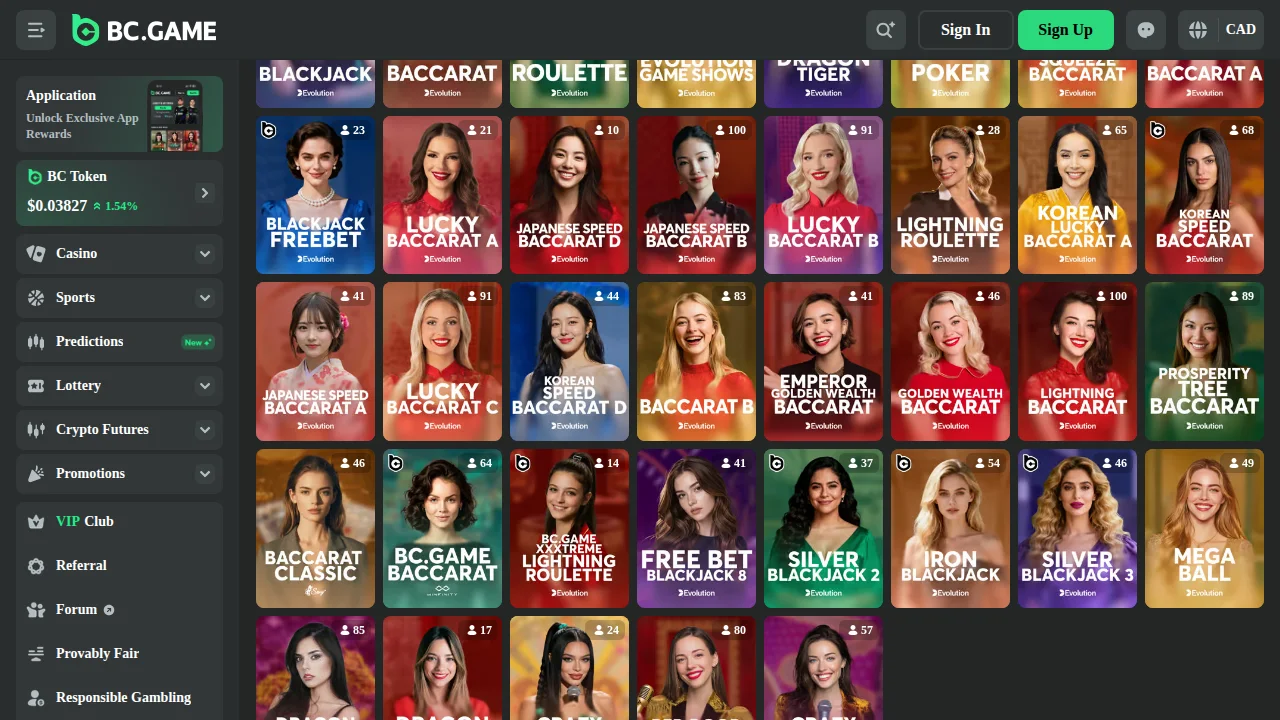
For a broader comparison of live studios and table types across our 12 brands, our live casino guide covers game shows, roulette and blackjack tables too.
Pro Tip:
The scorecards (“Big Road”, “Bead Plate” and friends) that live tables display are a history of past results, not a prediction tool. Each round is independent of the last, so use them for atmosphere, not decisions.
Where to Play Online Baccarat in Canada
Our five picks for online baccarat in Canada are Kingmaker, Golisimo, BC.Game, Need for Spin and Wild Tokyo — chosen because their lobbies, menus or game lists show dedicated baccarat sections or tables when we went through them from a Canadian IP on October 9, 2026. All five are offshore sites, not regulated by a Canadian province.
That matters for how disputes are handled. None of these operators is licensed by a provincial regulator, so if something goes wrong you deal with the operator and its licensing body, not your province. They are not options for players in Ontario or Alberta, who should use their province’s regulated sites — see our Ontario online casinos page and our explainer on whether online gambling is legal in Canada.
How we picked them: we did not open accounts or deposit. We read each operator’s lobby, menus, game lists, bonus terms and responsible-gambling pages, captured screenshots, and compared the terms that actually affect baccarat players. Our full method is on the how we rate page.
Kingmaker: Dedicated Baccarat & Dice Lobby (87/100)
Kingmaker’s live casino menu has a separate Baccarat & Dice category next to Gold Saloon, Roulette, Blackjack, International Tables, Game Shows and Poker, which makes baccarat tables easy to find. The site’s own copy invites you to “Play Live Baccarat with Dice”, and its table-games section lists Baccarat and Baccarat and Dice.
The card welcome offer reads “$750 + 50 chances to win $1,000,000” (verified on the operator’s site in October 2026). Before you count on it for baccarat, read the bonus rules below: Kingmaker’s general T&C give table and card games a 0% wagering contribution and live games 10%. The site’s terms and footer don’t name the operating company or a gaming licence (checked October 2026).
Support runs 24/7 by live chat and at support@kingmaker.com. Responsible-gambling options listed on its page include self-exclusion and a temporary break on request through support. The minimum age stated on the site is 18; provincial age rules still apply where you live. More detail in our Kingmaker review.

- 24/7 Live Chat & Email
- 5-Level VIP With Cashback
- CAD Account Currency
Golisimo: Large Live Lobby with a Baccarat Section (83/100)
Golisimo uses the same layout as Kingmaker, with a Baccarat & dice category inside its live casino menu and a “Baccarat Lobby” tile among the new live games on the homepage. The homepage showed 68 titles under its top live casino row when we captured it.
Its headline offer is a casino welcome package of 300% up to $3,750 + 300 FS, plus a separate crypto welcome of 200% up to 3,000 USDT (verified on the operator’s site in October 2026). Golisimo shares an identical general T&C with Kingmaker, so the same contribution table applies: live games 10%, table and card games 0%. As with Kingmaker, the site’s terms and footer don’t name the operating company or a gaming licence (checked October 2026).
Live chat and email (support@golisimo.com) are listed as available 24/7, and self-exclusion is available on request by email. Read our Golisimo review for the full picture.

- 8,387 Slots & 882 Jackpots
- 15+ Cryptos Incl. Bitcoin
- Daily Cashback Up to 15%
BC.Game: Deepest Live Baccarat Choice for Crypto Players (93/100)
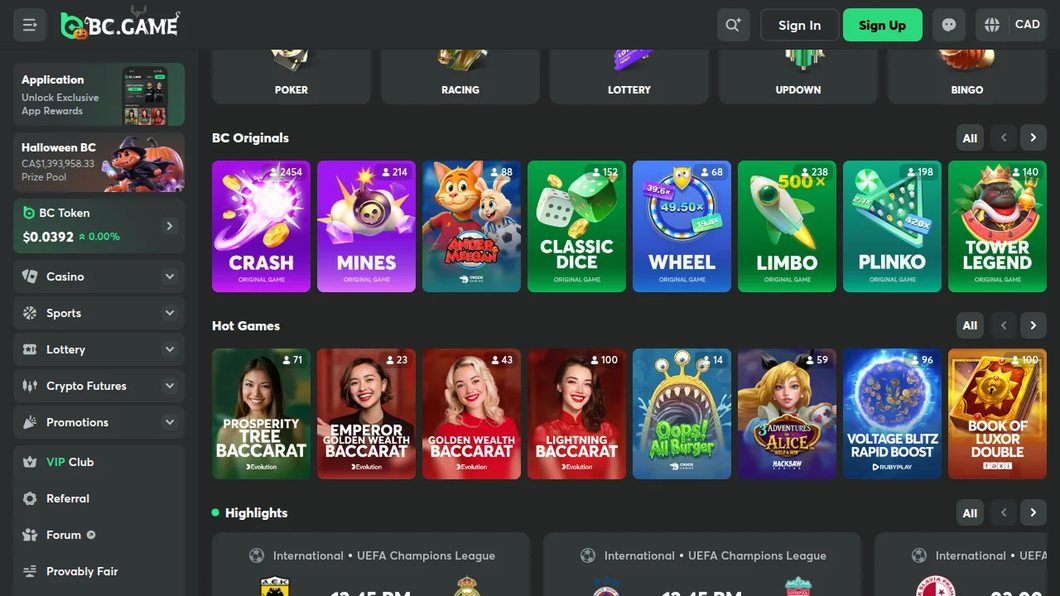
BC.Game has the clearest baccarat offer of the five. Its casino menu lists Baccarat as a table-game category, the live lobby includes a baccarat filter, and its BC Exclusive row features BC.GAME Baccarat and BC.GAME Korean Speed Baccarat tables from Evolution. The homepage also listed Control Squeeze Baccarat, and its in-house originals include a Baccarat Multiplayer game.
The site describes its originals as provably fair, and shows amounts in CA$, though the pages we read did not say whether CAD is a deposit currency or display-only. New players “can claim welcome bonuses and ongoing cashback”; the specific terms were not captured, so check them in the cashier before opting in. Its VIP page states that “all deposits and withdrawals are fee-free, fiat and crypto” as a VIP perk.
BC.Game is licensed by the Government of the Autonomous Island of Anjouan, Union of Comoros (licence ALSI-202410011-FI1) and operated by Twocent Technology Limited (Belize) — not by a Canadian provincial regulator. Its responsible-gambling page lists self-exclusion (minimum six months), a 7-day cooling-off period, gambling limits, a self-assessment and a budget calculator. Full details in our BC.Game review, and more crypto options on our crypto casinos page.

- 1000+ Slots & Live Casino
- Fee-Free VIP Withdrawals
- 24/7 Live Support
Need for Spin: RNG Baccarat in a Big Game Library (86/100)
Need for Spin advertises 8,000+ games, and the list of titles barred during an active bonus names several baccarat games, including Swintt’s Baccarat and Baccarat NC — a useful sign they sit in the catalogue. Its lobby has Table Games and Top Live Casino categories. The headline welcome pack is 250% up to C$4,500 + 550 free spins (verified on the operator’s site in October 2026).
The catch for baccarat players is spelled out in the bonus terms: “Live Dealer games, Table games, and Jackpots are not available for play with an active bonus.” Its loyalty points are also earned on slot bets only — “Bets on table games and live dealer games are excluded.” In practice, Need for Spin is a cash-balance baccarat site.
Need for Spin is operated by GBL Solutions N.V. and licensed by the Curaçao Gaming Control Board (OGL/2024/589/0556) — not by a Canadian provincial regulator. Tools include deposit limits, Take a Break (1 day, 3 days, 1 week), Reality Check reminders and self-exclusion. See our Need for Spin review.
Wild Tokyo: Same Operator, Same Bonus Rules (82/100)
Wild Tokyo, now at wildtokyocasino.com, is run by the same operator as Need for Spin and names the same baccarat titles in its list of games barred during an active bonus. The site names Evolution among its providers and offers a Live Casino category and Table Games in the lobby. The headline welcome pack reads 250% up to C$4,500 + 700 free spins (verified on the operator’s site in October 2026).
The bonus terms are identical on the point that matters here: live dealer and table games are not available while a bonus is active, and the maximum bet with a bonus is C$7. Payment methods named on the site include Visa, Mastercard, Neteller, Skrill and Bitcoin, with a C$15 minimum withdrawal by bank transfer and C$80 by crypto.
Wild Tokyo is licensed by the Curaçao Gaming Control Board (OGL/2024/589/0556) through GBL Solutions N.V. — not by a Canadian provincial regulator. Its responsible-gaming page lists personal limits, Take a Break, Reality Check (60/90/180 minutes), self-exclusion and two-factor authentication. More in our Wild Tokyo review.

- 5% Daily Cashback
- 88-Level Loyalty Program
- C$15 Minimum Withdrawal
Can You Use a Casino Bonus on Baccarat?
Usually not in any useful way. Every one of our five baccarat picks restricts table and live games while a bonus is active, so a welcome package is mainly a slots offer. For baccarat, playing with your own cash balance and no bonus attached is often the smarter choice.
Here is what the terms we read in October 2026 say, side by side:
- Kingmaker and Golisimo (shared T&C, section 7.7): slots 100%, all live games 10%, all table and card games 0%. Unless a promotion says otherwise, deposit bonuses carry x35 wagering on deposit + bonus and a maximum withdrawal of 10x the bonus. Individual bets above C$150 before wagering is met, “two-tier betting” and “minimum risk strategies” are listed as promotion abuse.
- Need for Spin and Wild Tokyo (shared operator): live dealer games and table games are not available with an active bonus at all, and the maximum bet with a bonus is C$7.
- BC.Game: the specific bonus and wager-contribution terms were not captured in our reading, so check its “Wager Contribution” page before opting in.
A Worked Example: Clearing a Bonus on Live Baccarat
Take the default Kingmaker/Golisimo rules. Deposit C$100, receive a C$100 bonus, and x35 on deposit + bonus means C$7,000 of qualifying bets. Live baccarat counts at 10%, so you would need C$70,000 in live baccarat bets to clear it.
At the Banker edge of 1.06%, C$70,000 of action has an expected cost of about C$742 — more than three times the C$200 you started with. RNG baccarat, at 0% contribution, would never clear it at all. That is why we tell baccarat players to decline the welcome bonus unless they also enjoy slots.
There’s a second trap: betting both Banker and Player in the same round to “clear” wagering with little risk is the kind of play that the Kingmaker/Golisimo ban on “minimum risk strategies” targets, and promotion abuse can cost you your bonus winnings. Our wagering requirements guide explains how contribution rates work, and our cashback bonus page covers offers that are friendlier to table players.
Watch out:
Before you accept any bonus at a baccarat site, search its bonus terms for “live”, “table” and “contribution”. If table games count at 0% or are blocked, decline the bonus at the cashier and play with real money only.
Baccarat Strategy: What Works and What’s a Myth
The only baccarat strategy that changes your long-run results is bet selection: back Banker (1.06%) or Player (1.24%), skip the Tie, and keep side bets small. Everything else — betting systems, pattern reading, streak chasing — changes how your results are distributed, not the house edge.
Myth: The Martingale Beats Baccarat
The Martingale doubles your bet after each loss so one win recovers everything. It feels safe because short losing streaks are common and long ones are rare. But rare is not never. Starting at C$10 on Banker, seven losses in a row means bets of C$10, 20, 40, 80, 160, 320 and 640 — C$1,270 lost to chase a C$10 profit.
Ignoring ties, Banker loses seven decided rounds in a row about 0.7% of the time, or roughly once in 140 sequences. Play long enough and you will meet that sequence — and table maximums can stop you doubling before it ends. Reverse systems such as Paroli or Fibonacci variations have the same flaw: the edge on each bet is unchanged.
Myth: Roads and Patterns Predict the Next Hand
Live tables show scorecards such as the Big Road and Bead Plate, and some players bet on “chops” and “streaks”. In an eight-deck shoe the effect of cards already dealt on the next result is so small that it cannot overcome the house edge. The scorecard is a record, not a forecast.
Myth: Card Counting Works in Baccarat
Card counting can shift blackjack odds because player decisions change with the deck. In baccarat you make no playing decisions, and analyses of counting the main bets show gains too small and too rare to be practical. Online, frequent or continuous reshuffling removes even that. If you like decision-based games, our online blackjack guide is the better read.
What Actually Helps
- Stick to Banker or Player. Switching between them costs nothing extra; the Tie and side bets do.
- Choose the slower table if your goal is a longer session for the same budget.
- Set a session budget and a time limit before you open the lobby, not after a losing run.
- Avoid bonus wagering on baccarat unless the contribution rate makes sense for you.
Bankroll and Pace: What a Session Really Costs
Your expected loss equals stake × rounds × house edge, so the speed of the table matters as much as the bet you choose. The same C$10 Banker bet costs very different amounts per hour at a classic table and at a speed table.
A simple illustration, using round counts as assumptions (actual pace depends on the table and the number of players):
- Classic live table, about 60 rounds an hour: C$10 × 60 × 1.06% ≈ C$6.36 expected cost per hour.
- Speed table, about 120 rounds an hour: C$10 × 120 × 1.06% ≈ C$12.72 per hour.
- Same speed table, C$10 on Tie: C$10 × 120 × 14.36% ≈ C$172 per hour.
Expected cost is an average; actual sessions swing well above and below it. A sensible rule of thumb is a session budget of at least 20–30 base bets so ordinary variance doesn’t end the night in ten minutes — and stop when that budget is gone. Our guide to best payout casinos explains how RTP and house edge compare across games.
Is Online Baccarat Legal in Canada?
Online baccarat is legal in Canada when it is offered by, or under the licence of, a provincial government. Under section 207(1)(a) of the Criminal Code of Canada, gambling is lawful only when “conducted and managed” by a province, and each province decides how online gaming works.
- Ontario: a regulated iGaming market since April 4, 2022, with the AGCO as regulator and iGaming Ontario conducting and managing the market. Players must be 19+ and physically in Ontario.
- Alberta: a regulated iGaming market launched July 13, 2026, regulated by AGLC with the Alberta iGaming Corporation; 18+.
- British Columbia, Manitoba and Saskatchewan: PlayNow.com is the government-run site.
- Quebec: Loto-Québec’s lotoquebec.com; 18+.
- Atlantic provinces: Atlantic Lottery Corporation runs the government online offering.
Offshore sites like the five above accept players from many provinces but are not regulated by your province. That doesn’t make playing a crime for you, but it does mean a provincial regulator can’t resolve a dispute with them. Residents of Ontario and Alberta should use their regulated provincial sites.
Age limits are 19+ in most provinces and territories and 18+ in Alberta, Manitoba and Quebec — whatever an offshore site’s own minimum says. On tax: the CRA generally treats recreational gambling winnings as windfalls that are not taxed; people carrying on gambling as a business may be taxed, and interest earned on winnings is taxable.
Play Baccarat Responsibly
Baccarat is fast, simple and easy to repeat, which is exactly why it needs limits. Decide your budget and session length before you start, never chase losses with bigger bets, and use the deposit limits, breaks and self-exclusion tools each casino provides.
If gambling stops being fun, free confidential help is available across Canada: ConnexOntario 1-866-531-2600, BC Problem Gambling Help Line 1-888-795-6111, Alberta Addiction and Mental Health Helpline 1-866-332-2322, Quebec Gambling: Help and Referral 1-800-461-0140, and the full provincial list at gamblingguidelines.ca. Our responsible gambling guide covers limits and self-exclusion step by step.
Related Guides

Online Blackjack Canada 2026: Best Sites, Rules & Strategy
The best online blackjack sites for Canadian players are Betinia, ToonieBet, Need for Spin, Wild Tokyo,…
Online Roulette Canada 2026: Best Sites, Odds & Rules
The best online roulette in Canada is single-zero European or French roulette (2.70% house edge, 1.35%…
Live Casino Canada 2026: Live Dealer Sites, Studios and Game Shows
The best live casino in Canada for players outside Ontario and Alberta depends on what you…



Dragon Tiger: The Two-Card Cousin of Baccarat
Dragon Tiger often sits in the same live lobby as baccarat, and many Canadian players treat it as a faster version of the same game. It is related, but the maths and the rules are different enough to look at on its own. The core idea is simple: one card goes to the Dragon, one card goes to the Tiger, and the higher card wins. There is no third card, no scoring by last digit and no commission.

That makes Dragon Tiger one of the quickest table games online. A live round often lasts only a few seconds after the betting window closes. Before you treat it as a substitute for baccarat, here is what changes:
- One card per side instead of two or three.
- Card rank decides the result, not a points total.
- Ties hurt main bets: on most tables you lose half your Dragon or Tiger stake when the cards tie.
- The house edge on the main bets is higher than on baccarat’s Banker or Player bets.
How a Dragon Tiger Round Works
Dragon Tiger is usually dealt from a shoe of eight standard 52-card decks. You bet on Dragon, Tiger or Tie, and many tables also offer side bets on the size, parity or suit of each card. When the timer closes, the dealer places one card face up in the Dragon box and one in the Tiger box.
Card ranking is fixed and has no exceptions:
- Ace is the lowest card (worth 1).
- 2 to 10 rank at face value.
- Jack, Queen and King rank 11, 12 and 13, so the King is the highest card.
- Suits do not matter for the main result. A King of hearts and a King of spades are a tie.
That is the whole game. With a Dragon 9 and a Tiger 4, Dragon wins. With a Dragon Queen and a Tiger King, Tiger wins. With two 7s, the result is a Tie, whatever the suits.
The key difference from baccarat is the tie rule. In baccarat, a Player or Banker bet is simply returned on a tie. In the common Dragon Tiger rule set, a Dragon or Tiger bet loses half its stake on a tie. That half-stake loss is where most of the house edge on the main bets comes from. Check the table’s help panel, because a few versions take the whole stake instead.
Dragon Tiger Payouts and House Edge
Because the cards are compared by rank alone, the probabilities are easy to work out. With eight decks, the chance that the second card matches the rank of the first is 31 out of the remaining 415 cards, or about 7.47%. The rest of the time, Dragon and Tiger are equally likely to win: about 46.27% each.
The table below shows the main bets under the most common rules, plus the less common variations you may see in an RNG version:
| Bet | Typical payout | Probability of winning (8 decks) | House edge |
|---|---|---|---|
| Dragon or Tiger (half stake lost on tie) | 1:1 | ≈ 46.27% | ≈ 3.73% |
| Dragon or Tiger (full stake lost on tie) | 1:1 | ≈ 46.27% | ≈ 7.47% |
| Tie (paying 11:1) | 11:1 | ≈ 7.47% | ≈ 10.36% |
| Tie (paying 8:1) | 8:1 | ≈ 7.47% | ≈ 32.77% |
| Suited Tie (same rank and suit, paying 50:1) | 50:1 | ≈ 1.69% | ≈ 13.98% |
A few points stand out from those numbers:
- The Dragon and Tiger bets are mirror images. Neither side has an advantage, so the choice between them is pure preference.
- The main bet costs about three and a half times as much as baccarat’s Banker bet, which carries a house edge of about 1.06% with eight decks.
- The Tie pays well but stays expensive. At 11:1, the Tie in Dragon Tiger is actually cheaper than the baccarat Tie at 8:1, but it is still around ten times the cost of a Banker bet.
- An 8:1 Tie in Dragon Tiger is among the worst bets in the casino. If a table pays only 8:1 on the Tie, leave it alone.
Dragon Tiger Side Bets
Live Dragon Tiger tables usually add a set of side bets on the individual cards. They look like even-money coin flips, but one card always beats them: the 7.
- Big / Small: bet that the Dragon (or Tiger) card is Big (8 to King) or Small (Ace to 6). Pays 1:1. A 7 loses both.
- Odd / Even: bet that the card is odd (Ace, 3, 5, 9, Jack, King) or even (2, 4, 6, 8, 10, Queen). Pays 1:1. A 7 loses both.
- Suit bets: on some tables you can back the suit of a card at a higher payout. Payouts vary from table to table, so read the paytable before you bet.
The maths behind the Big/Small and Odd/Even bets is clean. Six of the thirteen ranks win, six lose and the 7 always loses. That gives a winning chance of 6/13 against a losing chance of 7/13, and a house edge of 1/13, or about 7.69%. That is more than double the edge on the main Dragon or Tiger bet and more than seven times the edge on baccarat’s Banker bet.
Dragon Tiger vs Baccarat: Which Should You Play?
Both games are fast, both need no decisions after you bet, and both appear side by side in most live lobbies. The difference comes down to cost and pace:
| Feature | Baccarat (Punto Banco) | Dragon Tiger |
|---|---|---|
| Cards per side | 2 or 3 | 1 |
| How the winner is decided | Total closest to 9 (last digit only) | Higher card rank (Ace low, King high) |
| Best main bet house edge | Banker ≈ 1.06% | Dragon or Tiger ≈ 3.73% |
| Commission | 5% on Banker wins (standard tables) | None |
| What happens to main bets on a tie | Stake returned (push) | Usually half the stake lost |
| Round speed | Fast | Faster: two cards and done |
| Third-card rules to follow | Yes (applied automatically) | No |
If your goal is to get the most play for your money, baccarat’s Banker or Player bet is the better choice. Dragon Tiger suits players who want the fastest possible rounds and the simplest possible rules, and who accept a higher cost per bet in return.
Speed itself is a cost. Faster rounds mean more bets per hour, and every one of those bets carries the house edge. A higher edge combined with a faster pace makes Dragon Tiger noticeably more expensive per hour than a standard baccarat table at the same stake.
Dragon Tiger Strategy Claims to Ignore
Dragon Tiger attracts the same “system” talk as baccarat, plus a few ideas of its own. None of them changes the maths:
- “Track high and low cards to predict the next one.” With eight decks and frequent reshuffles or continuous shuffling online, tracking which ranks have gone gives far too small a shift to overcome the house edge. Many live tables also burn cards and shuffle well before the shoe is exhausted.
- “Follow the trend on the scoreboard.” Dragon Tiger tables show roadmaps just like baccarat tables. Past results do not affect the next two cards.
- “Back the Tie after a long gap.” A Tie is not “due”. The chance of a tie on the next round is about the same whether the last tie was one hand ago or fifty.
The only decision that really matters in Dragon Tiger is avoiding the expensive bets. That means skipping the Tie (especially at 8:1), skipping the 7-sensitive side bets and checking the tie rule on the main bets.
Does Online Baccarat Offer Good Odds?
Yes, measured against most of the casino floor. The Banker and Player bets are among the cheapest wagers you can place online, and they need no skill at all to get the full value. You do not have to learn a strategy chart, as in blackjack, to play baccarat at its lowest house edge. You only need to choose the right bet.
The question is relative, though. “Good odds” in a casino still means odds that favour the house. The comparison below puts baccarat next to other games you will find at Canadian-facing casinos, using standard rules:
| Game and bet | Approximate house edge | Skill needed for that edge |
|---|---|---|
| Blackjack (good rules, perfect basic strategy) | ≈ 0.5% (varies with rules) | High: every decision must be correct |
| Baccarat – Banker (5% commission, 8 decks) | ≈ 1.06% | None |
| Baccarat – Player (8 decks) | ≈ 1.24% | None |
| French roulette – even-money bets with La Partage | ≈ 1.35% | None |
| Craps – Pass Line | ≈ 1.41% | Low |
| No-Commission Baccarat – Banker (pays 1:2 on a winning 6) | ≈ 1.46% | None |
| European roulette – any standard bet | ≈ 2.70% | None |
| Dragon Tiger – Dragon or Tiger (half stake lost on tie) | ≈ 3.73% | None |
| Typical online slot (RTP around 94%–97%) | ≈ 3%–6% | None |
| American roulette – most bets | ≈ 5.26% | None |
| Baccarat – Tie (paying 8:1) | ≈ 14.36% | None |
Two conclusions follow. First, baccarat’s main bets belong in the top tier, next to the best roulette and craps bets and behind only well-played blackjack. Second, the same table can be either a good deal or a poor one depending on where you put your chips. The Tie bet sits at the bottom of the list, below slots and American roulette.
What a Low House Edge Does and Doesn’t Mean
A house edge of about 1% is a long-run average. It tells you what share of your total wagers you should expect to lose over thousands of hands. It says very little about any single session. Here is how to read it correctly:
- It is not a ceiling on losses. A run of Banker losses can wipe out a session bankroll in minutes. A 1% edge does not mean you can only lose 1% of your money.
- It applies to every bet, not to your deposit. If you deposit C$200 and cycle it through the table five times, you have wagered C$1,000, and the expected cost is based on the C$1,000.
- It does not shrink with clever staking. As the betting systems section below shows, changing your bet size changes how your results are spread out, not what you expect to lose per dollar wagered.
- Short-term wins are normal. Because Banker and Player bets are close to 50/50, it is common to finish a short session ahead. That is variance, not evidence of a working method.
Where Baccarat’s Good Odds Quietly Disappear
Most players who say baccarat “felt expensive” were not playing the Banker or Player bet alone. The good odds can slip away in a few predictable places:
- Side bets. Pairs, Dragon Bonus and similar wagers usually carry far higher edges than the main bets, and they are easy to add round after round without thinking.
- The Tie bet. Its big payout makes it look tempting, but at 8:1 it costs more than thirteen times as much as a Banker bet.
- Multiplier tables. Some variants add a fee or lower base payouts to fund random multipliers. Check the paytable: the headline multipliers are paid for by smaller standard wins.
- Altered payouts. Check the commission rate and Tie payout in the help panel. A table that charges more than 5% commission or pays the Tie at less than 8:1 is worse than the standard game.
- Pace. Speed tables and auto-play roughly double the number of bets per hour, so the hourly cost goes up even though the edge per bet does not change.
The practical rule is short: if you want baccarat’s good odds, play Banker or Player on a standard-commission table and skip the extras. Everything else is optional entertainment that costs more.
Are the Odds the Same Online and in a Land-Based Casino?
For the main bets, yes, as long as the rules are the same. The house edge comes from the drawing rules, the commission and the payouts, not from where the cards are dealt. A standard eight-deck Punto Banco game has the same Banker and Player edges in a live studio, in an RNG version and at a physical table.
What can differ online:
- Deck count in RNG versions. Some use fewer decks, which shifts the edges slightly. The changes are small, so the commission and payouts matter far more.
- Shuffling. RNG games effectively reshuffle every hand, and live studios usually reshuffle well before the end of the shoe.
- Side-bet paytables, which vary between game providers and even between tables in the same lobby.
The fairness of an RNG game depends on the casino and the software being independently tested and properly licensed. That is one of the points to check when you choose where to play, as covered next.
What to Consider When Choosing a Baccarat Online Casino
Most casino reviews rank sites by their welcome offer. For baccarat, that is the wrong place to start. A baccarat player needs a good table selection, fair payout rules, sensible limits and reliable withdrawals. The bonus comes a distant fifth, partly because many bonuses restrict or exclude table games.
Here are the factors that matter most, in rough order of importance:
- A licence you can check and terms you can find
- Standard baccarat rules: 5% commission, a Tie paying at least 8:1, clearly published side-bet paytables
- Enough tables, at the stakes you actually play
- Payment methods that work for Canadians, with withdrawals that are paid without delays
- Bonus terms that state clearly how baccarat counts toward wagering
- A stable live stream and a usable mobile interface
Licence, Ownership and Terms
Start with the footer. A legitimate casino displays the name of the company that runs it, its licence and a licence number. Copy that number and check it on the licensing authority’s own public register, not just on the casino’s page. If the casino names a licence you cannot confirm, treat that as a reason to look elsewhere.
While you are there, check a few documents that affect baccarat players directly:
- General terms: look for the rules on maximum withdrawals per day, week or month, and on dormant accounts.
- Bonus terms: look for a list of excluded or restricted games, and any rule against betting both Player and Banker in the same round.
- Game rules: each table should have a help or info panel that shows the payouts, the commission and what happens if a stream fails mid-round.
The legal side of playing from Canada, including the difference between provincially regulated sites and sites licensed elsewhere, is covered in the legality section of this guide. The point here is simpler: whatever type of site you choose, you should be able to verify who runs it.
Table Range and Studio Mix
A casino with only two or three baccarat tables can feel crowded at peak hours, and you may be stuck with stakes or a pace you don’t want. A wider live lobby, usually drawn from several game studios, gives you more options:
- Standard and low-limit Punto Banco for steady, cheap play.
- Speed tables if you want faster rounds (keep the hourly cost in mind).
- Squeeze tables if you prefer a slower, more theatrical reveal.
- No-commission tables for simpler maths, with a slightly higher Banker edge.
- Multiplier variants for occasional big swings.
- Dragon Tiger and dice-based games as alternatives within the same lobby.
Different studios also run different side-bet menus and paytables. A broad studio mix lets you compare and pick the table with the cleanest rules. A single studio means you accept whatever that one studio offers.
The number of tables matters less than their quality. A lobby with dozens of baccarat tables that all charge extra or pay the Tie at less than 8:1 is worse than a smaller lobby of standard tables.
Table Limits That Match Your Bankroll
Limits are easy to overlook and quickly become a problem. If the cheapest baccarat table in the lobby has a minimum that is too high for your bankroll, every session will be shorter and swingier than it needs to be. Look for:
- A low minimum on at least some live tables. Low-limit live tables often accept bets of a dollar or so, and RNG versions often go lower.
- A sensible gap between minimum and maximum, so you can adjust stakes without changing tables.
- Separate side-bet limits, which are usually lower than the main-bet limits and are shown in the table info.
- Clear currency handling. If the casino shows C$ balances but runs tables in another currency, small conversion differences add up.
As a guide, many experienced players keep their usual bet at a small fraction of the session bankroll so that a normal losing streak does not end the session after a few hands. The bankroll section of this guide goes into session costs in detail.
Payment Methods and Withdrawal Speed
Fast payouts are one of the most common things players look for, and with good reason. The quickest withdrawal option is only useful if the casino approves requests promptly. When you compare casinos, look at the whole chain:
- Pending time: how long the casino holds a withdrawal request before processing it. This often matters more than the payment method itself.
- Verification: most licensed casinos ask for ID and proof of address before the first withdrawal. Complete it early so a winning session isn’t followed by a wait.
- Method speed: crypto withdrawals and e-wallets are often faster than cards or bank transfers once approved. Interac options are widely used in Canada for deposits, and some casinos also support them for withdrawals.
- Limits and fees: check minimum and maximum withdrawal amounts, any fees, and whether the casino limits how much you can withdraw in a given period.
- Same-method rule: many casinos require you to withdraw using the method you deposited with, where possible.
If you play with crypto, remember that the C$ value of your balance moves with the coin’s price, both while it sits in your casino account and after it reaches your wallet. That volatility has nothing to do with baccarat, but it can change the real value of a win.
How the Casino Treats Baccarat in Its Bonus Terms
Bonus rules for baccarat are covered elsewhere in this guide, so only the selection angle is noted here. When comparing casinos, look for these points in the terms rather than at the size of the headline offer:
- Whether baccarat counts toward wagering at all, and at what percentage.
- Whether live baccarat and RNG baccarat count differently.
- Whether betting both Player and Banker in the same round is banned (it usually is).
- Whether there is a maximum bet while a bonus is active.
A casino that states these rules clearly is generally easier to deal with than one where you have to ask support to find out whether your baccarat bets counted.
Stream Quality and Mobile Play
Live baccarat depends on a steady video stream and a betting timer that you can actually reach before it closes. On mobile, small differences in layout make a real difference. Points worth checking during your first short session:
- Can you place a bet comfortably before the timer runs out on a phone screen?
- Does the stream adjust quality on a weaker connection instead of freezing?
- Is the bet history easy to find, so you can confirm what you placed and what was paid?
- Does the table show what happens if you lose connection mid-round? Typically your bet stands and the round is settled normally, but the rules should say so.
Quick Checklist: Picking a Baccarat Casino
| What to check | Good sign | Warning sign |
|---|---|---|
| Licence | Operator name and licence number you can confirm on the regulator’s register | Logo only, no number, or a number you cannot find |
| Banker commission | 5% (or a clearly explained no-commission rule) | Higher commission, or no explanation |
| Tie payout | 8:1 or better | Less than 8:1 |
| Table range | Several standard tables at different limits | Only high-minimum or only novelty tables |
| Side-bet paytables | Shown in the table’s info panel | Hidden or vague |
| Withdrawals | Clear pending times, limits and fees in the terms | Low withdrawal caps or unexplained delays |
| Bonus terms | States how baccarat counts toward wagering | Excluded games listed only in vague terms |
| Responsible gambling tools | Deposit, loss and session limits, time-out and self-exclusion in your account | Tools available only by emailing support |
Baccarat Betting Systems: A Closer Look at Each Approach
Betting systems are rules for deciding how much to bet on the next hand. They do not decide which hand to bet on, and none of them changes the house edge. Baccarat attracts more systems than most games because the main bets are close to even money and the rounds are quick, which makes progressions easy to run.
Systems fall into three broad groups:
- Flat betting: the same stake every hand.
- Positive progressions: raise the bet after a win (Paroli, 1-3-2-6).
- Negative progressions: raise the bet after a loss (D’Alembert, Fibonacci, and the Martingale already covered in the myths section).
Let’s take a closer look at each of these approaches, with the actual numbers behind them. The examples use a C$10 base unit and, unless stated otherwise, the Player bet, because it pays a clean 1:1. Ties are a push on Player and Banker bets, so they are left out of the sequences: a tie simply repeats the hand at the same stake.
Flat Betting
Flat betting means betting the same amount on every hand, whatever happened before. It is the least exciting approach and the most honest one. Your expected loss grows in a straight line with the number of hands you play, and you can predict it from the house edge.
Why many experienced players use it:
- It gives the least variance of any approach that keeps playing. No single hand can do outsized damage.
- It makes the cost of a session easy to estimate. At C$10 a hand on Banker, the expected loss is about C$0.11 per hand.
- It avoids the trap of rising stakes after losses, which is how most baccarat sessions turn from small losses into large ones.
- It works well with bonus wagering, where a maximum-bet rule often applies anyway.
The drawback is that flat betting offers no “story”. There is no target to hit and no sequence to complete. If you want a structured way to play that does not raise your risk, flat betting with a fixed session budget and a time limit is the best option available.
The Paroli System
The Paroli is a positive progression, sometimes called a reverse Martingale. You start with one unit and double your bet after each win. After three wins in a row, you bank the profit and go back to one unit. After any loss, you also go back to one unit.
With a C$10 base on Player, a full cycle looks like this:
- Bet C$10. If you win, you are up C$10.
- Bet C$20. If you win, you are up C$30.
- Bet C$40. If you win, you are up C$70. Reset to C$10.
The appeal is clear. A loss at any step costs you exactly one base unit (C$10), because the larger bets are funded by earlier wins. A complete run of three wins pays seven units. The table below shows how often each outcome happens with a Player bet, ignoring ties:
| How the cycle ends | Probability (Player bet, ties excluded) | Net result | Total wagered |
|---|---|---|---|
| Lose the first bet | ≈ 50.7% | −C$10 | C$10 |
| Win once, then lose | ≈ 25.0% | −C$10 | C$30 |
| Win twice, then lose | ≈ 12.3% | −C$10 | C$70 |
| Win three in a row | ≈ 12.0% | +C$70 | C$70 |
Now the maths. About 88% of cycles lose C$10, and about 12% win C$70. That gives an expected result of roughly −C$0.41 per cycle. The average cycle involves about C$29.60 in total bets, so the loss is about 1.4% of the money wagered. That is the Player bet’s normal house edge on hands that do not tie. The Paroli has rearranged the results, not improved them.
What the Paroli does do:
- It limits the damage per cycle to one base unit, which suits players who want to cap their risk.
- It creates a feeling of momentum: most cycles lose a little, and an occasional cycle wins a lot.
- It concentrates larger bets on money you have just won, which some players find easier to accept emotionally.
Using the Paroli on Banker works the same way, but the 5% commission means each win pays 0.95 units. Players usually round the next bet to the nearest chip, which slightly changes the figures but not the conclusion.
The biggest practical risk with the Paroli is not the system itself but abandoning it. Players who “let it ride” past three wins because a streak feels hot are turning a capped system into an uncapped one.
The 1-3-2-6 System
The 1-3-2-6 system is another positive progression, designed to reduce the all-or-nothing nature of the Paroli’s third bet. You bet 1 unit, then 3, then 2, then 6, moving to the next step after each win and returning to the start after any loss or after the fourth bet.
With a C$10 unit, the possible outcomes of a cycle are:
- Lose the first bet (C$10): −C$10.
- Win the first, lose the second (C$30): −C$20.
- Win two, lose the third (C$20): +C$20.
- Win three, lose the fourth (C$60): break even.
- Win all four: +C$120.
The structure is clever: once you have won the first two bets, the cycle can no longer end in a loss. The cost is that the second step, at three units, is the riskiest bet in the sequence, and losing it is the most common way the cycle ends after a first win.
As with the Paroli, the expected loss per dollar wagered is simply the house edge on the bet you choose. The 1-3-2-6 is best thought of as a way of pacing your stakes with a defined maximum bet of six units, not as a way of getting ahead.
The D’Alembert System
The D’Alembert is a gentler negative progression. You add one unit to your bet after each loss and remove one unit after each win, never going below one unit. With a C$10 unit, a loss takes your next bet to C$20, a second loss to C$30, and a win brings it back to C$20.
The theory behind it is the idea that wins and losses will “even out”, so a slightly higher stake during recovery will pay off. The problem is that baccarat outcomes do not balance themselves. Here is how it behaves in practice:
- Bets rise slowly, so it does not explode like the Martingale after a short losing run.
- Long losing streaks still push stakes well above your base. Ten losses with only a couple of wins in between can leave you betting eight or nine units.
- Your biggest bets come when you are already down, which is exactly when a session budget is under the most pressure.
- The house edge applies to every dollar, and because the system puts more money in play during losing periods, the total amount wagered is often higher than with flat betting.
If you use the D’Alembert, set a maximum bet in advance (for example, five units) and go back to flat betting once you reach it. That keeps the system from taking over the session.
The Fibonacci System
The Fibonacci system follows the sequence 1, 1, 2, 3, 5, 8, 13, 21, 34 and so on, where each number is the sum of the two before it. You move one step forward after a loss and two steps back after a win. With a C$10 unit, after five straight losses you are betting C$80; after eight losses, C$340.
Key points about the Fibonacci:
- It escalates more slowly than the Martingale at first, which makes it feel safer.
- It still grows quickly over a long streak. The tenth number in the sequence is 55 units, and the twelfth is 144.
- A single win does not recover all your losses, unlike the Martingale. You often need several wins to work back to the start of the sequence.
- Table maximums can stop the progression partway through, which leaves you with the losses and no way to continue as planned.
Losing streaks of eight or more hands on a near 50/50 bet are uncommon in any single sequence, but they happen regularly across a long session of hundreds of hands. Any negative progression has to be judged by what happens on its worst day, not its average day.
Betting Systems Compared
| Approach | Type | Bet change | Largest bet in a normal cycle | Variance | Effect on house edge |
|---|---|---|---|---|---|
| Flat betting | None | Never changes | 1 unit | Lowest | None |
| Paroli | Positive | Double after a win, reset after 3 wins or any loss | 4 units | Low to moderate | None |
| 1-3-2-6 | Positive | Follow 1, 3, 2, 6 after wins; reset after a loss | 6 units | Moderate | None |
| D’Alembert | Negative | +1 unit after a loss, −1 after a win | Open-ended (grows with losing runs) | Moderate to high | None |
| Fibonacci | Negative | One step forward after a loss, two back after a win | Open-ended (grows quickly) | High | None |
The last column is the one that matters. No staking plan can turn a negative-expectation bet into a positive one, because each hand is settled independently at the same odds. What a system can change is the shape of your results:
- Positive progressions produce many small losses and occasional larger wins.
- Negative progressions produce many small wins and occasional large losses.
- Flat betting sits in the middle and keeps your total wagering, and therefore your expected cost, as low as possible for a given number of hands.
If a system makes the game more enjoyable and you keep it within a fixed budget, it can be part of how you play. If you choose it because you believe it beats the game, the maths above shows why it won’t.
Which Hand to Back Within Any System
Systems only decide stake size, so the choice of hand still matters. On a standard 5% commission table, Banker has the lowest house edge, Player comes a close second, and the Tie is far behind. Many players simply back Banker every hand and choose a staking approach on top of that.
Points to keep in mind:
- Switching between Player and Banker based on recent results does not help; see the myths section on roads and patterns.
- On no-commission tables, the Banker edge is slightly higher, and the Player bet becomes the cheaper option on some versions. Check the payouts in the table info.
- Adding a Tie or side bet to “protect” a system adds cost to every cycle. It is never a hedge in the financial sense.
Staying in Control While Playing Real-Money Baccarat Online
Baccarat is easy to play on autopilot. You make one decision per round, the round takes seconds, and the next betting window opens almost immediately. That rhythm is part of its appeal and also the main reason players lose track of time and money. Staying in control is less about willpower and more about setting things up before you start.
The practical controls below focus on how baccarat itself is played online. They complement, rather than replace, the general responsible gambling information elsewhere on this page.
Set Your Limits Before You Open a Table
Most licensed casinos offer account tools in the responsible gambling or account settings area. Availability varies from site to site, but the common ones are:
- Deposit limits per day, week or month. Lowering a limit usually takes effect straight away, while raising one often comes with a waiting period.
- Loss limits, which cap your net losses over a set period.
- Wager limits, which cap the total amount you can bet.
- Session time limits that log you out or block play after a set time.
- Reality checks: pop-ups that show how long you have been playing and your net result.
Set these when you are calm and before your first session, not after a bad run. A limit chosen in the middle of a losing session is usually a limit that gets raised.
Watch the Pace, Not Just the Balance
Baccarat’s speed means a session can involve far more bets than you realise. A standard live table runs dozens of rounds an hour, speed tables run many more, and RNG versions run as fast as you can click. A few habits help keep the pace in check:
- Choose standard or squeeze tables over speed tables if you want a session to last longer on the same budget.
- Avoid auto-play and “repeat bet” features on RNG games, which remove the pause between decisions.
- Set a round count as well as a time limit. For example, decide to stop after 100 hands, whatever the result.
- Use the table’s bet history to check how much you have actually wagered, not just how your balance has moved.
Recognise Chasing Before It Starts
Chasing losses is the most common way a normal baccarat session turns into a costly one. It rarely looks like a dramatic decision. It usually starts with small changes in behaviour. Warning signs include:
- Raising your stake to “win back” what you have lost.
- Switching from Banker or Player to the Tie or side bets for a bigger payout.
- Starting a negative progression you had not planned to use.
- Making a second deposit in the same session after hitting your planned budget.
- Telling yourself a streak “has to” end soon.
If you notice any of these, stop the session. The next hand has exactly the same odds as the last one, and nothing about your losses makes a win more likely.
Keep Gambling Money Separate
Treat your baccarat budget as money already spent on entertainment, kept apart from money for bills, savings or debts. Some practical ways to do this:
- Use a dedicated payment method or account for gambling deposits, so you can see your total spending at a glance.
- Withdraw winnings instead of replaying them. Many players set a rule to withdraw part of any win above a certain amount at the end of a session.
- Never borrow to play, whether from a credit line, a loan or a friend.
- Review your transaction history monthly. Casinos are generally required to make deposits, withdrawals and bets available in your account.
Use Breaks, Time-Outs and Self-Exclusion
If baccarat is starting to take more time or money than you intended, the stronger tools exist for that situation. They are generally available at licensed casinos:
- Time-out or cool-off: a short block on your account, often from a day to several weeks, during which you cannot play.
- Self-exclusion: a longer block, often six months or more, which in many cases cannot be reversed before it ends.
- Marketing opt-outs: turning off promotional emails and texts reduces the prompts to come back.
- Device-level blocking software, which can block gambling sites across all your devices.
Self-exclusion at one casino does not usually apply to other casinos, especially across different licences. If you need a break from gambling generally, use blocking tools as well and seek support from the organisations listed in this guide’s responsible gambling section.
A Simple Session Plan for Baccarat
Putting all of this together, a controlled baccarat session can follow a short routine that takes a minute to set up:
- Pick a budget for the session, and make sure it is money you can afford to lose.
- Pick a base stake that is a small fraction of that budget.
- Pick a table with standard rules and a minimum that fits your stake.
- Pick your bet (Banker or Player) and decide in advance whether you will use any side bets at all.
- Set a stop point in time or hands, plus a win point at which you withdraw part of your balance.
- End the session when you reach any of those limits, without making exceptions for “one more shoe”.
Baccarat rewards discipline more than any form of prediction. The game’s good odds only last as long as you stick to the bets, stakes and limits you chose before the cards came out.