





















Safe Online Casinos in Canada: Quick Verdict
The safest online casino in Canada is the one your own province regulates. If you live in Ontario or Alberta, that means a site on the official provincial list; in Quebec it means Loto-Québec; elsewhere it means your provincial lottery site. Offshore casinos can still be transparent and well run, but no Canadian province stands behind them if something goes wrong.
For readers outside Ontario and Alberta who choose offshore sites anyway, the practical question becomes: which operators name their company, publish a licence number you can check, explain KYC and withdrawal caps in plain terms, and point you to an independent complaints route? That is what this guide measures, brand by brand, using only what each operator’s own pages said when we read them in October 2026.
Ontario and Alberta Players
Stick to the regulated lists. Ontario’s iGaming market has run since April 4, 2022, with 84 websites on iGaming Ontario’s list (accurate as of September 1, 2026). Alberta’s regulated market launched on July 13, 2026; 22 sites were approved at launch and the AiGC directory showed 48 entries when we checked on October 14, 2026. Our provincial guides, linked in the disclosure below, list the regulated options.
Quebec Players
Loto-Québec’s lotoquebec.com is the provincial site (18+). Offshore sites accept Quebec players, but Quebec does not regulate them. Our Quebec online casino guide covers the provincial option and its self-exclusion tools.
Players in Other Provinces
BC, Manitoba and Saskatchewan share PlayNow.com; the Atlantic provinces use the Atlantic Lottery Corporation. If you still go offshore, favour the brands in the transparency table below that name their operator, licence number and dispute route.
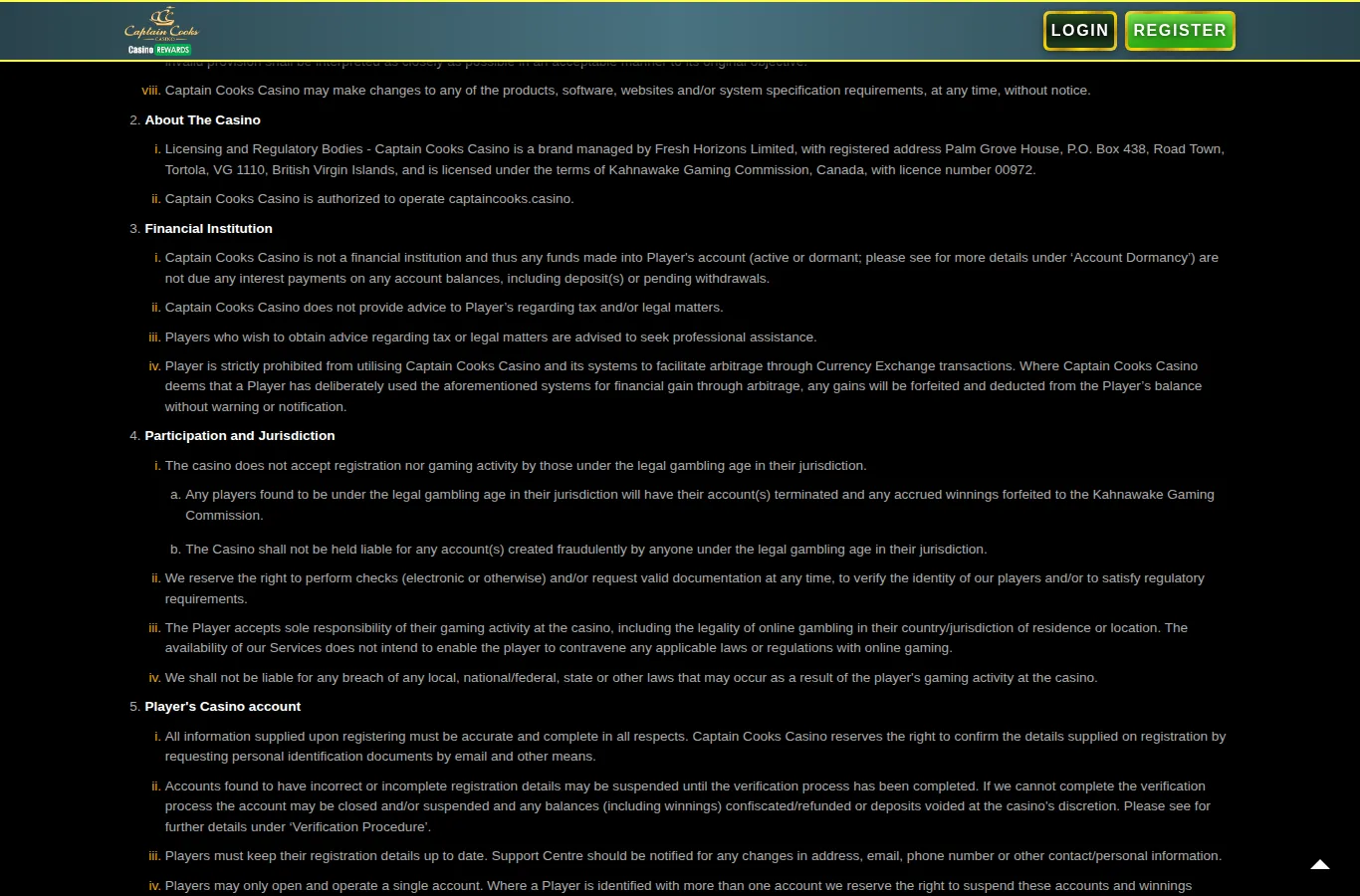
The screenshot above is what a transparent licence clause looks like: the Captain Cooks terms name Fresh Horizons Limited, its Tortola address and Kahnawake licence number 00972.
Regulated vs Offshore: What Safe Means in Canada
A regulated site is one your province conducts and manages, or licenses, under s.207 of the Criminal Code; an offshore site holds a licence from somewhere else. That single difference decides who you can complain to, which self-exclusion program covers you, and who audits the operator. Is online gambling legal in Canada? explains the legal background in more depth.
Ontario: iGaming Ontario and the AGCO
The AGCO registers and regulates operators under the Registrar’s Standards for Internet Gaming, and iGaming Ontario conducts and manages the market. Players must be 19+ and physically in Ontario. The official list lives at igamingontario.ca; if a site isn’t on it, it isn’t regulated in Ontario.
Alberta: AGLC and the AiGC
AGLC regulates and the Alberta iGaming Corporation conducts and manages. Every registered site must plug into AGLC’s centralized self-exclusion program, so one request covers all of them. The AiGC says it plainly: if an operator isn’t in its directory, it isn’t regulated. Check the AiGC registered sites list before you sign up anywhere.
Quebec: Loto-Québec
Loto-Québec is the only provincially authorised online operator. Its site checks your location and requires you to be 18+. Its self-exclusion runs from three months to five years, plus a shorter game break of 1 to 89 days, but it only covers Loto-Québec, not private sites.
BC, Manitoba and Saskatchewan: PlayNow
PlayNow.com is run by BCLC, with Manitoba Liquor & Lotteries in Manitoba and in Saskatchewan since 2022. Ages are 19+ in BC and Saskatchewan and 18+ in Manitoba.
Atlantic Canada: ALC
New Brunswick, Nova Scotia, PEI and Newfoundland and Labrador use the Atlantic Lottery Corporation’s government online offering. Legal age there is 19+.
| 🛡️ Protection | 🏛️ Regulated provincial site | 🌐 Offshore site |
|---|---|---|
| Who licenses it | Your province (AGCO/iGO, AGLC/AiGC, Loto-Québec, BCLC, ALC) | Kahnawake, Curaçao GCB, Anjouan or another body |
| Who handles a dispute | The operator, then the provincial regulator | The operator, then its licensing body or named ADR service |
| Self-exclusion reach | Province-wide program (e.g. AGLC centralized program in Alberta) | Only that operator or network, unless it links a licensing-body program |
| Bonus advertising | Restricted in Ontario (Standard 2.05) and Alberta (Standard 4.1) | Offers advertised freely |
| Age | 19+ (18+ in Alberta, Manitoba, Quebec) | Set by the operator’s terms, often 18+ |
| Location check | Must be physically in the province | Varies; many exclude Ontario and Alberta in their terms |
In short, regulated sites trade bigger bonuses for a regulator who can act on your behalf; offshore sites reverse that trade.
Offshore Licences Explained: Kahnawake, Curaçao, Anjouan
An offshore licence tells you which body can, at least in principle, discipline the operator; it doesn’t make the site regulated by your province. The three licences that appear most often on Canadian-facing offshore sites work quite differently.
Kahnawake Gaming Commission
The Kahnawà:ke Gaming Commission describes itself as the licensing and regulating authority for gaming activity within and from the Mohawk Territory of Kahnawà:ke, near Montréal. It issues interactive gaming licences and Client Provider Authorizations (CPAs). Several Casino Rewards sites link a KGC certificate page from their footer and list complaints@gamingcommission.ca as an escalation route. You can read about the commission at gamingcommission.ca.
Curaçao Gaming Control Board (GCB)
The Curaçao GCB issues OGL licences under its newer framework. A current licence number looks like OGL/2024/589/0556, the number Need for Spin, Rolling Slots, Winshark and Wild Tokyo all display for their shared operator, GBL Solutions N.V.
Anjouan
The Government of the Autonomous Island of Anjouan (Union of Comoros) issues licences too. BC.Game shows licence ALSI-202410011-FI1 and names Twocent Technology Limited, a Belize company, as operator.
When No Licence Is Named
Some sites we read did not name a licence at all on the pages available to us. That doesn’t prove anything sinister, but it removes your escalation route: if you can’t name the licensing body, you can’t complain to it.
| 📜 Licence | 🏛️ Issued by | ⚖️ Your escalation route | 🔎 How to check it |
|---|---|---|---|
| Kahnawake (KGC) | Kahnawà:ke Gaming Commission | Operator, then KGC; some brands also name eCOGRA as ADR | Footer certificate link to certificates.gamingcommission.ca |
| Curaçao GCB (OGL) | Curaçao Gaming Control Board | Operator, then the GCB | OGL number in the footer or About page |
| Anjouan (ALSI) | Government of Anjouan, Union of Comoros | Operator, then the Anjouan licensing authority | Licence page on the casino site |
| Ontario (iGO/AGCO) | Provincial | Operator, then AGCO/iGO | iGaming Ontario’s regulated-market list |
| Alberta (AGLC/AiGC) | Provincial | Operator, then AGLC | AiGC registered-sites directory |
The more of the right-hand column you can actually complete for a site, the safer your money is when a dispute comes up.
Transparency Check: 22 Offshore Brands Compared
This table lists every offshore brand we review, with the licence, whether the operating company is named, and the dispute route, using only what the operators’ own pages said in October 2026. All of them are offshore: none is regulated by your province.
| 🎰 Casino | 📜 Licence | 🏢 Operator named? | ⚖️ Dispute route | ⭐ Our rating |
|---|---|---|---|---|
| Stake | Not stated on the pages we read (help centre only) | Not stated on the pages we read | Not stated on the pages we read | 94/100 |
| BC.Game | Anjouan ALSI-202410011-FI1 | Yes: Twocent Technology Limited (Belize) | Operator, then Anjouan licensing body | 93/100 |
| Roobet | Not stated on the pages we read | Not stated on the pages we read | Not stated on the pages we read | 92/100 |
| 22Casino | Kahnawake 01056 | Yes: Starsten Ltd. (BVI) | Operator, then KGC | 91/100 |
| Vave | Not stated on the pages we read | Not stated on the pages we read | Not stated on the pages we read | 90/100 |
| TonyBet | Kahnawake 00902 (Canada excl. ON & AB) | Yes: Tonybet OÜ (Estonia) | Operator, then KGC | 89/100 |
| Casino Days | Kahnawake CPA 01054 | Yes: Indigo Nova Limited (Cyprus) | Operator, then KGC | 88/100 |
| Kingmaker | Not stated on the pages we read | Not stated on the pages we read | Not stated on the pages we read | 87/100 |
| Need for Spin | Curaçao GCB OGL/2024/589/0556 | Yes: GBL Solutions N.V. | Operator, then GCB | 86/100 |
| Rolling Slots | Curaçao GCB OGL/2024/589/0556 | Yes: GBL Solutions N.V. | Operator, then GCB | 85/100 |
| Winshark | Curaçao GCB OGL/2024/589/0556 | Yes: GBL Solutions N.V. | Operator, then GCB | 84/100 |
| Golisimo | Not stated on the pages we read | Not stated on the pages we read | Not stated on the pages we read | 83/100 |
| Wild Tokyo | Curaçao GCB OGL/2024/589/0556 | Yes: GBL Solutions N.V. | Operator, then GCB | 82/100 |
| Luxury Casino | Kahnawake 00972 | Yes: Fresh Horizons Limited (BVI) | eCOGRA ADR; KGC complaints | 78/100 |
| Golden Tiger | Kahnawake 00972 | Yes: Fresh Horizons Limited (BVI) | eCOGRA ADR; KGC complaints | 77/100 |
| Grand Mondial | Kahnawake 00972 | Yes: Fresh Horizons Limited (BVI) | eCOGRA ADR; KGC complaints | 76/100 |
| Zodiac Casino | Kahnawake 00972 | Yes: Fresh Horizons Limited (BVI) | eCOGRA ADR; KGC complaints | 76/100 |
| Yukon Gold | Kahnawake 00972 | Yes: Fresh Horizons Limited (BVI) | eCOGRA ADR (6-month limit); KGC complaints | 75/100 |
| Captain Cooks | Kahnawake 00972 | Yes: Fresh Horizons Limited (BVI) | eCOGRA ADR; KGC complaints | 75/100 |
| Casino Classic | Kahnawake 00972 | Yes: Fresh Horizons Limited (BVI) | eCOGRA ADR; KGC complaints | 74/100 |
| Quatro Casino | Kahnawake 00972 | Yes: Fresh Horizons Limited (BVI) | eCOGRA ADR (6-month limit); KGC complaints | 73/100 |
| Everygame | Not stated on the pages we read | Not stated on the pages we read | Footer links the Central Dispute System (CDS) | 70/100 |
Our overall rating weighs games, payments and bonuses as well as transparency, which is why a high score and a blank licence column can sit on the same row.
How to Read This Table
“Not stated on the pages we read” means exactly that: the terms, footer, About and help pages we opened did not show the item. For Stake and Roobet we could only read the help centres, because the main sites blocked automated access. Kingmaker’s and Golisimo’s terms and footers don’t name the operating company or a gaming licence (checked October 2026). Vave’s FAQ calls it “a reputable, licensed platform”, yet no issuer or number appeared on any page we fetched.
Same Brand, Different Licence
Several names appear twice in Canada. The Casino Rewards brands (Zodiac, Luxury, Grand Mondial, Golden Tiger, Yukon Gold, Captain Cooks, Casino Classic) run separate Ontario and Alberta sites through Apollo Entertainment Limited; the rest-of-Canada sites in our table are the Kahnawake versions. Casino Days, TonyBet and Stake also appear in Alberta’s AiGC directory. If you live in Ontario or Alberta, use the provincially registered version, never the offshore one.
Most Transparent Licensed Offshore Casinos
On transparency alone, the strongest offshore brands are the ones that name the company, show a checkable licence number and publish their limits. Here is what stands out for each group, based on terms verified on the operators’ sites in October 2026.
Best for Dispute Resolution: Casino Rewards Sites
Zodiac, Luxury, Grand Mondial, Golden Tiger, Yukon Gold, Captain Cooks, Casino Classic and Quatro all name Fresh Horizons Limited, hold Kahnawake licence 00972, name eCOGRA as their alternative dispute resolution service and list complaints@gamingcommission.ca. Their RNG is reviewed by eCOGRA, and PlayCheck shows your game history. The trade-offs are real: 200x wagering on the first and second deposit bonuses, a 48-hour pending period, a C$50 minimum withdrawal and a $4,000 weekly cap for players whose winnings far exceed their deposits.
- Up to C$480 on deposits 2–5
- Mega Moolah jackpots
- Casino Rewards VIP points
Best for Clear Payment Terms: Casino Days
Casino Days names Indigo Nova Limited (Cyprus, HE490808) and Kahnawake CPA 01054, links its KGC certificate, and spells out KYC before your first withdrawal: photo ID, proof of address dated within three months, and proof of payment method. Default withdrawal limits are published (EUR 5,000 a day, 20,000 a week, 50,000 a month), Interac works both ways with a C$10 minimum withdrawal, and you can set deposit, loss and wager limits inside your account.

- Interac Payouts From C$10
- 6,500+ Games, 1,000+ Live
- iOS and Android Apps
TonyBet: Licence Scope Spelled Out
TonyBet names Tonybet OÜ (Estonia) and Kahnawake licence 00902, and its terms say the Kahnawake licence covers Canada excluding Ontario and Alberta. That kind of honesty about scope is a good sign. You get deposit and loss limits, time-outs, self-exclusion from six months to three years, a link to the KGC self-exclusion program and a 48-hour cooling-off on limit increases.
22Casino: Named Operator, Newer Licence
22Casino names Starsten Ltd. (BVI, company 2174149) and Kahnawake licence 01056, issued on May 13, 2026. Its responsible-gambling tools include deposit limits with a 24-hour wait to raise them and self-exclusion for up to five years. One mismatch worth knowing: the homepage promises instant withdrawals, while the terms allow payment within 30 calendar days.
GBL Solutions Sites: Need for Spin, Rolling Slots, Winshark, Wild Tokyo
All four name GBL Solutions N.V. (Curaçao, registration 155090) and Curaçao GCB licence OGL/2024/589/0556. They offer Take a Break, Reality Check reminders at 60, 90 or 180 minutes and two-factor authentication, and three of them publish withdrawal caps by loyalty level. The fine print is stricter than average, as the withdrawal section below shows.
7 Safety Signals We Check on Every Site
A safe offshore casino passes most of these seven checks; a site that fails three or more is not one we would trust with a deposit. These checks feed directly into the licence and transparency score in how we rate casinos.
1. The Operating Company Is Named
A full company name, registration number and address belong in the footer or terms. Casino Days, 22Casino, TonyBet, BC.Game, the GBL sites and the Casino Rewards brands all pass.
2. The Licence Number Can Be Checked
A number alone is good; a link to the regulator’s certificate is better. Casino Days and several Casino Rewards sites link a certificate page at certificates.gamingcommission.ca.
3. One Version of the Terms
Conflicting figures on the same site are a warning. We found welcome-pack totals on several sites that didn’t add up between the homepage and the promotions page. Always trust the bonus terms over the banner.
4. Withdrawal Caps Are Published
You should know the daily, weekly and monthly caps before you win, not after. Casino Days, Need for Spin, Rolling Slots and Wild Tokyo publish theirs; the Casino Rewards sites publish the $4,000 weekly cap rule.
5. KYC Is Explained Up Front
Good terms list the documents, the deadline and what happens if you miss it. TonyBet gives you seven calendar days; the GBL sites give you 30 days; Vave gives you 14 days.
6. Responsible-Gambling Tools Are Self-Service
Limits you can set yourself, instantly, are safer than limits you have to request by email. Casino Days says you can set deposit, loss and wager limits within your account, and Stake’s help centre says limit decreases apply immediately while increases wait 24 hours.
7. An Independent Complaints Route Exists
eCOGRA ADR (Casino Rewards sites), a licensing-body complaints address, or at least a named regulator. Everygame’s footer links the Central Dispute System, though no licence was named on the pages we read.
Pro Tip:
Open the terms page and search for the words “licence”, “withdrawal” and “dormant” before you register. Three searches take two minutes and show you most of what matters.
Withdrawal Limits and KYC: Where Safe Sites Differ
Most offshore complaints come down to withdrawals, and most withdrawal problems come down to verification and caps. A safe casino tells you both before you deposit. Here is what each group’s terms say, as verified on the operators’ sites in October 2026.
| 🎰 Casino | 💸 Min withdrawal | 📊 Published caps | 🪪 KYC rule |
|---|---|---|---|
| Casino Days | C$10 (Interac) | EUR 5,000/day, 20,000/week, 50,000/month | Photo ID, address proof (3 months), payment proof before first withdrawal |
| Casino Rewards sites | C$50 | $4,000/week when winnings far exceed deposits | ID, proof of residence, payment ownership; may need notarising |
| Need for Spin | C$15 bank / C$30 other / C$80 crypto | C$750 per day, C$10,500 per month (levels 1-10) | Documents within 30 days or winnings confiscated |
| Rolling Slots | C$15 bank / C$30 other / C$80 crypto | C$750 per day, C$15,000 per month (levels 1-10) | Documents within 30 days or winnings confiscated |
| Wild Tokyo | C$15 bank / C$30 other / C$80 crypto | C$750 per day, C$12,000 per month (levels 1-22) | Documents within 30 days; verification up to 72 hours |
| TonyBet | Set per method | Not stated on the pages we read | Documents at first withdrawal; 7 days or request rejected |
| Stake | C$5 (cards) | C$5 to C$3,000 per card transaction | ID before first withdrawal |
| Vave | Depends on method | Wins of 50,000 USDT+ may be paid in parts over 30 days | Verification within 14 days or account terminated |
The lower the monthly cap, the longer a big win takes to reach you, so check this row before chasing a jackpot.
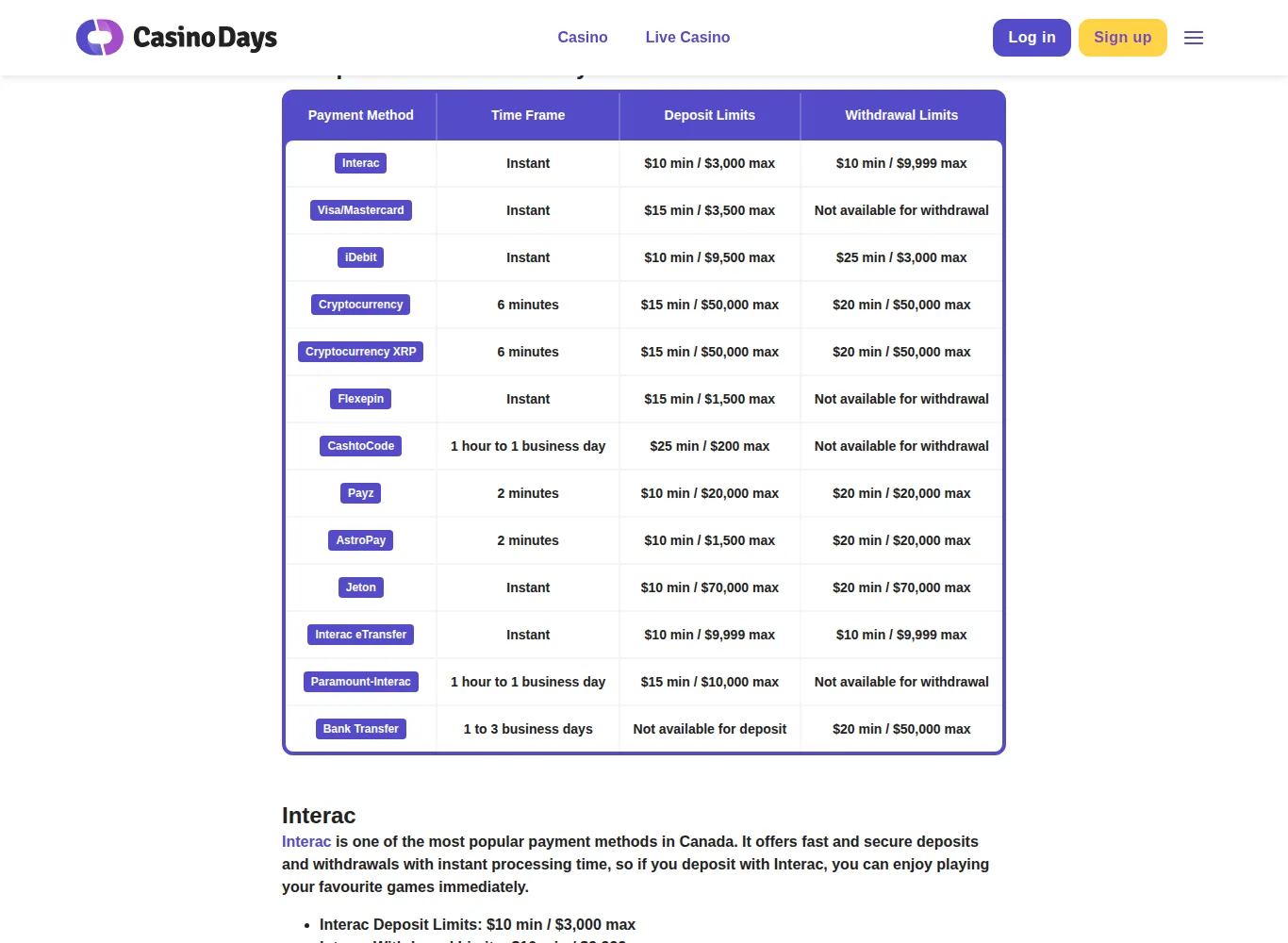
Casino Days’ payments page, pictured above, lists methods with their minimums in one place, which is the level of clarity we look for.
Why KYC Protects You
Identity checks feel like friction, but they also stop someone else withdrawing your balance. The safest approach is to verify right after signing up, before you have a balance waiting. Stake, for example, requires identity verification before the first withdrawal and email verification before the first CAD deposit.
Deadlines That Can Cost You Winnings
The GBL sites say documents are due within 30 days or winnings are confiscated, and payouts above EUR 2,000 in 24 hours or EUR 2,300 in total are held until you’re verified. TonyBet returns the funds to your balance if you miss its seven-day window. Read the deadline, then diarise it.
Fees That Catch Players Out
The GBL terms allow up to a 10% commission if you withdraw after wagering less than 3x your deposit. TonyBet charges a C$7 monthly fee on dormant accounts; Rolling Slots and Wild Tokyo charge EUR 10 a month after six months of inactivity. None of these is hidden, but all of them are easy to miss. Our fast withdrawal casinos guide compares processing times.
Responsible Gambling Tools Compared
The safest offshore sites let you set limits yourself, apply decreases instantly and delay increases. Here is how the main groups compare.
| 🎰 Casino | 🎚️ Limits | ⏸️ Cooling-off | 🚫 Self-exclusion | 🖱️ How you set it |
|---|---|---|---|---|
| Casino Days | Deposit, loss, wager | Yes | Min. 6 months | In account (exclusion via support) |
| TonyBet | Deposit, loss | Time-out | 6 months to 3 years; KGC program | 48h cooling-off on limit increases |
| 22Casino | Deposit (day/week/month) | Yes | Up to 5 years | 24h wait to raise; requests by email or chat |
| Casino Rewards sites | Deposit (day/week/month) | 24 hours to 6 weeks | 6 months, irreversible; KGC program | Via support |
| GBL Solutions sites | Personal limits | Take a Break (1 day to 1 week) | Indefinite, by email | Personal limits settings; Reality Check reminders |
| Stake | Deposit, loss, wager | Break In Play | Indefinite, min. 6 months | In account; decreases immediate |
| Roobet | Wager, loss, deposit | 24-hour time-out | 1 day to permanent | Up to 3 limits active at once |
| Vave | Deposit, loss, wager | 1 week to 6 months | 6 months to 1 year; indefinite via support | Permanent closure via support |
Self-service tools win on safety because they work at 2 a.m., when you most need them and support may be slowest.
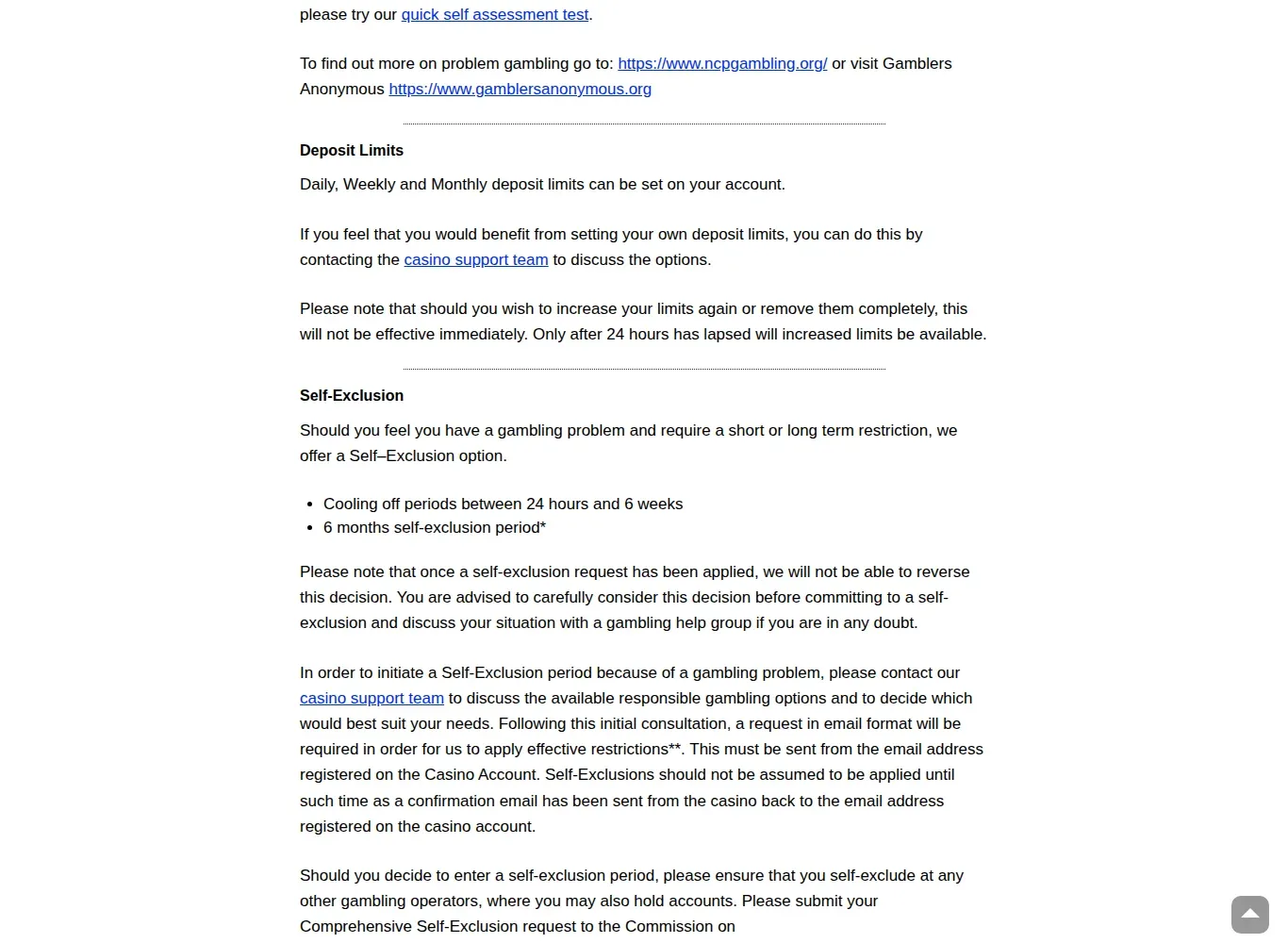
Zodiac’s responsible gambling page, shown above, lists cooling-off periods of 24 hours to six weeks and a six-month self-exclusion, both arranged through support.
Self-Service vs On Request
On the Casino Rewards sites, limits and exclusions are arranged by contacting support rather than set in the public pages, and increases take effect after 24 hours. That works, but it adds a step at exactly the wrong moment.
How Long Self-Exclusion Lasts
Terms range from Roobet’s one day to permanent, to TonyBet’s six months to three years and 22Casino’s up to five years. The Casino Rewards six-month exclusion is irreversible once applied, which is a protection, not a flaw.
Provincial Self-Exclusion Programs
Offshore exclusions only cover that operator or network. Alberta’s AGLC program covers every registered Alberta site at once; Loto-Québec’s covers its own site and venues. More options are listed on our responsible gambling page.
Red Flags That Should Stop You
Walk away, or at least deposit very little, if a site shows any of these warning signs. Each one below comes from patterns we saw while reading Canadian-facing casino terms in October 2026.
No Company Name Anywhere
If neither the footer nor the terms name an operator, you have nobody specific to hold to account. A copyright line alone is not enough.
“Licensed” With No Licence
A claim like “reputable, licensed platform” with no issuer or number is a statement you can’t verify. Ask support for the licence number in writing before depositing.
Numbers That Don’t Match
When the homepage, promotions page and terms give different bonus totals or withdrawal times, the terms win, and the mismatch tells you how carefully the site is maintained.
Marketing Built Around Location Workarounds
Winshark’s homepage SEO text calls the site “VPN friendly”. We treat that wording as a warning sign. Never change your apparent location to reach a casino; if your province has a regulated market, use it.
Extreme Wagering or Low Cash-Out Caps
200x wagering on a deposit bonus, as on the Casino Rewards first and second deposits, means a C$100 bonus needs C$20,000 in bets. Kingmaker and Golisimo cap deposit-bonus withdrawals at 10x the bonus by default. Our wagering requirements guide shows the maths.
Fees and Dormancy Rules
Monthly dormant-account fees, withdrawal commissions and balances voided after long inactivity (Everygame’s terms say 18 months) all reduce what you get back. Withdraw idle balances instead of leaving them on the site.
Watch out:
If a site’s terms page won’t load, is cut off, or contradicts itself on the licence, that is reason enough to skip it, however good the bonus looks.
What Reddit Users Complain About (and Why)
Search “best online casino canada reddit” and the same complaint themes come up again and again. We don’t quote individual threads, but the patterns line up closely with the terms clauses covered above. If those same patterns are what you’re wary of, our montreal online casino guide walks through the terms clauses above so you know what to check before signing up.
Slow or Stalled Withdrawals
The most common gripe. Usually the cause is a pending period (48 hours on Casino Rewards sites), weekday-only processing (GBL sites work Monday to Friday, 09:00 to 18:00 GMT+3) or verification that started only after the withdrawal request.
Voided Bonus Winnings
Breaking a max-bet rule, such as C$7 with bonus funds on the GBL sites or $10 at Casino Days, can wipe bonus winnings. Players often learn the rule after the fact.
Accounts Closed After Verification
Missed document deadlines, mismatched payment ownership or a second account usually trigger these. Clear KYC terms let you avoid most of them.
Support That Goes in Circles
Complaints escalate when there’s no route beyond live chat. That is exactly why a named ADR service or licensing-body address matters before you sign up.
How to Handle a Dispute With an Offshore Casino
With an offshore site, you resolve a dispute with the operator first and its licensing body or ADR service second; your province cannot step in. Keep it orderly:
- Save evidence: screenshots of your balance, the bonus terms in force and every chat transcript.
- File a written complaint with the operator by email, quoting the exact terms clause.
- Allow the operator’s stated response time, then ask for a final answer in writing.
- Escalate to the ADR service or licensing body named in the terms.
- Watch the time limit: Quatro and Yukon Gold give six months for eCOGRA complaints.
Step One: The Operator
Use the support email from the terms, not only live chat, so there’s a dated record. Zodiac says it aims to answer emails within 48 hours; Casino Days aims for 24 hours.
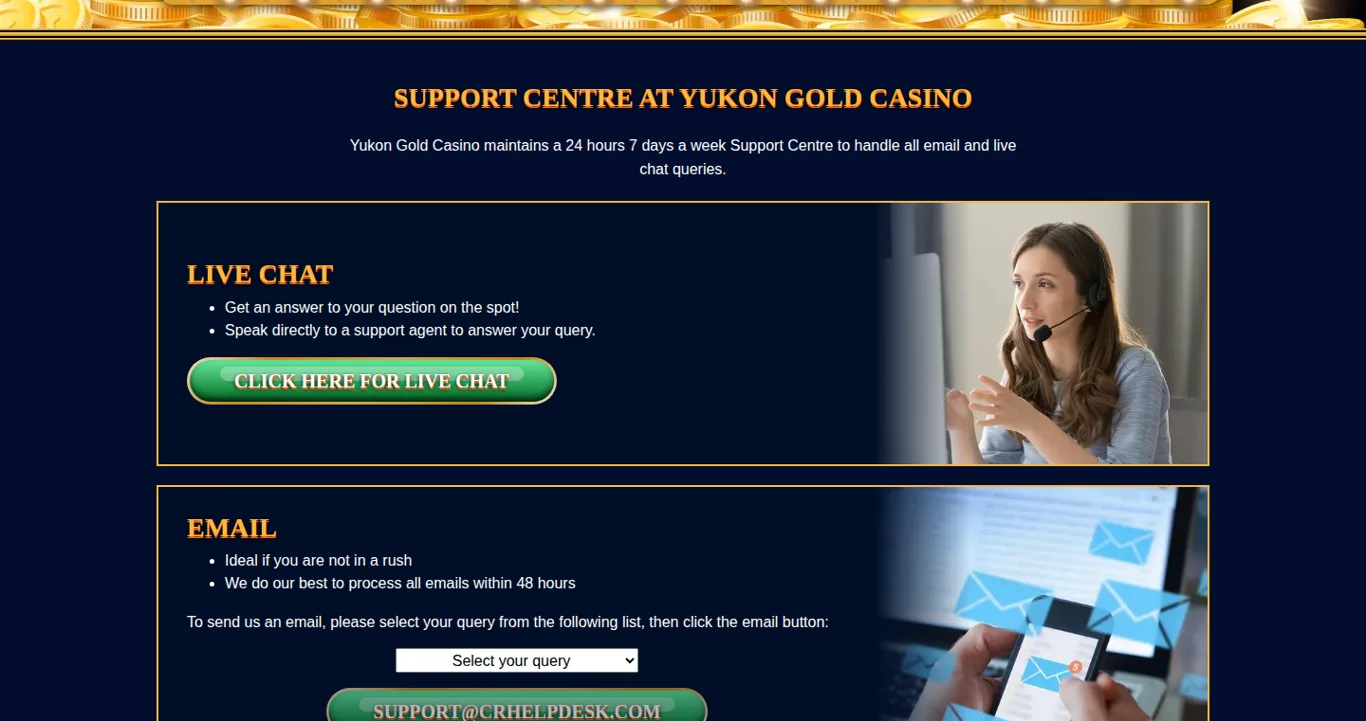
The Yukon Gold support page above lists its contact options; keep that page bookmarked before you need it.
Escalating to ADR or the Licensing Body
Casino Rewards sites name eCOGRA as ADR and complaints@gamingcommission.ca. For Curaçao-licensed GBL sites the licensing body is the GCB. Where no licence is named, you have no regulator to escalate to, which is the strongest argument for choosing transparent sites.
What Your Province Can’t Do
A provincial regulator can’t resolve a dispute with an offshore operator. That’s not a technicality; it’s the main practical difference between regulated and offshore play.
Safe Casino Checklist Before You Deposit
Run through this list in five minutes before you deposit anywhere offshore.
Five-Minute Pre-Deposit Check
- Find the operator and licence in the footer or terms; click any certificate link.
- Confirm your province isn’t excluded; if you live in Ontario or Alberta, go to the regulated list instead.
- Read the withdrawal section: minimum, caps, pending time, fees.
- Read the KYC section: documents and deadlines.
- Check the bonus terms: wagering, max bet, max cash-out.
- Locate the RG tools and the dispute route.
Right After You Sign Up
- Set a deposit limit before your first deposit.
- Upload your verification documents straight away.
- Use a payment method in your own name; see our Interac casinos guide for Canadian options.
- Turn on two-factor authentication where offered (the GBL sites have it).
Staying Safe: Age, Help Lines and Taxes
Safe play also means playing at the legal age, knowing where to get help and understanding the tax position.
Legal Age by Province
19+ in most provinces and territories, including Ontario; 18+ in Alberta, Manitoba and Quebec.
Free, Confidential Help Lines
- ConnexOntario: 1-866-531-2600
- Alberta Addiction and Mental Health Helpline: 1-866-332-2322 (or call 211)
- Quebec Gambling: Help and Referral: 1-800-461-0140
- BC Problem Gambling Help Line: 1-888-795-6111
- Manitoba: 1-800-463-1554 · Saskatchewan: 1-800-306-6789
- New Brunswick: 1-800-461-1234 · PEI: 1-855-255-4255 · Newfoundland and Labrador: 1-888-899-4357
Taxes on Winnings
Recreational gambling winnings are generally treated as windfalls and aren’t taxed in Canada; people in the business of gambling may be taxed, and interest earned on winnings is taxable.
Disclosure and How We Checked
The offshore casinos on this page are not regulated by your province. If you live in Ontario or Alberta, use your province’s regulated sites: see our Ontario and Alberta guides. Quebec residents can use Loto-Québec. If a dispute arises with an offshore site, you deal with the operator and its licensing body, not your province.
How We Checked
We read each operator’s terms, footer, payments, KYC and responsible-gambling pages from a Canadian IP in October 2026 and captured screenshots. We did not open real-money accounts. Where a fact wasn’t on the pages we read, we say so rather than guess.
What Makes an Online Casino Reputable in Canada
“Reputable” is one of the most overused words in casino marketing. Almost every site calls itself trusted, secure or reputable, and none of those words carries any legal weight. In Canada, reputation means something narrower and more useful: can you identify who runs the site, can you confirm who licenses it, and is there someone outside the operator who will hear you if something goes wrong?
Reputation in this sense is not about how big a brand is or how long it has advertised. It is about accountability. A small site with a named operator, a checkable licence and clear terms can be more reputable, in the way that matters to your money, than a famous name whose terms are vague. The signals below are the ones that hold up when you check them:
- A named legal entity. The company that holds your balance and owes you your winnings, not just a brand name.
- A licence you can trace. A licence number or registration that appears on the regulator’s own website, not only on the casino’s.
- Terms that agree with each other. The licence clause, the withdrawal rules and the bonus terms should not contradict one another.
- A route beyond the operator. An independent complaints body or a licensing authority that accepts player complaints.
- Self-service protection tools. Limits and exclusions you can set yourself without arguing with support.
Reputation vs Regulation
For players in Ontario and Alberta, the strongest form of reputation is already decided for you: the provincial list. A site on iGaming Ontario’s list or the AiGC directory answers to a Canadian regulator, which is a different category of accountability from anything an offshore site can offer. The AGCO’s own overview of its role alongside iGaming Ontario puts the number of operators in Ontario’s market at 49; because one operator can run several websites, that figure is lower than the count of websites on iGaming Ontario’s list.
Outside those two provinces, the legal option is the provincial lottery site, and offshore casinos operate in a space that no Canadian province regulates. That does not make every offshore casino disreputable, but it shifts the burden of checking onto you. The table below separates claims that sound reassuring from evidence that actually protects you.
| What the site says | What it proves on its own | What to look for instead |
|---|---|---|
| “Trusted by thousands of players” | Nothing you can verify | A named operating company in the terms |
| “Fully licensed and regulated” | Nothing until you see which licence | A licence number and the authority that issued it |
| “Safe and secure” | Usually refers only to encryption | Clear KYC, withdrawal and dispute rules |
| “Fast payouts” | A marketing promise, not a term | Published processing times and withdrawal caps |
| Logos of regulators in the footer | An image anyone can paste | A clickable link to a register entry on the regulator’s domain |
| “Award-winning casino” | Recognition from an industry body, not a player safeguard | Licence, terms and complaints route |
Where to Verify Each Claim
Every credible claim on a casino site points somewhere you can check it. If a claim points nowhere, treat it as advertising. Use this as a quick map of where each piece of evidence should live.
| Claim | Where it should appear on the casino site | Where to confirm it independently |
|---|---|---|
| Provincially regulated (Ontario) | Footer and terms, with the Ontario-specific domain | iGaming Ontario’s list at igamingontario.ca |
| Provincially regulated (Alberta) | Footer and terms | The AiGC directory |
| Kahnawake licence | Licence clause in the terms | The Kahnawake Gaming Commission’s list of permit holders |
| Curaçao licence | Licence clause or footer seal | The Curaçao Gaming Control Board’s register |
| Anjouan licence | Licence clause or footer seal | The licensing authority’s own site |
| Operating company | First paragraphs of the terms and conditions | Cross-check the same name across the licence entry |
| Complaints route | Complaints or dispute section of the terms | The ADR body’s or licensing body’s own complaints page |
Rule of thumb: if verifying a site’s reputation requires you to trust the site itself, you haven’t verified anything. Every claim that matters should lead to a page the casino does not control.
Reputation Is Brand-by-Brand, Licence-by-Licence
One trap is assuming that reputation transfers. A brand that is regulated in Ontario may run a separate offshore version for other provinces under a different licence, a different operator, or different terms. What applies to one version does not automatically apply to the other. When you judge a site, judge the exact domain you are about to deposit on, under the exact terms shown to you from your location.
- Note the full domain in your browser bar, including country-code endings.
- Open the terms from that domain, not from a review or a cached copy.
- Check that the operator named in those terms matches the licence entry.
- Save a copy or screenshot of the terms on the day you register.
Casino Days: How to Check the Safety Claims Yourself
Earlier in this guide, Casino Days stands out for clear payment terms. That assessment rests on what its own pages said when they were read in October 2026, and terms can change. The more useful skill is knowing how to confirm, on the day you visit, that the things that made a site look safe are still there. The same method works for every brand in the transparency table above.
Clear payment terms matter because payments are where most offshore disputes start. A site that writes its withdrawal rules plainly is giving you something you can hold it to later. A site that hides them behind vague phrases such as “at our discretion” or “subject to review” is keeping its options open at your expense.
What “Clear Payment Terms” Should Mean in Practice
- Withdrawal caps are stated as amounts in CAD, per day, week or month, not as “limits may apply”.
- Processing times are stated for each step: pending, review and payment.
- Any fees are named, with the conditions that trigger them.
- The documents needed for verification are listed before you deposit.
- The rules on returning funds to the deposit method are explained.
- The consequences of an incomplete verification are spelled out.
When you open a site’s payment page, you should be able to answer every item on that list without contacting support. If you cannot, the terms are not clear, whatever the brand’s reputation. The table below turns that into a step-by-step check you can run on Casino Days or any other offshore site in a few minutes.
| Step | Page to open | What a clear answer looks like | Warning sign |
|---|---|---|---|
| 1 | Terms and conditions, opening clauses | Operating company named, with registered address | Only the brand name appears |
| 2 | Licence clause or footer | Licensing authority and licence number | “Licensed” with no authority or number |
| 3 | Payments or banking page | Methods listed with minimums, maximums and times | “Varies” or “contact support” |
| 4 | Withdrawal section of the terms | Caps stated in CAD per period | Caps that change by “VIP status” with no table |
| 5 | KYC or verification section | Document types and when they are requested | “We may request any documents” |
| 6 | Responsible gambling page | Tools you can set in your account | “Email us to request limits” |
| 7 | Complaints section | Internal steps, then an external body | No external route at all |
Re-Checking After Terms Change
Offshore operators update their terms, sometimes quietly. A site that was transparent last month may have changed its withdrawal rules, its licence, or even its operating company. This is not unusual in the offshore market, where licences are renewed, transferred or replaced. The fact that a guide once praised a site is a starting point, not a guarantee.
Before every larger deposit: reopen the terms, check the “last updated” date, and compare the licence clause and withdrawal caps with what you saved when you signed up. If something changed, read the new version before you play.
- Look for a version number or “last updated” date near the top of the terms.
- Compare the operating company with the one you saw at registration.
- Check whether the licence authority or number has changed.
- Re-read the withdrawal and bonus sections, since these change most often.
Clear Terms Are Necessary, Not Sufficient
Clear payment terms tell you what the operator promises. They do not tell you whether a Canadian authority will enforce those promises, because for offshore sites none will. That is why clarity sits alongside the other signals in this guide rather than replacing them. A site that is clear about payments but has no external complaints route still leaves you dependent on the operator’s goodwill.
Is a Big International Brand Automatically Safe?
Many Canadian players assume that a household name in online gambling must be safe everywhere it operates. The reasoning feels sensible: a large, established company has a reputation to protect. But a brand name is not a licence, and a famous logo can sit on top of several different legal arrangements depending on where you are logging in from.
The question to ask about any well-known brand is not “is this brand safe?” but “which company runs the version I can access, and under which licence?” The answer can differ between Ontario and the rest of Canada, and sometimes between one domain and another.
Brand Name vs Legal Entity
| Layer | What it is | Why it matters to you |
|---|---|---|
| Brand | The name and logo you see in ads and on the site | Tells you nothing legal on its own |
| Domain | The exact web address you are using | Different domains can carry different terms |
| Operating company | The legal entity named in the terms | This is who owes you your balance |
| Licence | The authorization held by that company | Decides who you can complain to |
| Jurisdiction of the terms | The law that governs your contract | Decides where a legal dispute would be heard |
In Ontario, the regulated version of a brand appears on iGaming Ontario’s list. If a brand you know is on that list, the Ontario version is the one to use if you are physically in Ontario and 19+. If you are elsewhere in Canada and the same brand is available to you, you are almost certainly looking at a different arrangement, and the protections of Ontario’s framework do not travel with the logo. The rules don’t transfer between provinces.
Questions to Ask of Any Famous Brand
- Is the version I’m seeing the one listed by my province, or a separate site?
- Which company is named in the terms on this exact domain?
- Is that company the same one that holds the licence shown?
- Does the site redirect me to a different domain based on my location?
- Are the self-exclusion and complaints rules the same as on the regulated version?
| Situation | What it usually means | What to do |
|---|---|---|
| Brand is on iGaming Ontario’s list and you’re in Ontario | Ontario-regulated version available | Use the listed site, confirm the domain matches |
| Brand is in the AiGC directory and you’re in Alberta | Alberta-regulated version available | Use the listed site, confirm the domain matches |
| Same brand opens for you in another province | Likely a separate offshore arrangement | Read that site’s licence clause from scratch |
| Site names a different company than the regulated version | Different legal entity, different obligations | Judge it as a separate casino |
| Site names no company at all | Accountability unclear | Treat it as a red flag, whatever the brand |
Why Size Doesn’t Replace Checking
Large operators often do have mature compliance teams, published policies and strong security. That is a reasonable starting assumption. But a large company is also more likely to run multiple licences in multiple markets, which makes it more important, not less, to know which one applies to you. The famous name is the reason to look closer, not the reason to stop looking.
Plain answer: a well-known brand is as safe as the specific licence, operator and terms behind the version you use. In Ontario and Alberta, that means the version on the provincial list. Everywhere else, read the terms as if you’d never heard of the brand.
Responsible Gaming Tools as a Safety Test
The quality of a site’s responsible gaming tools is one of the most revealing safety signals available, because it shows whether the operator is willing to make it easier for you to spend less. A site that buries its limit settings, or requires you to email support to set them, is telling you something about its priorities. A site that puts them a click or two from your account menu is telling you something else.
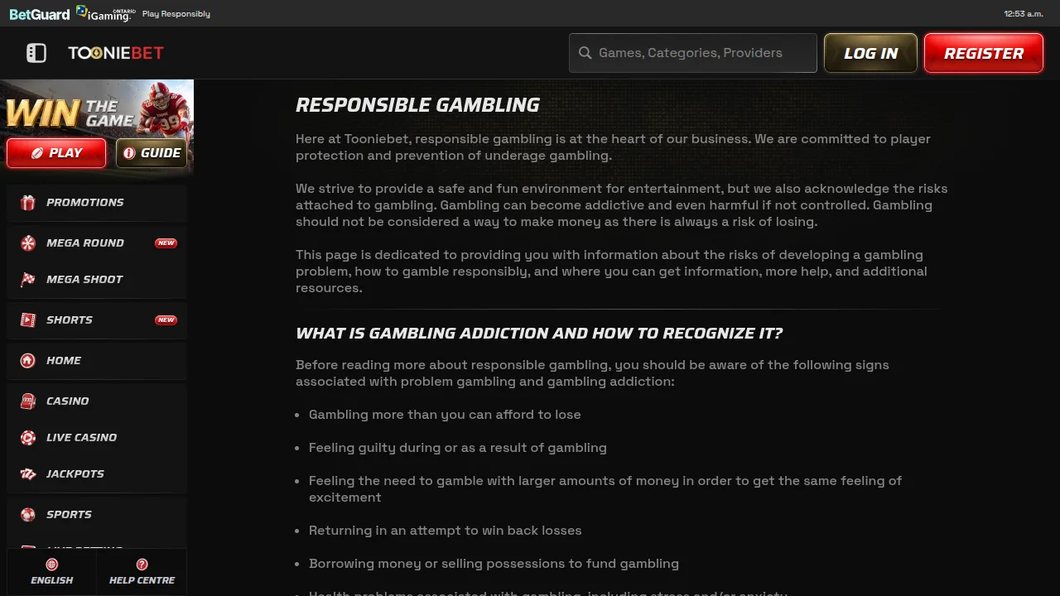
Earlier sections compare which brands offer self-service tools and how long exclusions last. This section looks at what each tool actually does, how well-designed tools behave, and how to tell a working tool from a token gesture.
The Main Tools and What Good Looks Like
| Tool | What it does | What a well-designed version looks like |
|---|---|---|
| Deposit limit | Caps how much you can deposit over a set period | Daily, weekly and monthly options, set in your account |
| Loss limit | Caps net losses over a period | Clear definition of how losses are calculated |
| Wager limit | Caps the total amount staked | Applies across all games, not just some |
| Session time limit | Ends or warns at a set session length | You choose the length; the reminder can’t be silently dismissed forever |
| Reality check | Periodic pop-up showing time played and net result | Shows actual figures, not just a “keep playing?” prompt |
| Cool-off / time-out | Short break from your account | Takes effect immediately and can’t be reversed early |
| Self-exclusion | Longer block on your account | Clear duration, marketing stops, no easy reopening |
| Activity statement | History of deposits, withdrawals and play | Downloadable, covers your full account history |
How Limit Changes Should Behave
The design detail that separates serious tools from cosmetic ones is how changes are handled. Lowering a limit is a protective step and should take effect right away. Raising a limit is the step most likely to be made in the heat of a losing session, so well-designed systems slow it down. If a site lets you raise a deposit limit instantly, with one click, the limit offers little protection when you need it most.
| Action | Protective design | Weak design |
|---|---|---|
| Lowering a limit | Applies immediately | Waits for a period to end, or needs support approval |
| Raising a limit | Delayed by a cooling-off period, sometimes with a confirmation step | Applies instantly |
| Removing a limit | Treated like a raise, with a delay | One click, no delay |
| Ending a time-out early | Not possible | Possible by contacting support |
| Ending a self-exclusion early | Not possible during the chosen period | Possible on request |
Checking Tools Before You Need Them
Most players only look for responsible gaming tools when something has already gone wrong. It is far better to find them on the day you sign up, while you’re calm. Open your account settings and look for the following before your first deposit:
- A dedicated responsible gambling section in the account menu, not just a page in the footer.
- Limit fields you can fill in yourself, with clear time periods.
- An explanation of how quickly changes take effect.
- Time-out and self-exclusion options with stated durations.
- Links to provincial help services rather than generic international ones.
- A way to download your account history.
If you set a deposit limit at registration, you lose nothing and gain a guardrail. It is the single cheapest safety step available on any casino site, regulated or offshore.
Provincial Tools vs Offshore Tools
There is one structural difference that no offshore site can close. Provincial self-exclusion programs, like Alberta’s centralized program described earlier, can cover every regulated site in a province at once. An offshore exclusion covers only that operator, or at best the operator’s own group of brands. If you need a break from gambling across the board, the provincial route is broader, and offshore exclusions should be treated as one site at a time.
Need to talk to someone? In Ontario, ConnexOntario offers free, confidential support at 1-866-531-2600, or by text at 247247. Help services in Canada are provincial; if you live outside Ontario, look up your own province’s line rather than using Ontario’s.
Signs a Site Is Serious About Player Protection
- Responsible gambling information is written for players, not copied boilerplate.
- Self-exclusion stops marketing emails and bonus offers, and the terms say so.
- The site explains what happens to your balance if you self-exclude.
- Bonus promotions do not appear in your account while a limit or time-out is active.
- Support staff point you to the tools rather than offering a bonus to keep playing.
Identity and Age Verification: Why Strict Is a Good Sign
Few things annoy casino players more than being asked for documents. Yet strict, well-explained verification is one of the clearest signs that an operator takes its obligations seriously. Identity checks stop under-age play, make it harder for someone else to use your account, and give the operator fewer excuses to hold your winnings later. The problem is rarely that a site verifies; it is when and how.

Ontario’s framework requires players to be 19+ and physically in Ontario, and regulated operators must confirm both. Offshore sites set their own verification rules within whatever their licence requires, which is why practice varies so widely. The earlier section on why KYC protects you explains the principle; this section looks at how verification works in stages and what separates a strict, fair process from an arbitrary one.
The Stages of Verification
| Stage | What is checked | Typical evidence | When it should happen |
|---|---|---|---|
| Registration | Name, date of birth, address | Details you enter, sometimes checked against databases | Before or at first deposit |
| Age confirmation | That you meet the legal minimum | Government-issued photo ID | Before you can play for real money, on well-run sites |
| Address confirmation | That you live where you say | Recent utility bill or bank statement | Usually before first withdrawal |
| Location | Where you are physically playing from | Geolocation checks on regulated sites | Every session on regulated sites |
| Payment ownership | That the payment method is yours | Card image with digits masked, or account screenshot | Before withdrawal to that method |
| Source of funds | Where larger deposits come from | Pay slips, bank statements | Only when activity reaches the operator’s thresholds |
Strict and Fair vs Strict and Arbitrary
Strictness is good when it is predictable. A site that asks for ID up front and tells you exactly what it needs is protecting both you and itself. A site that lets you deposit and play freely, then demands an expanding list of documents only when you try to withdraw a win, is using verification as a delay tactic. Both are “strict”, but only one is fair.
| Signal | Strict and fair | Strict and arbitrary |
|---|---|---|
| Timing | Checks before play or before first withdrawal, as stated | Checks appear only after a win |
| Document list | Published in the terms | “Any documents we deem necessary” |
| Review time | Stated, even if approximate | Open-ended |
| Rejections | Reason given, with what to resubmit | Rejected with no explanation |
| Repeat requests | New request only when circumstances change | Same documents requested repeatedly |
| Upload method | Secure upload in your account | Asked to send documents by ordinary email |
How to Make Verification Go Smoothly
- Register with your legal name exactly as it appears on your ID.
- Use your current residential address, matching your bills or statements.
- Deposit only with payment methods in your own name.
- Upload documents as soon as the site allows, rather than waiting for a withdrawal.
- Make sure images are sharp, uncropped and show all four corners of the document.
- Mask the middle digits of card numbers if the site’s instructions allow it.
- Keep a note of what you uploaded and when.
Protecting Your Documents
Handing over ID to a casino is a real privacy decision, especially offshore. Before you upload anything, check the site’s privacy policy for who controls your data, where it is stored and how long it is kept. A named operating company matters here too: if your data is mishandled, you need to know which legal entity is responsible for it.
Don’t send ID by plain email unless the site gives you no other option and you are confident in the address. A secure upload area inside your account is the standard to expect. Never send documents in response to an unsolicited message claiming to be from a casino.
Age Verification and Shared Devices
Age checks protect more than the operator. If you share a computer or phone with younger family members, a site that verifies age before real-money play adds a second layer of protection. You can add your own on top:
- Never save your casino password in a shared browser.
- Log out after every session on shared devices.
- Use device-level parental controls or filtering tools where children have access.
- Keep payment cards and e-wallet logins out of reach and off auto-fill.
Industry Awards: What They Prove and What They Don’t
Some casino brands display rows of award badges on their homepages. These awards usually come from industry conferences, trade publications or affiliate networks, and they recognize things like marketing, product design, mobile apps or growth. They can be a sign that a company is well established in the industry. What they are not is a safety credential.
An award does not license an operator, does not hear player complaints, and does not audit games. It does not tell you which company runs the version of the brand available in your province. That doesn’t make awards meaningless; it means you should place them where they belong: below the licence, the terms and the complaints route, not above them.
Awards Compared With Real Safeguards
| Question | Industry award | Provincial regulation | Offshore licence |
|---|---|---|---|
| Who grants it? | Trade body, publication or event organizer | Your province | Licensing authority abroad or, for Kahnawake, on Mohawk territory |
| Can it be revoked for mistreating players? | Not as a regulatory sanction | Yes | Depends on the authority |
| Does it give you a complaints route? | No | Yes | Sometimes |
| Does it require game testing? | No | Yes, under the applicable standards | Depends on the authority |
| Does it cover your specific province? | No | Yes, for that province only | No Canadian province stands behind it |
How to Read an Award Badge
- Check the category. An award for “best marketing campaign” says nothing about payouts.
- Check the year. An old award may predate a change of ownership or licence.
- Check which entity won it. A group may win an award for a brand in one market while you’re using a different version.
- Check who gave it. Some awards are run by bodies with commercial ties to operators.
- Check whether it links anywhere. A badge that doesn’t lead to the awarding body’s site is decoration.
Keep the order straight: licence and operator first, terms second, complaints route third. Awards come after all of those, if they count at all.
When Awards Can Be Useful
Awards for things like responsible gambling programs or compliance can indicate that an operator has invested in those areas and is willing to have them examined by outsiders. They can also help you separate an established operator from a site that appeared last month. Used that way, as a secondary hint alongside the signals in this guide, they have some value. Used as a replacement for checking a licence, they can mislead.
Customer Support You Can Depend On
Support quality rarely matters until it suddenly matters a great deal. On a normal day you may never contact a casino’s support team. On the day a withdrawal stalls, a verification is rejected or a bonus is voided, support becomes the most important part of the site. Dependable support is a safety feature because it is your first and often only route to fixing a problem with an offshore operator.
The section on support that goes in circles describes how it fails. Here the focus is on what dependable support looks like, and how to judge it before you have a problem.
Support Channels Compared
| Channel | Strengths | Weaknesses | Best used for |
|---|---|---|---|
| Live chat | Fast, convenient | Transcripts not always saved for you | Quick questions, simple fixes |
| Written record you keep | Slower replies | Disputes, documents, anything you may need to prove later | |
| Phone | Can resolve complex issues quickly | No written record unless you make notes | Urgent account security problems |
| Contact form | Structured, often routes to the right team | You may not get a copy of what you sent | Formal requests, if you keep your own copy |
| Help centre / FAQ | Available any time | Can’t handle your specific case | Checking rules before you ask |
What Dependable Support Looks Like
- Agents quote the relevant term or section when answering a rule question.
- You get a ticket or reference number for anything beyond a quick query.
- There is a clear way to escalate to a complaints or compliance team.
- Chat transcripts can be emailed to you or downloaded.
- Answers are consistent between chat and email.
- Agents don’t push bonuses when you raise a complaint or ask about limits.
- Support is available in the language of your terms; for Quebec players, French support is a practical consideration.
Testing Support Before You Deposit
You can learn a lot from one short conversation before you put any money in. Ask support a question whose answer you already know from the terms, then compare. A good agent will answer correctly and point you to the clause. A poor one will give a vague reply, contradict the terms, or send you elsewhere. Useful questions include:
- “Which company operates this site, and under which licence?”
- “What is the maximum I can withdraw per week?”
- “What documents will I need before my first withdrawal?”
- “How do I set a deposit limit, and how long does raising it take?”
- “If I have a complaint you can’t resolve, who can I take it to?”
| Response you get | What it suggests |
|---|---|
| Correct answer with the relevant term quoted | Trained staff and terms that match practice |
| Correct answer without a reference | Acceptable, but ask for the clause |
| “Please check our terms” | Not helpful, but not a red flag on its own |
| Answer that contradicts the terms | Inconsistent operation; keep written records |
| Can’t name the operator or licence | Serious warning sign |
| Offers a bonus instead of answering | Priorities are on retention, not service |
Keeping a Paper Trail
If you ever need to escalate to an ADR body or a licensing authority, they will want evidence. Your own records are often the strongest evidence you have. Build the habit from day one:
- Use email for anything involving money, documents or disputes.
- Save chat transcripts, or screenshot them if no download is offered.
- Note dates, times, agent names and ticket numbers.
- Keep copies of the terms as they stood when the issue arose.
- Write a short timeline as soon as a problem begins, while details are fresh.
Support is not the referee. On an offshore site, support works for the operator. Dependable support can fix most problems, but if it can’t, the complaints route in the terms is what matters, which is why it is one of the seven safety signals in this guide.
Published Fairness Audits and Payout Reports
“Provably fair”, “certified RNG” and “audited payouts” are phrases you’ll see on many casino sites. Some point to real documents; some point to nothing. A published audit is only useful if you can see who did it, what it covered and when, and ideally confirm it on the auditor’s own website. This section explains the main types of fairness documents and how to read them.
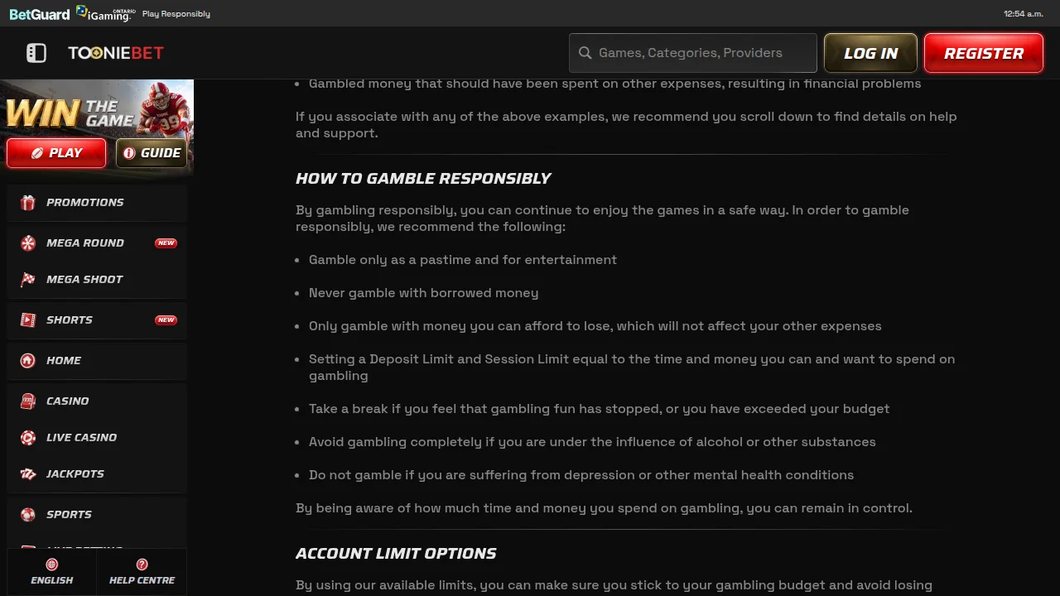
In Ontario, the Registrar’s Standards for Internet Gaming cover game integrity, and regulated operators must meet them. Offshore, fairness testing depends on what the licensing authority requires and what the operator chooses to publish. That makes published documents more important offshore, and also makes it more important to check them.
Types of Fairness Documents
| Document | What it covers | What it doesn’t cover | How to judge it |
|---|---|---|---|
| RNG certificate | That the random number generator produces unpredictable results | Whether the casino pays withdrawals | Named lab, date, specific software version |
| Game certification | That a specific game behaves as designed | Other games on the site | Game name and version listed |
| Payout (RTP) report | Actual return to players over a period | Your individual results | Period covered, game categories, issuing lab |
| Theoretical RTP in game info | The game’s long-run design return | Short-term outcomes | Shown inside the game’s help or paytable |
| Testing lab seal | That a relationship exists with a lab | Anything specific, unless it links to a certificate | Seal should link to a certificate on the lab’s domain |
How to Check an Audit Is Real
- Click the seal or link. It should open a page on the testing lab’s own domain, not a PDF hosted only by the casino.
- Check that the certificate names the casino’s domain or operating company.
- Look at the date. A certificate from years ago may not reflect the current setup.
- Check the scope: one game, a game library, or the whole platform.
- Be wary of certificates with no lab name, or with a lab you can’t find anywhere else.
Reading Payout Percentages Sensibly
Return-to-player figures describe the long run across very large numbers of bets. A published RTP for a game or category tells you how the game is designed to perform overall, not what will happen in your session. Two practical points follow. First, RTP shown inside a game’s info panel is the figure to check, because some games come in several RTP versions and operators can choose which one to offer. Second, a high RTP does not change the fact that the house has an edge; it describes how large that edge is.
Check inside the game: open the paytable or help screen of the actual game you’re playing on the site you’re using. If the RTP is shown there, that is the version you’re getting. If it isn’t shown anywhere, that is worth noting.
What Audits Can’t Tell You
- Whether withdrawals are paid on time.
- Whether bonus terms are fair.
- Whether the operator will honour a disputed win.
- Whether your province has any oversight of the site.
Fairness audits answer one question, “are the games honest?”, and answer it well when done properly. The rest of this guide’s checks cover the others.
Game Developers and Why They Matter for Safety
A casino site is, in large part, a storefront for games made by other companies. The studios that build slots, table games and live dealer products are a quiet but important part of the safety picture. Established game developers license their titles into regulated markets, which means their games have typically been tested against technical standards somewhere. When a casino carries games from well-known studios, it borrows some of that integrity.
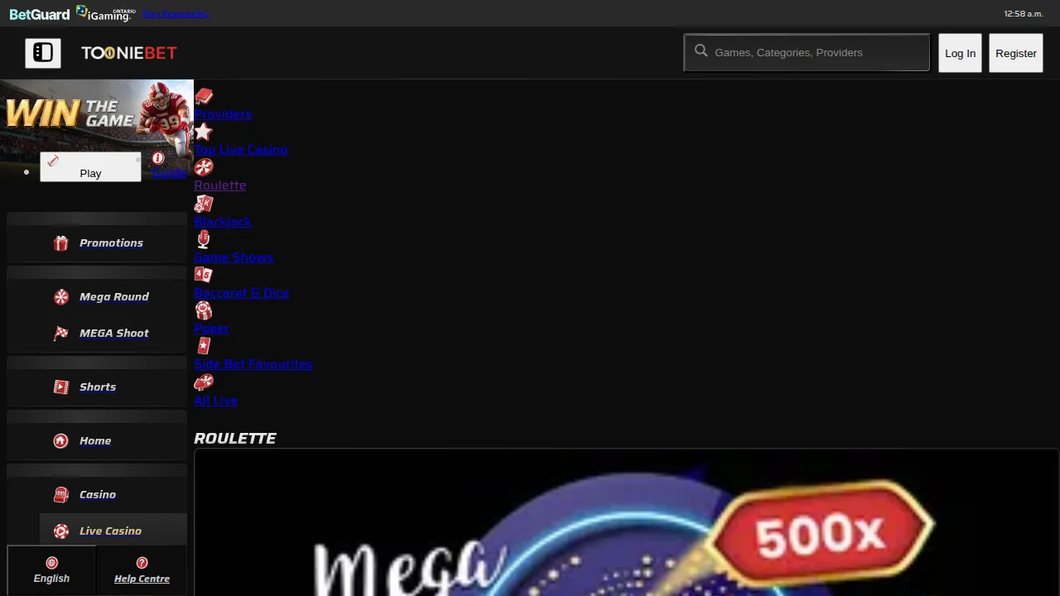
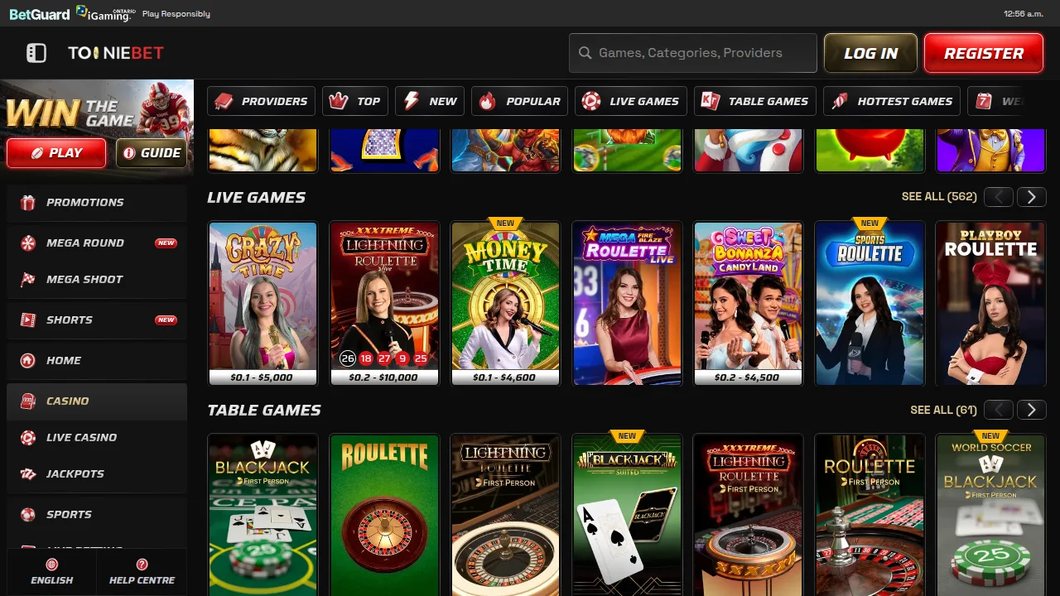
TonyBet appears earlier in this guide for spelling out the scope of its licence. The same habit of transparency is worth looking for in a site’s game lobby: can you see which studio made each game, and does the game itself carry the developer’s branding and information screens? That applies to TonyBet and to every other site you consider.
What a Reputable Developer Adds
| Factor | Why it helps | What it doesn’t guarantee |
|---|---|---|
| Games built for regulated markets | Likely tested against technical standards | That the casino offers the same version everywhere |
| Developer branding inside the game | Lets you identify the source | That the game was obtained through a legitimate licence |
| Published game rules and RTP | Lets you understand the game before playing | Short-term results |
| Supplier registration in Ontario | In Ontario, gaming-related suppliers must be registered with the AGCO | Anything about offshore versions |
| Long track record | Reputation at stake across many markets | That every casino carrying the game is safe |
Spotting Genuine vs Questionable Games
Most players never think about where a game came from. Most of the time that’s fine. But in parts of the offshore market, copied or modified versions of popular games have been reported, and a site that hosts them is not one to trust with your money. You can’t run a lab test yourself, but you can look for simple signs.
| Check | Reassuring sign | Warning sign |
|---|---|---|
| Loading screen | Developer logo appears as the game loads | No developer branding at all |
| Info / paytable screen | Full rules, RTP and developer details | Missing or partial information |
| Lobby filter | Games can be filtered by provider | No way to see who made a game |
| Game behaviour | Consistent with the developer’s published description | Features that don’t match the official game |
| Game address | Loads from a server the provider recognizably uses | Unusual domains or broken frames |
Live Dealer Games
Live dealer tables are streamed from studios run by specialist providers. The safety logic is similar: established live studios operate under their own oversight and supply many regulated markets. What you can check from your side is simpler:
- The studio’s branding appears on the table or in the game window.
- Table rules and payouts are shown before you place a bet.
- Your bet history shows results for each round.
- The stream is stable and the dealer’s actions are clearly visible.
Why the Game Library Isn’t the Whole Story
A strong game library can sit on top of weak terms. Famous games tell you that the games themselves are likely to be genuine. They don’t tell you whether the operator will pay your winnings, handle your data properly, or give you a fair complaints process. Treat reputable developers as one positive signal among the seven earlier in this guide, not a reason to skip the others.
Short version: genuine games from recognizable studios are a good sign. A site with no visible game provenance is a bad one. Neither replaces checking the operator, licence and terms.
What Makes a Gambling Site Safe: The Building Blocks
Safety on a gambling site isn’t one feature. It’s a set of building blocks that each protect something different: your identity, your money, the fairness of the games, and your ability to stop or complain. A site can be strong in one area and weak in another. Encryption protects your card number but does nothing for a voided bonus. A licence gives you a complaints route but doesn’t make the withdrawal page clearer.
This overview maps each building block to what it protects and where it is covered in more detail. The next three sections go deeper into security, game fairness and payments.
| Building block | What it protects | Key evidence |
|---|---|---|
| Regulation or licence | Your right to complain and the operator’s obligations | Provincial listing, or licence number on the authority’s register |
| Named operator | Clarity on who owes you your balance | Company name and address in the terms |
| Data security | Your personal and payment information | HTTPS, account security features, privacy policy |
| Game fairness | Honest outcomes | Testing certificates, in-game RTP information |
| Payment safety | Your deposits and withdrawals | Clear methods, caps and processing times |
| Verification | Your account against misuse and under-age play | Published KYC process |
| Responsible gambling | Your control over time and spending | Self-service limits and exclusions |
| Dispute route | Your recourse when things go wrong | Named external body in the terms |
How the Blocks Fit Together
- Regulation is the foundation. In Ontario and Alberta, the provincial framework sets requirements across most of the other blocks at once.
- Offshore, each block stands alone. You need to check them separately, because no Canadian province enforces them.
- Weak blocks matter more than strong ones. A site is only as safe as its weakest area when something goes wrong in that area.
- Some blocks can’t be fixed by you. You can set your own limits and secure your own account; you can’t create a complaints route that doesn’t exist.
A useful way to decide: list the building blocks and mark each one as “confirmed”, “unclear” or “missing” for the site you’re considering. Any “missing” in licence, operator or dispute route is enough to walk away.
Independently Tested Game Fairness
The section on published audits explains the documents you might see. This section looks at the testing itself: what independent testing checks, how it differs across game types, and what you can reasonably conclude from it. The core idea is simple. In a fair casino game, outcomes are random within the game’s designed odds, and nobody, including the operator, can predict or influence individual results.

Independent testing means a laboratory with no stake in the outcome examines the software and confirms that it behaves as described. In Ontario, game integrity forms part of the Registrar’s Standards for Internet Gaming. Offshore, the extent of testing depends on the licensing authority and the operator’s own choices.
How Fairness Works Across Game Types
| Game type | Source of randomness | What testing focuses on | What you can check |
|---|---|---|---|
| Slots | Software random number generator | RNG quality, game maths matching stated RTP | RTP and rules in the game’s info screen |
| RNG table games | Software random number generator | Shuffling and dealing logic, payout tables | Rules and payouts shown before betting |
| Live dealer games | Physical cards, wheels or dice | Studio procedures, equipment, recording of results | Round history and visible dealer actions |
| Jackpot games | RNG plus jackpot trigger logic | Trigger mechanics and contribution rules | Jackpot rules in the game info |
| Instant win / crash-style games | Software RNG, sometimes with verifiable hashes | Outcome generation method | Any published verification method the game offers |
What Independent Testing Typically Involves
- Statistical analysis of large numbers of generated outcomes to confirm randomness.
- Review of the game’s maths to confirm it matches the stated return.
- Checks that the game behaves consistently with its published rules.
- Verification that the tested version is the version deployed.
- Re-testing when software is changed, under many regulatory frameworks.
What You Can and Can’t Conclude
Testing gives you confidence that the game isn’t rigged against its own rules. It doesn’t mean you’ll win, and it doesn’t mean the house edge is small. A properly tested slot still has a built-in return below 100%, which is how casinos make money. Understanding that keeps fairness in perspective: a fair game is one that does what it says, not one that favours the player.
A fair game can still be a costly one. Testing confirms honesty, not value. Check the RTP and the rules, set a budget, and use the deposit limit tools covered earlier.
Warning Signs Around Fairness
- “Provably fair” or “certified” claims with no link to any certificate or method.
- Testing seals that don’t link to the lab’s own site.
- Game info screens that hide or omit the RTP.
- Games with no visible developer branding.
- Player complaints describing game behaviour that doesn’t match the published rules.
Fairness Under Different Licences
Because no Canadian province oversees offshore sites, the testing that applies to an offshore casino comes from its own licence and its own choices. That is one more reason the licence clause matters. When you check a licence on the authority’s register, as described in the offshore licences section, you are also checking which set of rules, including any game testing rules, the operator has agreed to follow.
| Setting | Who sets fairness requirements | Who you can raise a fairness concern with |
|---|---|---|
| Ontario-regulated site | AGCO, under the Registrar’s Standards for Internet Gaming | The operator, then the AGCO |
| Alberta-regulated site | AGLC | The operator, then the provincial framework |
| Provincial lottery site | The provincial operator’s own framework | The provincial operator |
| Offshore site | The licensing authority named in the terms | The operator, then any ADR body or the licensing authority |
Secure Deposit and Withdrawal Methods
Payments are where safety becomes concrete. Every other check in this guide ultimately protects one thing: your ability to put money in and get money out, on the terms you were promised. The method you choose affects how quickly funds move, how much personal information you share, whether a payment can be reversed, and how easy it is to prove what happened if something goes wrong.
Earlier sections cover withdrawal caps, deadlines and fees. This section focuses on the methods themselves and the habits that keep your payments safe. All amounts in this guide are in Canadian dollars; when a site shows limits in another currency, check how and when conversion is applied before you deposit.
Payment Method Types Compared
| Method type | Safety strengths | Things to watch |
|---|---|---|
| Interac (bank transfer) | Canadian banking system, no card number shared with the casino | Availability varies by site; withdrawals may use a different method |
| Debit or credit card | Familiar, with your issuer’s fraud protection | Some issuers decline gambling transactions; card details are shared |
| E-wallet | Keeps bank details away from the casino | Account must be in your name; some bonuses exclude e-wallet deposits |
| Prepaid voucher | No bank or card details shared | Usually deposit-only; you’ll need another method to withdraw |
| Cryptocurrency | Fast transfers on some sites | Irreversible, value can change between deposit and withdrawal, availability and rules vary widely |
| Bank wire | Direct to your bank | Often slower, may carry bank fees |
Why Withdrawals Often Follow Deposits
Many sites require you to withdraw to the same method you used to deposit, where that method supports withdrawals. This “closed-loop” approach is an anti-money-laundering measure, and it also protects you: it makes it harder for someone who takes over your account to send your money elsewhere. It does mean you should choose your deposit method with withdrawals in mind.
- Check whether your deposit method also supports withdrawals on that site.
- If it doesn’t, find out which method the site will use instead.
- Expect to verify ownership of any method you withdraw to.
- Avoid switching between many methods; it can complicate verification.
Safe Payment Habits
| Habit | Why it helps |
|---|---|
| Use only methods in your own name | Third-party payments are a common reason for frozen withdrawals |
| Read the cashier page before depositing | Confirms minimums, maximums and withdrawal options for your method |
| Complete verification early | Removes the most common delay before your first withdrawal |
| Keep deposit receipts and confirmation emails | Evidence if a payment goes missing |
| Check whether a bonus is attached before depositing | Some deposits automatically activate bonuses with wagering conditions |
| Withdraw winnings rather than leaving large balances | Limits exposure if the site changes terms or has problems |
| Don’t cancel and replay pending withdrawals | Reversing a withdrawal is a common way winnings are lost |
Understanding Withdrawal Stages
Knowing what happens after you click “withdraw” helps you tell normal delays from problem delays. Most sites move a request through several stages, and well-run sites tell you which stage you’re in.
| Stage | What’s happening | What you should be able to see |
|---|---|---|
| Pending | Request received, not yet reviewed | Status in your account; some sites let you cancel here |
| Under review | Verification and risk checks | Any document requests, clearly stated |
| Approved | Operator has released the payment | Approval confirmation, often by email |
| Processing by payment provider | Funds moving through the method’s network | Timeframe stated for that method |
| Completed | Funds in your account or wallet | Matching record in your bank or e-wallet |
Payment Red Flags
- The cashier page opens on an unfamiliar domain with no clear link to the casino or a known processor.
- You’re asked to pay a “release fee” or “tax” to the casino before a withdrawal is paid.
- Support asks you to send money to a personal account or an unusual wallet address.
- Withdrawal options are far narrower than deposit options, with no explanation in the terms.
- The site pressures you to cancel a pending withdrawal in exchange for a bonus.
Never pay to get paid. A request to send money before a withdrawal can be released is a classic scam pattern. A legitimate operator deducts any genuine fee from the withdrawal itself, as stated in its terms.
Payments and Your Province
On Ontario- and Alberta-regulated sites, payment handling sits inside a provincial framework, and Ontario’s standards address the protection of player funds. On provincial lottery sites, you’re dealing with a provincial operator. On offshore sites, payment protection comes from the operator’s terms, the licence it holds, and your payment provider’s own rules. That’s why the payment sections of the terms are worth reading slowly, and why the earlier checks on withdrawal caps and fees matter as much as the choice of method.
Taxes and Records
How gambling winnings are treated for tax purposes is covered in the earlier section on taxes. From a payment-safety point of view, the practical step is simple: keep your own records of deposits, withdrawals and account statements. Download your account history periodically, especially from offshore sites, because you can’t count on access to it if an account is closed or a site stops operating.
- Download account statements at regular intervals.
- Keep bank and e-wallet records that match casino transactions.
- Save withdrawal confirmation emails.
- Store everything somewhere other than the casino account itself.
Putting It All Together: A Practical Order of Checks
The sections above cover a lot of ground. In practice, you don’t need to check everything at once. What matters is doing the checks in an order that rules out unsafe sites quickly, so you only spend time on sites that pass the basics. The order below starts with the questions that can disqualify a site outright and ends with the ones that refine your choice.
| Order | Question | If the answer is no |
|---|---|---|
| 1 | Is there a provincially regulated option where I live? | Continue only if you’ve chosen to go offshore, knowing no province stands behind it |
| 2 | Does the site name its operating company? | Stop |
| 3 | Is there a licence number I can find on the authority’s register? | Stop |
| 4 | Is there an external complaints route? | Think hard before depositing |
| 5 | Are withdrawal caps, times and fees published? | Ask support in writing, and decide based on the answer |
| 6 | Is KYC explained before I deposit? | Expect delays at first withdrawal |
| 7 | Can I set limits and exclusions myself? | Weigh this heavily if you want firm control over spending |
| 8 | Are account security features available? | Rely on a strong unique password and stay alert to phishing |
| 9 | Do games show their developer and RTP? | Prefer games that do |
| 10 | Is support consistent with the terms? | Keep everything in writing |
Why the Order Matters
- Questions 1 to 3 are about accountability. Without them, nothing else can be enforced.
- Questions 4 to 6 are about your money. They decide how disputes and withdrawals go.
- Questions 7 and 8 are about your protection. They decide how well you’re shielded from overspending and account misuse.
- Questions 9 and 10 are about day-to-day quality. They separate good sites from merely acceptable ones.
The safest choice remains the regulated one. If your province offers a regulated or provincially operated site, that is the option with a Canadian authority behind it. Everything in this guide about offshore sites is about reducing risk, not removing it.
Which Canadian Online Casinos Are the Most Trusted?
There is no national list of trusted casinos in Canada because there is no federal online gambling regulator. Each province decides what is legal within its borders. So “most trusted” has a different answer depending on where you are standing when you log in. A site that is fully regulated for someone in Toronto can be an offshore site for someone in Halifax. A provincial lottery site in Winnipeg offers nothing to a player in Montréal.
A useful way to rank trust is by who stands behind the site if something goes wrong. The rest of this section uses that approach.
Trust, Tier by Tier
| Tier | What it is | Who stands behind it | Where it applies |
|---|---|---|---|
| 1. Provincially conducted or regulated | A site on iGaming Ontario’s list, the AiGC directory, or your provincial lottery site (Loto-Québec, PlayNow, ALC) | Your province, its regulator and its self-exclusion program | Only in the province that runs or regulates it |
| 2. Offshore, fully transparent | Names the operating company, publishes a licence number you can verify, explains KYC and withdrawal caps, and names an independent complaints route | The foreign licensing body and any named dispute service | Players outside the regulated markets who choose offshore anyway |
| 3. Offshore, partly transparent | A licence is named, but key details are missing or inconsistent | Unclear, and harder to escalate | Treat with caution |
| 4. Offshore, opaque | No company name, no checkable licence, no complaints route | No one you can reach | Avoid |
Tier 1 is the only tier where a Canadian body has a direct say over the operator. Everything below that is a judgment about how much the operator tells you, not a guarantee of how it will behave.
Where the Brands in This Guide Fit
The offshore brands we cover sit in tier 2 or tier 3, depending on how complete their published details were when we read their pages in October 2026. The transparency table earlier in this guide gives the brand-by-brand detail. In summary:
- Captain Cooks: its terms name Fresh Horizons Limited, a Tortola address and Kahnawake licence number 00972. That is the kind of licence clause a reader can check.
- Casino Rewards sites: highlighted in this guide for their dispute-resolution route.
- Casino Days: highlighted for clear payment terms.
- TonyBet: highlighted because its pages spell out the scope of its licence.
- 22Casino: names its operator, though its licence is newer.
- GBL Solutions sites (Need for Spin, Rolling Slots, Winshark, Wild Tokyo): grouped because they share an operator, so a check on one tells you a lot about the others.
Keep in mind: a high place on a transparency table means the operator tells you more. It does not mean a Canadian province supervises it. If you are in Ontario or Alberta, the regulated list comes first.
Why the Answer Changes at the Provincial Border
Regulatory rules do not carry over from one province to another. Ontario’s standards, its registration process and its player protections apply to Ontario. They do not follow you to Saskatchewan, and a site’s Ontario registration says nothing about how the same brand treats players elsewhere. The same brand can also run under a different licence in different places, as the “Same Brand, Different Licence” section explains. Before trusting a familiar name, confirm which entity and which licence apply to your account.
- Check the footer and terms after you choose your province or country at sign-up, not before.
- Confirm the company name in the terms matches the one in the footer.
- If the brand is regulated in your province, look it up on the official provincial list rather than relying on a logo.
How to Spot a Fake or Cloned Casino Site
A fake casino site is not always a crude scam page. Some copy a real brand’s design, logos and even its terms, then change only the payment details. Others make up a brand and add a licence seal that links nowhere. The checks below focus on the site’s identity: is this really who it says it is? That question is different from asking whether a genuine operator treats players well.
Start With the Address Bar
- Look-alike spellings: swapped letters, extra hyphens, or a brand name followed by words such as “-bonus”, “-ca” or “-official”.
- Unexpected endings: a brand you know on a domain ending you have never seen it use.
- Links from messages: do not log in through a link in an unsolicited email, text or social media message. Type the address yourself or use a bookmark you saved earlier.
- Redirect chains: if the address changes several times before the page loads, find out why before you enter any details.
Verify the Licence at the Source, Not on the Site
A seal in a casino’s footer is just an image. A licence only counts if it appears on the regulator’s own website, under the same company name and for the same domain. The table below shows where each check should happen.
| Claim on the site | Where to confirm it |
|---|---|
| Regulated in Ontario | The official list at igamingontario.ca |
| Registered in Alberta | The AiGC directory |
| Provincial lottery site | The provincial lottery’s own home page: Loto-Québec, PlayNow or ALC |
| Kahnawake licence | The Kahnawake Gaming Commission’s own website |
| Curaçao licence | The Curaçao Gaming Control Board’s own website |
| Anjouan licence | The licensing body’s own website, reached independently rather than through the casino’s link |
Don’t click the seal. A fake site can link its badge to a fake verification page. Open a new tab, find the regulator yourself, and search for the company or domain there.
Signs You’re Looking at a Clone
- The company name in the terms does not match the one on the regulator’s register.
- The terms mention a different domain from the one you are on.
- The only contact option is a chat widget, with no email address and no postal address.
- The site offers payment methods the genuine brand does not list, especially transfers to individuals.
- Bonus offers are far larger than anything the genuine brand promotes on its official site.
If you think a site is impersonating a brand, contact the genuine operator through its verified domain. It has every reason to want to know.
Advanced Security and Data Encryption
Casino security comes in layers. Encryption protects your data while it travels between your device and the site. Account security protects your login. The operator’s internal controls protect your data once it is stored. A site can do well on the first layer and poorly on the others, so it helps to know what each layer covers before you judge a site as “secure”.
The Layers Compared
| Layer | What it protects | What you can check yourself |
|---|---|---|
| Connection encryption (HTTPS/TLS) | Data travelling between your browser or app and the site | The address starts with https and your browser shows no certificate warnings |
| Account security | Access to your balance and personal details | Whether two-step verification is offered, whether you are alerted to new logins, and whether you can view active sessions |
| Payment handling | Card and bank details | Whether the payment page is run by a named payment provider, and whether stored methods are partly masked |
| Data storage and retention | Your ID documents and history once they are stored | What the privacy policy says about retention periods, the countries data is sent to, and who it is shared with |
| Internal controls | Staff access and fraud prevention | Largely invisible to you; the licence and the privacy policy are your main signals |
Account Features Worth Turning On
Whatever the site does on its side, these steps are in your control:
- Two-step verification, if offered. An authenticator app is generally sturdier than a text message code.
- A unique password that you don’t use for email or banking.
- Login and withdrawal alerts by email, so you notice activity you didn’t start.
- A withdrawal confirmation step, where the site requires extra confirmation before changing payout details.
Reading the Privacy Policy for Security Clues
Few players read the privacy policy, but it is often where an operator explains how it handles data. Look for:
- The name of the data controller, which should be the same company named in the terms.
- A contact address for privacy requests.
- How long ID documents and transaction records are kept after you close your account.
- Whether data is shared with marketing partners, and whether you can opt out.
A mismatch is a signal. If the privacy policy names one company and the terms name another, ask support to explain the relationship in writing before you upload any documents.
Encryption, and Why the Padlock Proves Nothing
The padlock icon, or its replacement in newer browsers, means one thing only: your connection to that domain is encrypted. It does not tell you who owns the domain, whether the business is licensed, or whether it will pay out. Certificates that enable encryption are widely available, often free, and fake sites use them as routinely as genuine ones. A scam page with a padlock is still a scam page. It is simply an encrypted one.
What the Padlock Does and Doesn’t Tell You
| The padlock confirms | The padlock does not confirm |
|---|---|
| The connection to this domain is encrypted | That the domain belongs to the brand it shows |
| Data in transit is harder to intercept | That the operator holds any licence |
| The certificate is valid for this address | That your data is stored safely |
| — | That withdrawals will be honoured |
| — | That the games are fair |
When Encryption Does Matter
The padlock is not useless. It is a minimum requirement, not a sign of quality. Its absence should stop you; its presence shouldn’t reassure you. In practice:
- Never enter login, card or ID details on a page without HTTPS.
- If your browser shows a certificate warning, leave the page. Do not click through.
- Avoid logging in on public Wi-Fi without encryption you trust, even on a site that uses HTTPS.
- Once encryption is confirmed, move on to the checks that actually measure safety: the named operator, a licence you can verify, published terms and a complaints route.
“Bank-grade encryption” is marketing. Phrases like “military-grade” or “bank-level security” tell you nothing a padlock doesn’t. They are not a licence, an audit or a guarantee.
What Personal and Financial Data Casinos Ask For
Every legitimate casino needs some personal data. Regulated and licensed operators must confirm your identity, check your age and location, and meet anti-money-laundering rules. The question is not whether a site asks for data, but whether it asks for the right data, at a reasonable stage, through a secure channel. The table below sets out what is typical and where requests should start to worry you.
Typical Requests, Stage by Stage
| Stage | Commonly requested | Why |
|---|---|---|
| Registration | Full name, date of birth, email, phone number, home address | To open the account and run initial age and identity checks |
| First deposit | Payment method details entered on a payment page | To process the deposit and link the method to your account |
| Identity verification (KYC) | Government-issued photo ID; sometimes a selfie | To confirm you are the account holder and of legal age |
| Address verification | A recent utility bill or bank statement | To confirm where you live |
| Payment verification | Proof of ownership of the card, e-wallet or bank account | To make sure withdrawals go back to the account holder |
| Enhanced checks | Source-of-funds or source-of-wealth documents | Triggered by higher deposit levels or unusual activity under anti-money-laundering rules |
What a Casino Should Never Need
- Your online banking password or one-time banking codes.
- Your card PIN.
- A full, unmasked card photo showing the security code. If you’re asked for card proof, the usual practice is to cover the middle digits and the security code. Check the site’s instructions.
- Remote access to your device.
- Documents sent through social media messages or a personal email address.
Upload only through the account. Send documents through the casino’s secure upload area inside your account, not by replying to an email. If a message asks you to send ID elsewhere, check with support through the site itself.
Asking What Is Held About You
Your privacy rights depend on which company holds your data and where it is based. Canadian privacy law applies to provincial and Canadian-regulated operators. An offshore operator’s privacy policy should say which laws it follows and how to make a request. Before you upload documents, check that the policy names:
- A privacy contact or data protection officer.
- How to request a copy of your data.
- How to request deletion once legal retention periods end.
If none of this is stated, treat that as a weak point in the site’s transparency, just as you would a missing licence number.
Mobile Casino Safety: Apps, Browsers and Your Phone
Most casino sessions now happen on a phone, and the safety checks carry over, but small screens make them easier to skip. Mobile layouts often hide the footer, collapse the terms into menus and leave out the licence details. A site that looks transparent on a laptop can look anonymous on a phone. Before you treat a mobile casino as safe, find the same information you would expect on desktop.
App or Browser?
| Option | Safety considerations |
|---|---|
| App from an official app store | Check that the developer name matches the operator named in the terms; read the permissions the app requests |
| App installed from a downloaded file | Higher risk: you are trusting the source of the file directly. Only consider this if the download comes from the operator’s verified domain |
| Mobile browser | No install needed; the same domain and licence checks apply as on desktop |
| “App” that is just a home-screen shortcut | Works like the browser version; confirm the domain it opens |
Checks That Are Easy to Miss on a Phone
- Scroll to the very bottom of the mobile page to find the company name and licence number.
- Open the full terms, not just the bonus pop-up, and confirm that the company name matches.
- Find the responsible-gambling tools in the mobile account menu. If deposit limits only work on desktop, that is a weakness.
- Check location permissions. Provincially regulated sites may need to confirm you are in the province. An offshore app asking for contacts, photos or other unrelated permissions deserves questions.
Protecting the Phone Itself
Your phone often holds your casino login, your email and your banking app together, which makes it a single point of failure.
- Use a screen lock, and keep the operating system and apps updated.
- Turn off message previews on the lock screen for verification codes.
- Don’t save casino passwords in plain notes.
- If your phone is lost, change your casino password from another device and ask support to end active sessions.
Shared tablets and family phones: log out after every session and don’t let the browser remember the password. This protects your balance and keeps minors from reaching the account.
Problem Gambling Support Province by Province
In Canada, gambling is regulated by the provinces, and so is most gambling support. There is no single national gambling helpline, and a number that serves one province should not be used for another. The practical step is to find the service that covers where you live, ideally before you need it. The table below shows where to start in each part of the country.
Where to Start
| Where you live | Where to start |
|---|---|
| Ontario | ConnexOntario: call 1-866-531-2600 or text 247247. The service is free and confidential. |
| Alberta | Alberta’s provincial health services, and the responsible-gambling pages on AGLC-regulated sites, which link to the centralized self-exclusion program |
| Quebec | Quebec’s provincial health and social services, and the responsible-gambling section on lotoquebec.com |
| British Columbia, Manitoba, Saskatchewan | Your province’s health services, and the responsible-gambling section on PlayNow.com |
| Atlantic provinces | Your province’s health services, and the responsible-gambling section of the Atlantic Lottery Corporation’s site |
| Territories | Your territorial health services |
Playing offshore doesn’t change who can help you. Support services are based on where you live, not where the casino is licensed. An offshore site’s links may point to services in other countries, so look for the service in your own province.
What Support Services Typically Offer
- Confidential conversations by phone, text or chat, depending on the service.
- Referrals to counselling, which may be free in your province.
- Help for family members and friends affected by someone else’s gambling.
- Information on self-exclusion and on blocking tools for your devices and bank cards.
Signs It’s Time to Reach Out
- You deposit more to win back losses.
- You hide how much or how often you play.
- You use money set aside for bills, rent or savings.
- You feel restless or irritable when you try to cut back.
- You’ve set limits and keep raising or removing them.
If any of these sound familiar, contact your provincial service. You don’t need to be in crisis to call. Earlier is better.
Practical Blocks Alongside Support
Support works best when it is paired with barriers that make impulsive play harder:
- Self-exclude through your provincial program if you play on provincial or regulated sites.
- Self-exclude separately on each offshore site. Provincial programs don’t reach them.
- Ask your bank whether it offers a gambling block on your cards.
- Install blocking software on your devices.
- Unsubscribe from casino marketing emails and texts.
Checking the Game Providers Behind a Brand Like TonyBet
This guide covers TonyBet for how clearly it spells out the scope of its licence. Players also want to know whether the games in a lobby come from reputable developers. That information changes as providers are added or removed, so it is better to check it yourself at the time you play than to rely on a fixed list. The same method works for any brand in this guide.
How to Check the Providers
- Filter the lobby by provider. Most casino lobbies, including TonyBet’s, let you browse by studio. Note the names you see.
- Open a game’s information panel. Look for the developer’s name and, where shown, the return-to-player figure.
- Visit the developer’s own website. Reputable studios list the jurisdictions they are licensed in and the testing they undergo.
- Compare the details. If the RTP shown in the casino differs from the figure on the developer’s site, ask support which version is running.
- Check the game loads from the provider. Official versions of a game look and behave the same across casinos. A slot that looks slightly “off” compared with the developer’s demo deserves a question.
What a Strong Provider List Does and Doesn’t Mean
| A reputable provider list suggests | It doesn’t guarantee |
|---|---|
| The operator has passed the developers’ own partner checks | That withdrawals will be smooth |
| Games come from studios that are tested and licensed in their own right | That bonus terms are fair |
| Game rules and RTP information are usually published | That the operator’s licence covers your location |
Order of priority: confirm the operator and licence first, then look at the game library. Good games on an unverifiable site are still on an unverifiable site.
Putting Trust Into Practice Over Time
Trust isn’t a single check at sign-up. Operators change owners, licences get renewed or lapse, and terms get rewritten. The details in this guide reflect what operators published when we read their pages in October 2026. Your own checks matter most at the moment you deposit or withdraw. A short routine keeps that trust current without much effort.
A Simple Routine
- Every time you deposit: make sure you are on the correct domain and the connection is secure.
- Every few months: recheck the company name and licence number in the terms and on the regulator’s site.
- Before every withdrawal: reread the current withdrawal caps, fees and KYC requirements.
- Whenever the terms change: save a copy with the date, so you have a record if a dispute arises.
- If anything looks different: pause deposits, withdraw your balance and ask support for an explanation in writing.
Records Worth Keeping
| Record | Why keep it |
|---|---|
| Screenshots of the licence clause and company name | Shows which entity you dealt with |
| Dated copies of terms and bonus rules | Shows which rules applied when you played |
| Deposit and withdrawal confirmations in CAD | Supports complaints and your own records |
| Support transcripts and emails | Evidence for escalation to a dispute service or licensing body |
These habits won’t turn an offshore site into a provincially regulated one, but they put you in the strongest possible position if something goes wrong.
A Reputation Scorecard for Any Canadian Casino
A reputable online casino in Canada is not the one with the loudest marketing. It is the one whose claims hold up when you check them against a source the casino doesn’t control. The scorecard below turns that idea into something you can fill in for any site in a few minutes.
Give each line a simple yes or no. A site does not need a perfect score to be usable, but every “no” should have a reason you can live with.
| Question | Where the answer should come from | What a “yes” looks like |
|---|---|---|
| Is the site on my province’s official list? | The provincial regulator or Crown corporation, not the casino | The exact domain appears on the list for Ontario or Alberta. Elsewhere, it is the provincial lottery site. |
| Is the operating company named? | Terms and conditions, footer, privacy policy | The same legal entity and address appear in all three places |
| Can the licence be checked? | The licensing body’s own register | The number on the site matches a live entry under the same company name |
| Are withdrawal caps and fees published? | Payments page and banking terms | Amounts in $ (CAD), stated before you deposit |
| Is KYC explained? | Terms, verification page, help centre | The documents and the trigger points are listed in plain English |
| Are limits and time-outs self-service? | Account settings | You can set them without contacting support |
| Is there a route beyond the operator? | Complaints section of the terms | An ADR service or the licensing body is named, with contact details |
Using the Scorecard Honestly
Fill the scorecard in yourself rather than accepting a site’s own summary. A “Why choose us” page tends to answer every question with “yes” and link to nothing. A reputable operator rarely minds being checked. Its answers point outward, to a register, a regulator or an independent body.
- Write down where you found each answer. A screenshot or a saved copy of the page is enough.
- Date your notes. Terms change, so “checked on November 26, 2026” is more useful than “checked”.
- Treat blanks as answers. If you can’t find the operator’s name after a genuine look, that is a “no”.
Turning Marketing Claims Into Checkable Facts
Casino marketing leans on a small set of phrases: “award-winning”, “trusted”, “24/7 support”, “top game providers”, “fast payouts”. None of these is a safety guarantee on its own. Each one can, though, be turned into a question with a checkable answer.
| The claim | The question behind it | What to look for |
|---|---|---|
| “Award-winning casino” | Who gave the award, for what, and when? | A named organizer, a category and a year. Awards rarely judge payouts or complaint handling, so check those separately. |
| “Dependable 24/7 support” | Which channels, and in which language? | Live chat or email you can try before depositing, plus a written complaints procedure |
| “Home of top game developers” | Are those studios’ games genuine and certified? | Game info screens that name the studio, and fairness certificates you can trace to the testing lab |
| “Fast payouts” | Fast from which point? | Published pending periods, processing times and caps, plus whether KYC has to be complete first |
| “Fully licensed” | Licensed by whom, and for which market? | A licence number that matches the regulator’s register and covers the company named in the terms |
| “Trusted by Canadians” | Trusted on what evidence? | Nothing specific to check. Treat it as a slogan and fall back on the scorecard above. |
Claims That Actually Change Your Risk
Some claims affect your experience. Others affect what happens when something goes wrong. Give the second group more attention:
- Experience claims: game count, awards, app design, number of providers.
- Protection claims: licence scope, named operator, withdrawal terms, dispute route, self-exclusion coverage.
A casino can excel on experience and still leave you exposed on protection. The brands highlighted earlier in this guide, such as Casino Days for payment terms and TonyBet for spelling out licence scope, stand out for protection-side transparency. That is the side that counts when a withdrawal stalls.
Real Player Reviews and Online Reputation
Player reviews can tell you things no terms and conditions page will. They show how a casino behaves under pressure: during a large withdrawal, after a verification request, or when a bonus dispute arises. They are also easy to misread, and some are not genuine.
Where Reviews Live and What Each Source Is Good For
| Source | Useful for | Watch out for |
|---|---|---|
| Forums and discussion threads | Detailed first-hand accounts, follow-ups over weeks | Venting without context, outdated posts about old terms |
| General review platforms | Volume of complaints over time, operator replies | Bursts of short five-star reviews, incentivized reviews |
| Complaint mediation sites | How disputes were resolved and whether the casino engaged | Cases settled privately, partial records |
| Affiliate review pages | Collected terms, licence details, bonus rules | Commercial ties that favour promoted brands |
Reading Patterns, Not Individual Posts
One angry review proves very little. A repeated pattern across sources and months proves much more. When you read reviews of a casino, look for:
- The same problem from different people. Repeated stories of documents “never accepted”, or of winnings voided under one vague clause, deserve weight.
- Dates. A cluster of complaints after a change of owner or licence tells you more than complaints from years ago.
- Which site version is involved. A complaint about an offshore version of a brand says little about its provincially regulated site, and the reverse is also true.
- Operator responses. A specific, polite reply that cites the clause involved is a better sign than silence or a copy-paste apology.
- Whether the player broke a rule. Many complaints describe a max-bet breach or duplicate account. Those are rules the player agreed to, not hidden traps.
Spotting manufactured praise: very short reviews posted close together, generic wording (“best casino ever, fast payout”), and reviewer profiles with a single review are common signs of reviews that weren’t written by real customers.
What Reputation Cannot Replace
Good reviews do not give you a complaints route or a self-exclusion program. If a casino with a glowing reputation is offshore, your recourse still depends on its licence and its named ADR service. Your province plays no part in that. Use reputation as a tie-breaker between sites that already pass the basic checks, never as a substitute for them.
Protecting the Accounts That Surround Your Casino Account
Your casino login is only as secure as the email address that can reset it and the payment methods connected to it. Many account takeovers don’t start at the casino at all. They start with a reused password or a compromised inbox.
Settings Worth Switching On Outside the Casino
- Email two-step verification. Protect the inbox that receives password resets and withdrawal confirmations.
- A unique password. Use one you don’t use anywhere else, ideally generated and stored in a password manager.
- Bank and card alerts. Set your banking app to notify you of every card transaction or e-transfer, so an unauthorized deposit shows up immediately.
- A separate payment method for gambling. A single card or e-wallet used only for gambling makes spending easier to track and limits exposure if details leak.
- Carrier account PIN. Where your mobile provider offers one, it makes it harder for someone to move your number and intercept text-message codes.
Session Habits That Prevent Problems
| Habit | Why it matters |
|---|---|
| Log out on shared or public devices | Stops the next user from accessing your balance or personal details |
| Avoid public Wi-Fi for deposits and document uploads | Reduces the chance of your session or documents being intercepted |
| Type the casino address yourself or use a saved bookmark | Protects against look-alike phishing domains |
| Ignore “verify your account” emails with links | Log in directly and check messages inside the account instead |
If you suspect a takeover: change your email password first, then the casino password. Contact the casino’s support in writing to freeze the account, and call your bank to block any linked card.
What “35x Wagering” Actually Costs You
A wagering requirement tells you how much you must bet before bonus funds, or winnings made with them, can be withdrawn. “35x” sounds abstract until you turn it into dollars. The figures below are a worked illustration with round hypothetical amounts, not an offer from any casino.
First: 35x of What?
The multiplier matters less than what it is applied to. Read the bonus terms for one of these two common structures:
| Illustration | Bonus only | Deposit + bonus |
|---|---|---|
| Hypothetical deposit | $50 | $50 |
| Hypothetical matched bonus | $50 | $50 |
| Amount the 35x applies to | $50 | $100 |
| Total you must bet | $1,750 | $3,500 |
The same “35x” headline can therefore mean twice the betting, depending on one line in the terms.
Turning Turnover Into an Expected Cost
Every casino game has a built-in house edge, which is the share of each bet the game is designed to keep over the long run. The edge is 100% minus the game’s RTP. Multiply the edge by the total amount you must bet, and you get a rough idea of what clearing the bonus costs you on average.
Worked example (hypothetical): a slot with a stated RTP of 96% has a 4% edge. On $3,500 of required betting, the average expected loss is 4% × $3,500 = $140. That is more than the $50 bonus itself. On $1,750 of betting, it would be $70.
This is an average, not a prediction. Some players will finish ahead and many will bust before completing the requirement. The point is that the requirement has a price, and that price grows with the multiplier, the base it applies to, and the edge of the games you play.
Rules That Quietly Raise the Cost
- Game contribution. If table games count for only part of each bet, you must bet more to clear the same requirement.
- Maximum bet rules. Going over a per-spin limit while a bonus is active is one of the most common reasons winnings get voided.
- Time limits. A short deadline pushes you to bet faster and larger than you otherwise would.
- Cash-out caps on bonus winnings. A cap can mean that even a big win after clearing the requirement is cut down to a fixed amount.
- Excluded games. Playing a restricted title can void the bonus outright.
- Locked real money. On some structures, your deposit is tied up until the bonus is cleared or forfeited.
A Simple Decision Rule
- Work out the total amount you must bet.
- Multiply it by the house edge of the games you plan to play.
- Compare that expected cost with the bonus value and any cash-out cap.
- If the expected cost is close to or above the bonus, or the deadline would push you past your budget, decline the bonus. Most casinos let you play without one.
RTP on Slots: What the Number Means and Where to Find It
RTP, or return to player, is the percentage of all money wagered on a game that the game is designed to pay back over a very large number of plays. It describes the long run across every player. It does not describe your session, your evening or your month.
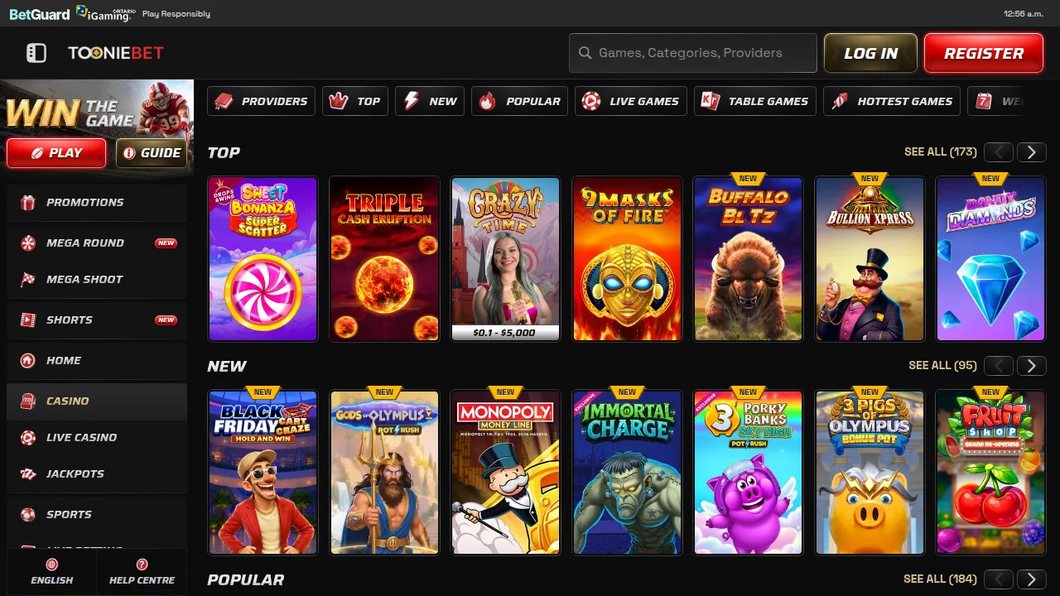
What RTP Is and Isn’t
| RTP tells you | RTP does not tell you |
|---|---|
| The game’s long-run design return | What you will win or lose in one session |
| The house edge (100% minus RTP) | How often the game pays out (that is hit frequency) |
| How to compare the cost of play between games | How large or rare the big wins are (that is volatility) |
| Roughly what bonus wagering will cost you | Whether a game is “due” to pay. Outcomes are independent. |
Where to Find a Slot’s RTP
Don’t rely on a figure quoted in a blog post or a casino lobby banner. The figure that applies to you is the one on the site you are playing:
- Open the game, then the info or paytable screen. Reputable studios state the RTP there, often in a “game rules” section.
- Check that the studio is named. A genuine game identifies its developer. An unnamed or generic title is harder to trace to a certificate.
- Compare with the studio’s own game page. Developers often publish their games’ RTP information. A mismatch is worth asking support about.
- Read the casino’s fairness or game-rules page. Some operators list RTPs or link to independent payout reports.
Why the Same Slot Can Have Different RTPs
Many studios release a single slot in several RTP configurations. The casino chooses which one it offers, so the same title, with the same art and features, can return less on one site than on another. This is legitimate when it is disclosed. It is also why a figure you remember from one casino may not apply at the next.
Practical habit: whenever you try a slot on a new site, open the info screen before your first spin and note the RTP shown. If the screen gives no figure at all, choose a game that does.
Matching Fair-Play Certificates to the Games You Play
A fairness seal in a footer is a starting point, not a conclusion. To be meaningful, a certificate has to connect three things: the testing lab, the operator or studio, and the games in question.
- Click the seal. It should lead to a page on the testing lab’s own domain, not an image hosted by the casino.
- Check the name on the certificate. It should match the operating company or the game studio named on the site.
- Check the date and scope. Look at whether it covers the random number generator, specific games, or a payout period, and whether it is current.
- Cross-check the game. If the certificate lists titles, confirm that the slot you play is among them, or that its studio holds its own certification.
A certificate that fails any of these steps doesn’t prove the games are unfair. It does mean the casino has given you nothing you can rely on, and you should weigh that accordingly.
Which Safety Signals Should Carry the Most Weight
Real casinos rarely score perfectly. One site names its operator but buries its withdrawal caps. Another has excellent responsible-gambling tools but a licence you can’t confirm. When signals conflict, some matter far more than others. A useful way to rank them is to ask: if this one fails, can anything else make up for it?
| Weight | Signal | Why |
|---|---|---|
| Decisive | Provincial regulation (Ontario, Alberta) or a provincial lottery site | Brings provincial oversight, provincial self-exclusion and a local complaints route that no offshore licence can match |
| Decisive (offshore) | Named operator plus a licence you can verify | Without both, there is no one to hold accountable and no body to escalate to |
| High | An independent complaints route | Decides whether a dispute can go anywhere beyond the operator itself |
| High | Published withdrawal caps, fees and KYC rules | These are the rules most likely to affect your money, so they must be known in advance |
| Important | Self-service limits, time-outs and self-exclusion | Protect you from your own worst session, which is often the biggest risk |
| Supporting | One consistent version of the terms | Makes every other promise provable |
| Tie-breaker | Reviews, awards, game library, app design | Useful between sites that already pass everything above, meaningless on their own |
The “No Compensation” Rule
Strength in a lower row can never make up for failure in a higher one. A site with thousands of games, prompt chat support and glowing reviews still fails if no company or licence can be identified. Likewise, an offshore site with an excellent licence is still the wrong choice for a player in Ontario or Alberta, where a regulated list exists.
- Fail a decisive signal: don’t deposit.
- Fail a high signal: deposit only if you accept the specific risk, and keep the amount small.
- Fail an important or supporting signal: keep looking for a site that offers the same games with better protection.
Cooling-Off Periods and Time-Outs
A cooling-off period, often called a time-out or “take a break”, is a short, fixed pause on your account. Self-exclusion is designed for a longer or more decisive step away from gambling. A cooling-off period is meant to break a single bad streak: an evening of chasing losses, a frustrating bonus, or a moment when you notice you are playing on autopilot.
How Cooling-Off Differs From Other Tools
| Tool | What it does | Best used when |
|---|---|---|
| Deposit limit | Caps how much you can add over a day, week or month | You want to keep playing within a firm budget |
| Session or time reminder | Alerts you after a set amount of play | You lose track of time while playing |
| Cooling-off period | Blocks play and deposits for a fixed short period | You need an immediate, short break that you can’t undo on impulse |
| Self-exclusion | Closes access for a long period, sometimes across many sites | Gambling is causing harm, or a short break hasn’t been enough |
What a Good Cooling-Off Option Looks Like
- Self-service. It sits in account settings and takes effect at once, without a chat with support.
- Locked for the full period. Once set, it can’t be shortened or cancelled early.
- Covers deposits and play. It is not merely a pause on promotional emails.
- Stops marketing too. Bonus offers during a break undermine its purpose.
- Clear about pending withdrawals. The terms should state whether you can still withdraw an existing balance during the break.
- No automatic restart surprises. You should know exactly when access returns, and ideally have to confirm that you want it back.
Before you need it: find the cooling-off option the day you open an account, the same way you’d find the fire exit in a new building. Having to search for it mid-session is exactly when you are least likely to use it.
Regulated Sites vs Offshore Sites
On regulated sites in Ontario and Alberta, responsible-gambling tools form part of what the provincial rules expect of operators. In Alberta, for example, registered sites connect to AGLC’s centralized self-exclusion program. On offshore sites, the options and how they behave depend entirely on the operator and its licence. Some offer a full set of self-service time-outs, while others handle breaks only by request. A cooling-off period you set at one offshore casino applies only to that account. It doesn’t follow you to any other site.
When a Break Isn’t Enough
If you keep setting time-outs and returning straight afterwards, or you play to win back losses, it may be time to step up to a longer exclusion and to talk to someone. Help is provincial in Canada, and there is no single national line. Look up the service for your own province before you need it.
- Ontario: ConnexOntario, 1-866-531-2600, or text 247247. It is free and confidential.
- Other provinces: use your province’s own problem-gambling service, which your provincial lottery site or health authority will list.
A short pause, a firm deposit limit and a support line are not signs that something has gone wrong. Used early, they are part of what playing safely looks like.