









Two Kinds of Online Poker: Rooms vs Casino Tables
Online poker in Canada means one of two very different products: player-vs-player poker rooms, where you play against other people and the site takes a rake, and casino poker, where you play against the house at a fixed house edge. Knowing which one a site actually offers saves you from signing up for the wrong thing.
Most “poker” links in a casino menu lead to the second kind. A real poker room needs a player pool, tournament schedules and cash tables running around the clock, so only a handful of operators bother to build one. Among the 12 sites we track, Stake and TonyBet describe genuine poker rooms in their own rules pages; Kingmaker, Golisimo and 22Casino list poker as a lobby category inside the casino.
Player-vs-Player Poker Rooms
In a poker room the cards are dealt by software, but your opponents are other players. The site has no stake in who wins a pot. It earns money by taking a small slice of each pot (the rake) in cash games, or an entry fee on top of each tournament buy-in.
This is the only form of gambling at an online casino where skill can give you a long-term edge. Good players beat weaker ones over thousands of hands; the house edge does not exist as such, but the rake is a cost every player pays, winner or loser.
Casino Poker Against the House
Casino poker games — Casino Hold’em, Three Card Poker, Caribbean Stud and similar — use poker hands but play like blackjack. You face the dealer, not other players, and the paytable is fixed so the casino keeps a built-in edge on every hand.
You can play them as RNG (software) tables or at live dealer tables streamed from a studio. Your decisions matter — folding or raising at the right moment lowers the edge — but no decision removes it. Expect to lose a few percent of your ante over time.
Video Poker Machines
Video poker sits between the two. It looks like a slot machine, but you are dealt five cards, choose which to hold and draw replacements. The return depends on the paytable and on how well you play, which is why the best versions return over 99% to perfect-strategy players.
Which Kind Suits You?
The right choice depends on what you want from a session:
- You enjoy reading opponents and studying the game: a poker room, starting with low-stakes cash games or small tournaments.
- You want quick, simple hands without other players: casino poker such as Casino Hold’em or Three Card Poker.
- You like slots but want some control over the outcome: video poker, ideally a full-pay Jacks or Better machine.
- You want to clear a welcome bonus: none of the three is a good fit at most of our sites — more on that in the bonus section below.
Best Online Poker Sites in Canada (October 2026)
The best online poker sites for Canadians among the 12 we review are Stake for a full poker room, TonyBet for Omaha tournaments and Spins, Kingmaker and Golisimo for live dealer poker tables, and 22Casino for a dedicated poker category. All five are offshore operators, not regulated by any Canadian province.
We built this shortlist by reading each operator’s own pages from a Canadian IP on October 9, 2026 — menus, poker rules, help-centre articles, bonus terms and responsible-gambling pages — and comparing what they actually confirm. We did not open accounts or play real-money hands, so we only describe what the sites publish.
| 🏠 Site | 🃏 Poker Product (as shown on the site) | 📜 Licence | 🎁 Poker & Bonus Note |
|---|---|---|---|
| Stake | Poker room: Texas Hold’em, Omaha, Pineapple, All in or Fold, Next! fast-fold, JAQKpot! | Not named in our sources (help centre only) | Rakeback on poker = 3.5% of the rake (from Bronze VIP) |
| TonyBet | Poker room: Omaha 4, 5 and 6; tournaments, Sit & Go, Spins | Kahnawake No. 00902 (Canada excl. ON & AB) | Table and live games don’t count to bonus wagering |
| Kingmaker | Live casino “Poker” category | Not named in T&C or footer | Live games 10%, table and card games 0% towards wagering |
| Golisimo | Live casino “Poker” category | Not named in T&C or footer | Same rules as Kingmaker; video poker 10% |
| 22Casino | “POKER” in the main menu and as a lobby category | Kahnawake No. 01056 | Welcome package terms not published on pages read |
The table shows the key split: only Stake and TonyBet publish rules for player-vs-player poker, while the other three put poker inside the casino lobby.
Best for a Full Poker Room: Stake
Stake’s help centre has a dedicated Poker collection with 23 articles, which is the most detailed poker documentation of any site on our list. It covers six game types: Texas Hold’em, Omaha, Pineapple, All in or Fold (AoF), Next! (fast-fold) and JAQKpot!.
Tournament features listed in the same collection include Knockout, Re-entry, Satellite, Multi-Flight and Mystery Bounty tournaments, Early Bird Bubble Protection, Next! tournaments and tickets. Table features include Rabbit Hunting, Run it Multiple Times, a Bad Beat Jackpot, Straddle and Re-Straddle, and an All in or Fold Jackpot.
For Canadian players, Stake’s help centre documents CAD deposits and withdrawals: Visa and Mastercard at C$5 to C$3,000 per transaction, Interac e-Transfer withdrawals sent via Payper Inc. (up to 3 business days), plus cryptocurrency. Our sources do not name Stake’s licence, and stake.com blocked automated access, so we relied on help.stake.com only.
- Rakeback: 3.5% of the rake on poker, unlocked at Bronze VIP after $10,000 wagered.
- Poker Exclusion: a separate tool to block poker only, alongside loss, wager and deposit limits.
- Not regulated in Canada: Stake is an offshore operator; Ontario and Alberta players should use their provincial regulated sites.

- 15 VIP Levels to Obsidian
- CAD Cards C$5 to C$3,000
- Interac e-Transfer Payouts
Best for Omaha and Spins: TonyBet
TonyBet’s main navigation shows POKER next to Casino, Live Casino and sports betting, and its homepage banner reads “Saved you a sit — Poker now available”. The published Poker Rules page focuses on Omaha 4, Omaha 5 and Omaha 6, in tournament, Sit & Go and Spins formats.
The rules are clear and worth reading before you sit down. In all three Omaha variants your final hand must use exactly two of your private cards and exactly three community cards. TonyBet’s own example: with four hearts on the board, you need two hearts in your hand to make a flush — one is not enough.
TonyBet’s Spins are three-player Sit & Go tournaments with a random prize multiplier revealed as the tournament starts; if no other distribution is specified, the winner takes the whole prize. If your account currency differs from the currency of the poker game, the amount is converted when you join the table, at an exchange rate provided by Coinlayer.
tonybet.com runs under Kahnawake Gaming Commission licence No. 00902, and its terms state that this licence covers Canada excluding Ontario and Alberta. Support is 24/7 by live chat and email, and the responsible-gaming tools include deposit and loss limits, time-outs and self-exclusion from 6 months to 3 years.

- Kahnawake licence No. 00902
- VIP cashback up to 10%
- Sportsbook and Omaha poker
Kingmaker: Live Dealer Poker Tables
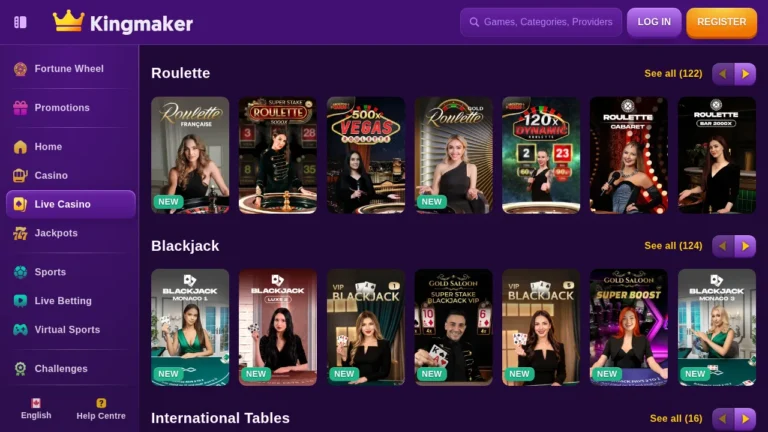
Kingmaker’s live casino is split into sections — Gold Saloon, Roulette, Blackjack, International Tables, Game Shows, Baccarat & Dice and Poker. That poker section is where you’ll find dealer-hosted casino poker, the type where you play against the house rather than other players.
The site’s own copy invites you to “Play Live Blackjack, Poker, and Baccarat” and interact with the dealer. Kingmaker’s General T&C and footer don’t name the operating company or a gaming licence (checked October 2026), so weigh that before depositing. Its T&C also says NetEnt games are unavailable to players in Canada.
The bonus rules matter if you plan to play poker: under section 7.7 of the T&C, all live games contribute only 10% to wagering and table and card games 0%. Read our Kingmaker review for the full welcome-offer picture.

- 24/7 Live Chat & Email
- 5-Level VIP With Cashback
- CAD Account Currency
Golisimo: Live Poker With Interac Deposits
Golisimo runs on the same platform as Kingmaker (identical General T&C), and its live casino has the same Poker section next to Gold Saloon, Roulette, Blackjack and Game Shows. The homepage shows 68 titles under Top Live Casino.
Where Golisimo stands out for Canadians is the cashier. Its public payments page for Canada/CAD lists Interac at C$10 to C$3,000, Skrill and bank transfer at C$20 to C$7,800, MiFinity, and a long list of crypto options, including Bitcoin at C$90 to C$10,000. Like Kingmaker, its terms and footer don’t name the operating company or a gaming licence.
The current casino welcome package is 300% up to $3,750 + 300 FS (verified on the operator’s site in October 2026), but its value to a poker player is low: under the default rules a deposit bonus carries x35 wagering on deposit plus bonus, and live games count only 10%.

- 8,387 Slots & 882 Jackpots
- 15+ Cryptos Incl. Bitcoin
- Daily Cashback Up to 15%
22Casino: A Dedicated Poker Category
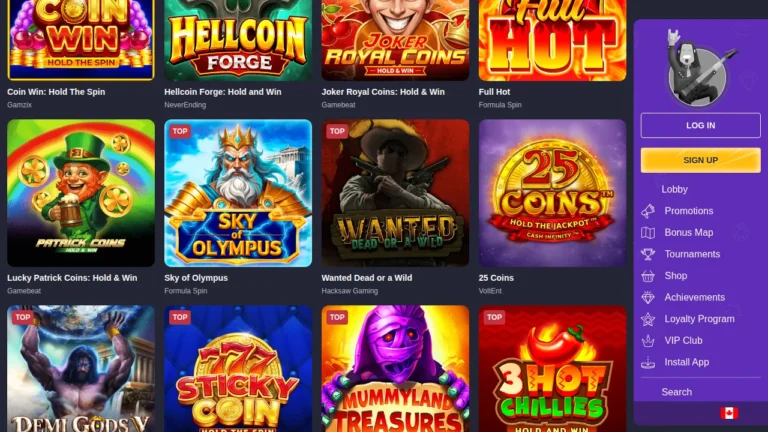
22Casino puts POKER in its top menu alongside Slots, Live Casino, TV Games, Bingo and Virtual Sports, and again as a filter in the game lobby next to Roulette, Blackjack and Baccarat. The footer’s Games list also includes Poker as its own entry.
The site is licensed by Kahnawake (licence No. 01056, issued on 13 May 2026), offers 24/7 live chat in English, and its welcome package is advertised at up to C$2,360 + 150 FS on the homepage (C$2,250 on the promo page; verified on the operator’s site in October 2026). Its terms allow up to 30 calendar days to pay winnings, which is long if you plan to cash out tournament prizes quickly.

- 24/7/365 live chat support
- 10% extra on crypto deposits
- Self-exclusion up to 5 years
Other Sites With Poker in the Lobby
BC.Game also shows POKER in its top navigation, a live casino Poker filter with around 70 titles when we checked, and a Video Poker game among its in-house titles. It is licensed in Anjouan (ALSI-202410011-FI1) and suits players who already use crypto — see our BC.Game review and crypto casinos guide.
The remaining sites on our list focus on slots, live casino and table games; poker variants may appear in their lobbies, but we found no poker room or poker section on the pages we read.
Poker Hand Rankings From Royal Flush Down
Poker hands rank from royal flush (best) to high card (worst), and the order is the same in Texas Hold’em, Omaha, Caribbean Stud and video poker. The rarer the hand, the higher it ranks — that is the whole logic behind the list.
The table below uses the standard deck of 52 cards and counts every possible five-card hand: there are exactly 2,598,960 of them. The probability column is the chance of being dealt that hand in five cards, which is why video poker paytables reward a royal flush so heavily.
| 🏆 Hand | 🃏 Example | 🔢 Five-Card Combinations | 📊 Probability |
|---|---|---|---|
| Royal flush | A♠ K♠ Q♠ J♠ 10♠ | 4 | 0.000154% (1 in 649,740) |
| Straight flush | 9♥ 8♥ 7♥ 6♥ 5♥ | 36 | 0.00139% |
| Four of a kind | Q♣ Q♦ Q♥ Q♠ 4♦ | 624 | 0.024% |
| Full house | 8♠ 8♦ 8♣ K♥ K♠ | 3,744 | 0.144% |
| Flush | A♦ J♦ 9♦ 6♦ 2♦ | 5,108 | 0.197% |
| Straight | 10♣ 9♦ 8♠ 7♥ 6♣ | 10,200 | 0.392% |
| Three of a kind | 7♠ 7♥ 7♦ K♣ 3♠ | 54,912 | 2.11% |
| Two pair | J♥ J♣ 4♠ 4♦ A♠ | 123,552 | 4.75% |
| One pair | 10♥ 10♠ K♦ 8♣ 3♥ | 1,098,240 | 42.3% |
| High card | A♣ Q♦ 9♠ 6♥ 3♣ | 1,302,540 | 50.1% |
Notice that half of all five-card hands are nothing more than high card, and more than nine in ten are one pair or worse — which is why a single pair often wins small pots in Hold’em.
How Ties Are Broken: Kickers
When two players hold the same type of hand, the higher-ranked cards win. Two pairs of jacks are decided by the kicker, the highest unpaired card: J-J-A-8-3 beats J-J-K-Q-9 because the ace outranks the king.
For full houses, the three-of-a-kind part counts first (8-8-8-2-2 beats 7-7-7-A-A). For flushes, compare the highest card, then the next, and so on. Suits never break ties in standard poker — two identical straights split the pot. TonyBet’s rules page states this explicitly.
The Ace-Low Straight and Other Edge Cases
The ace plays high or low in a straight, so A-2-3-4-5 (the “wheel”) is a valid straight — the lowest one. It cannot wrap around: Q-K-A-2-3 is not a straight. A few other points trip up newcomers:
- In Hold’em you use the best five cards from your two hole cards and the five community cards, in any combination — even all five from the board.
- If the board itself is the best hand for everyone, all remaining players split the pot.
- In Omaha the rule changes: exactly two hole cards plus exactly three board cards, no exceptions.
- In video poker and most casino poker games, the paytable — not a showdown — decides what each hand is worth.
How to Play Texas Hold’em Online
Texas Hold’em gives each player two private cards and deals five shared community cards in three stages; you make the best five-card hand from those seven cards, and you win either by having the best hand at showdown or by making everyone else fold. It is the most common poker game online and the default at most poker rooms, including Stake’s.
Blinds and the Dealer Button
Each hand starts with two forced bets. The player directly left of the dealer button posts the small blind and the next player posts the big blind (usually double the small blind). In a C$0.25/C$0.50 game, the blinds are C$0.25 and C$0.50.
The button moves one seat clockwise after every hand, so everyone pays the blinds in turn. Blinds exist to give each pot something to fight for; without them, the correct strategy would be to wait for aces every hand.
The Four Betting Rounds
A hand of Hold’em has up to four rounds of betting. On each one you can fold, check (if nobody has bet), call, bet or raise:
- Preflop: everyone gets two hole cards; action starts left of the big blind, and the big blind acts last.
- The flop: three community cards are dealt face up, followed by a round of betting starting left of the button.
- The turn: a fourth community card, then another betting round.
- The river: the fifth and final card, then the last betting round.
After the flop, the player on the button always acts last. That is a real advantage: you see what everyone else does before you decide, which is why good players play more hands from late position.
Showdown and Split Pots
If two or more players are still in after the river betting, hands are revealed and the best five-card hand wins. If everyone else folds earlier, the last player standing wins the pot without showing their cards.
Equal hands split the pot equally. TonyBet’s rules add a detail many players never think about: if an odd chip remains after a split, it goes to the first winning player to the left of the dealer button.
Limit, Pot-Limit and No-Limit
The betting structure changes the game more than most rule details. In no-limit, you can bet all your chips at any time. In pot-limit, the largest bet is the size of the pot. In fixed-limit, bets and raises come in set increments.
No-limit Hold’em is the standard for tournaments and most cash tables. Omaha is usually played pot-limit, because four or more hole cards create so many strong hands that no-limit betting would turn into constant all-ins.
Omaha, Pineapple and Fast-Fold Variants
Beyond Hold’em, the variants you’ll meet most often online are Omaha (four, five or six hole cards), Pineapple, and speed formats such as fast-fold and all-in-or-fold. Each one changes the maths of the game, so it pays to learn the rules before buying in.
Omaha 4, 5 and 6
Omaha uses the same flop, turn and river as Hold’em, but players receive more private cards. TonyBet’s rules page describes three versions: Omaha 4 (four hole cards), Omaha 5 (five) and Omaha 6 (six). In every version the final hand must use exactly two hole cards and exactly three community cards — no more, no fewer.
That one rule catches out Hold’em players. Holding A♠ with four spades on the board is not a flush in Omaha; you need two spades in your hand. Holding four aces is also weak — you can only use two of them. More hole cards means stronger average winning hands, so a straight that wins in Hold’em is often second best in Omaha 5 or 6.
Pineapple
Stake lists Pineapple among its poker game types. In the common version of Pineapple you receive three hole cards and discard one before the flop, then the hand plays like Hold’em. The extra card gives you a choice that rewards good starting-hand judgment.
Fast-Fold and All in or Fold
Fast-fold poker moves you to a new table with new opponents the moment you fold, so you never wait for a hand to finish. Stake’s version is called Next!, and it also runs Next! tournaments.
All in or Fold (AoF), also on Stake, strips decisions down to one: you either push all your chips or fold. Hands are fast and variance is high, so set a strict session budget before you start. Stake’s help centre lists a separate All in or Fold Jackpot as a table feature.
JAQKpot! and Jackpot Features
Stake’s game list also includes JAQKpot!, alongside a Bad Beat Jackpot table feature. Bad beat jackpots typically pay out when a very strong hand loses at showdown; check the qualifying conditions in the site’s own help article before assuming a hand counts.
Cash Games, Tournaments, Sit & Go and Spins
The four main formats are cash games (real money on the table, leave whenever you like), multi-table tournaments (fixed buy-in, play until one player has all the chips), Sit & Go (a tournament that starts when the seats fill) and Spins (a three-player Sit & Go with a random prize multiplier).
Cash Games
In a cash game, your chips are worth exactly what you bought in for. You can join and leave at any time, and the blinds never go up. That makes cash games the easiest way to control a budget: sit down with C$20 at a C$0.05/C$0.10 table and you can never lose more than that C$20 at that table.
The cost is rake, taken from pots you play. Over thousands of hands rake adds up, which is why rakeback (covered below) matters to regular players.
Multi-Table Tournaments
Tournaments trade flexibility for a capped risk. You pay a fixed buy-in (plus an entry fee in some cases), receive a stack of tournament chips with no cash value, and play until you bust or win. Blinds rise on a schedule, forcing action as the field shrinks; tables are balanced until one final table is left.
TonyBet’s rules note that late registration, re-entry, rebuys and add-ons apply only when the specific tournament allows them. Stake lists Re-entry, Multi-Flight and Satellite tournaments, which let you qualify for a bigger event through a cheaper one.
Sit & Go
A Sit & Go starts as soon as the required number of players registers — no fixed start time. Late registration is closed once play begins. Single-table Sit & Gos are popular with recreational players because they take a predictable amount of time.
Spins and Prize Multipliers
Spins (also called Spin & Go) are three-player Sit & Gos where a random multiplier sets the prize pool. On TonyBet, the possible multipliers and their probabilities depend on the specific Spins event, and level lengths and starting stacks may vary by multiplier.
Because the large multipliers are rare, most of the money in a Spins format is concentrated in a few prize pools. Expect long stretches of small results. Treat any advertised top multiplier as a lottery-style extra, not the expected return.
Bounty and Knockout Tournaments
In a knockout (KO) tournament, part of every buy-in goes into a bounty on each player’s head; eliminate someone and you collect it. Mystery Bounty tournaments, listed in Stake’s help centre, hide the bounty values until you win one. Both formats reward aggressive play and give you a way to earn money even if you don’t make the final table.
Pro Tip:
If you’re new to online poker, start with low-buy-in Sit & Gos or micro-stakes cash games. They teach you the software, the betting flow and position without risking a meaningful part of your bankroll in a single long tournament.
Poker Odds: Outs, Draws and Pot Odds
Poker odds come down to counting outs — the unseen cards that complete your hand — and comparing your chance of hitting with the price you’re being asked to pay. With 47 unseen cards after the flop, a flush draw (9 outs) hits on the turn 19.1% of the time and by the river 35.0% of the time.
These are fixed mathematical facts, not opinions, and they’re identical in every Hold’em game on every site. The table covers the draws you’ll face most often.
| 🎯 Draw (After the Flop) | 🔢 Outs | ➡️ Hit on the Turn | 🏁 Hit by the River | 🧮 Rule of 2 & 4 Estimate |
|---|---|---|---|---|
| Flush draw + open-ended straight draw | 15 | 31.9% | 54.1% | 60% |
| Flush draw | 9 | 19.1% | 35.0% | 36% |
| Open-ended straight draw | 8 | 17.0% | 31.5% | 32% |
| Two overcards (to pair up) | 6 | 12.8% | 24.1% | 24% |
| Gutshot (inside) straight draw | 4 | 8.5% | 16.5% | 16% |
| Pocket pair to a set | 2 | 4.3% | 8.4% | 8% |
The quick estimate works well for small numbers of outs and overstates big draws, so for 12 outs or more, trust the exact column.
The Rule of 2 and 4
At the table you won’t have time to calculate exact fractions. The shortcut: multiply your outs by 4 on the flop (to estimate your chance of hitting by the river if you’ll see both cards) and by 2 on the turn (one card to come).
Holding a flush draw on the flop gives 9 × 4 = 36%, close to the true 35.0%. On the turn, 9 × 2 = 18%, close to the true 19.6% (9 of 46 cards). Remember that “seeing both cards” assumes you won’t face another bet on the turn — in no-limit, you usually will.
Pot Odds: A Worked Example
Pot odds compare the cost of a call to the size of the pot you could win. Suppose the pot on the turn is C$40 and your opponent bets C$10. You must call C$10 to win C$50 (the C$40 pot plus their C$10), so you need to win at least 10 ÷ 60 = 16.7% of the time for the call to break even.
With a flush draw on the turn (19.6% to hit on the river), the call is profitable over time. With a gutshot (8.7%), it isn’t — unless you expect to win extra chips when you hit, a concept players call implied odds.
Preflop Numbers Worth Knowing
A few preflop probabilities shape every starting-hand decision:
- You’re dealt any specific pocket pair (say, pocket aces) once every 221 hands (0.45%), and any pocket pair about once every 17 hands (5.9%).
- A pocket pair flops a set or better about 11.8% of the time — roughly one flop in eight.
- Pocket aces against pocket kings all-in preflop win about 82% of the time.
- A pair against two higher unpaired cards (e.g. 8-8 vs A-K) is close to a coin flip, with the pair a slight favourite at roughly 55%.
Rake and Rakeback: The Real Cost of Poker
Rake is the commission a poker room takes from cash-game pots or adds to tournament buy-ins, and rakeback returns a share of the rake you paid. It is the poker room’s equivalent of the house edge — every player pays it, even winners.
How Rake Works
In cash games, rake is usually a percentage of each pot that reaches the flop, up to a fixed cap per hand. In tournaments it appears as an entry fee on top of the buy-in — a C$10 + C$1 tournament puts C$10 in the prize pool and C$1 goes to the site.
Small edges decide whether a poker player wins or loses over time, so the rake structure matters more than a flashy promotion. At low stakes, where pots are small relative to the cap, rake takes a bigger share of each pot than it does at higher stakes.
Stake’s Poker Rakeback in Practice
Stake’s help centre states that its rakeback on poker is 3.5% of the rake, available once you reach Bronze VIP ($10,000 wagered, as the VIP article phrases it). On casino games, the same programme returns 3.5% of the house edge.
In concrete terms: if you pay C$200 in rake over a month, rakeback returns C$7. That’s a modest figure compared with how rakeback is often marketed elsewhere, so treat it as a small perk rather than a reason to choose a site. Stake’s other VIP rewards (weekly boosts, monthly bonuses, level-up bonuses) are based on wagering and rank — read the cashback bonus guide to see how such programmes compare.
Watch out:
Rakeback and VIP rewards are calculated on how much you play, not on whether you win. Chasing a VIP level by playing more hands than you planned costs far more in rake and losses than the rewards return.
Casino Poker Games and Their House Edge
Casino poker games pit you against the dealer with a fixed paytable, and their house edge ranges from about 2% to over 5% of the ante with optimal play. Casino Hold’em (~2.16%) and Ultimate Texas Hold’em (~2.19%) are the cheapest, Three Card Poker sits at about 3.37% on the ante, and Caribbean Stud is the most expensive of the common games at about 5.22%.
These figures are standard published values for the usual paytables and assume you follow the basic strategy for each game. Side bets and progressive jackpots usually carry much higher edges.
| 🎲 Game | 🧩 How It Plays | 📉 House Edge (Optimal Play) | 💡 Key Decision |
|---|---|---|---|
| Casino Hold’em | Ante, two hole cards, flop; call (2× ante) or fold | ~2.16% of the ante | Call with most hands; fold only the weakest |
| Ultimate Texas Hold’em | Ante + Blind; raise 4×/3× preflop, 2× on flop, 1× on river | ~2.19% of the ante | Raise 4× preflop with strong hands |
| Three Card Poker (Ante/Play) | Three cards; play (1× ante) or fold | ~3.37% of the ante | Play Q-6-4 or better |
| Three Card Poker (Pair Plus) | Side bet on your three cards, no dealer | ~7.28% (1-4-6-30-40 paytable) | Optional — the costlier bet |
| Let It Ride | Three bets; pull back two of them | ~3.51% | Pull bets back unless you hold a paying hand or strong draw |
| Caribbean Stud Poker | Five cards; raise (2× ante) or fold vs dealer | ~5.22% of the ante | Raise with A-K or better; the dealer must qualify |
Use this table to set expectations: at a 5.22% edge, C$1,000 in total antes costs about C$52 on average; at 2.16%, about C$22.
Casino Hold’em
Casino Hold’em plays like heads-up Texas Hold’em against the dealer. You post an ante, see your two cards and the flop, then either fold (losing the ante) or call with a bet twice the ante. The dealer needs a pair of fours or better to qualify.
Its edge of about 2.16% of the ante is the lowest of the classic casino poker games. The simple strategy: call far more often than feels natural, folding only your worst unpaired, unconnected hands.
Three Card Poker
Three Card Poker deals you three cards against the dealer’s three. You decide to play (matching your ante) or fold. Hand rankings differ from five-card poker: a straight beats a flush because it’s rarer with three cards.
The well-known rule is to play with Q-6-4 or better. That keeps the ante/play edge near 3.37%. The Pair Plus side bet is independent of the dealer and costs more — about 7.28% on the common 1-4-6-30-40 paytable.
Caribbean Stud Poker
In Caribbean Stud you get five cards and see one of the dealer’s. Raise (twice the ante) or fold. The dealer must qualify with ace-king or better; if not, you win only the ante and your raise is returned.
That qualifying rule is why the edge is high — about 5.22% of the ante. Many versions add a progressive jackpot side bet, which raises the cost further. Caribbean Stud titles from several providers appear in the game lists of Kingmaker’s and Golisimo’s terms, inside the list of games that can’t be played at all with an active bonus.
Live Dealer Poker Tables
Live dealer versions of these games are streamed from studios with real cards and a human dealer. The rules and edges match the RNG versions; the differences are pace (slower), minimum bets (usually higher) and atmosphere. At Kingmaker and Golisimo, these tables sit in the live casino’s Poker section.
If you play live, budget for a fixed number of hands rather than a time limit — you’ll see fewer hands per hour than at an RNG table, which actually lowers your hourly cost. Our live casino guide explains how live studios work and what to check before you sit down.
Video Poker: Jacks or Better and Pay Tables
Video poker is the casino’s best-value poker game when you find a full-pay machine: 9/6 Jacks or Better returns about 99.54% with perfect strategy, an edge of only 0.46%. The catch is that the same game with a cut paytable can return two to three percentage points less.
Reading the 9/6 Paytable
“9/6” refers to the payouts for a full house (9 for 1) and a flush (6 for 1) on a one-coin bet. Those two lines are the quickest way to spot a good machine; the rest of the paytable is usually standard.
- 9/6 Jacks or Better: about 99.54% return.
- 8/5 Jacks or Better: about 97.30% — a full house pays 8 and a flush 5.
- 7/5 Jacks or Better: about 96.15%.
Always check the paytable on the game’s info screen before you play. Two machines with the same name can carry different returns. At Kingmaker and Golisimo, video poker counts 10% towards bonus wagering, which tells you how little a bonus helps here.
Basic Holding Strategy
You don’t need to memorise a full strategy chart to play close to the maximum return. A simplified priority order covers most hands:
- Hold any paying hand of a straight or better; keep four to a royal flush even over a made flush or straight.
- Hold three of a kind, two pair or a high pair (jacks or better).
- Hold four to a flush or a low pair before a four-card open-ended straight.
- Hold two high cards of the same suit, or up to two unsuited high cards.
- With nothing else, discard all five and draw a fresh hand.
Bet the maximum coins only if the royal flush pays a bonus at max bet, and only if that max bet fits your budget. Otherwise, the same strategy at one coin is fine.
Poker and Casino Bonuses: What Actually Counts
Casino welcome bonuses are a poor fit for poker at the sites we review: table and card games count 0% and live games 10% towards wagering at Kingmaker and Golisimo, and TonyBet’s general bonus terms exclude table games, crash games and live dealer games from wagering entirely. If poker is your main game, skip the casino bonus or claim one only if you also play slots.
The reason is simple. Casinos weight wagering by how much of each bet they expect to keep. Slots carry a higher house edge than poker tables, so a C$1 slot spin counts in full while a C$1 poker hand counts for little or nothing. Our wagering requirements guide explains the mechanics in detail.
Kingmaker and Golisimo: The 10% Problem
Kingmaker and Golisimo share the same General T&C. Unless a promotion says otherwise, a deposit bonus must be wagered 35 times the deposit plus the bonus, within 10 days, and the maximum you can withdraw from bonus winnings is ten times the bonus amount.
Here’s what that means in practice. Take a C$100 deposit with a C$100 bonus (an illustrative split — the per-deposit breakdown of the current offers wasn’t on the pages we read):
- Wagering target: 35 × (C$100 + C$100) = C$7,000.
- At slot contribution (100%): C$7,000 in slot bets.
- At live game contribution (10%): C$70,000 in live casino bets — including live poker tables.
- At table and card game contribution (0%): impossible; RNG casino poker never clears it.
- Video poker (10%): also C$70,000 of play, within 10 days.
On top of that, section 7.10 of the same terms lists games that cannot be played at all with an active bonus. That list includes several Caribbean Stud Poker, Caribbean Poker, Oasis Poker and Triple Edge Poker titles, plus Texas Hold’em and High Hand Hold’em Poker games from some providers. Playing them with a bonus active risks the bonus and its winnings.
TonyBet’s Bonus Rules for Poker Players
TonyBet’s casino welcome offer is advertised as up to $2,500 + 250 free spins + 6 bonus games (verified on the operator’s site in October 2026). Its general bonus terms set 30x wagering for welcome bonuses, a $10 maximum bet while a bonus is active, a $20 minimum deposit for any deposit bonus and a 14-day expiry by default.
Because table games and live dealer games don’t count, this is a slot bonus. If you’re joining TonyBet to play Omaha tournaments or Spins, you can use its Bonus Issuance opt-out among the responsible-gaming tools, or simply not claim the offer.
Stake: Rakeback Instead of a Welcome Package
Stake’s help centre says its welcome offer is redeemed only with an affiliate offer code, and our sources don’t include the terms. For poker players, the documented value is the 3.5% rakeback on rake from Bronze VIP upward, plus weekly and monthly VIP bonuses based on rank and wagering.
That structure suits regular players more than casual ones: nothing is paid until you reach Bronze, and rewards scale with volume. Compare it with the welcome bonus guide if you play mainly casino games.
Pro Tip:
If a site’s poker product is a separate room (as at Stake and TonyBet), look for poker-specific promotions — freerolls, tournament tickets or rakeback — instead of the casino welcome bonus. They’re built around the game you actually play.
Online Poker Strategy Tips for Beginners
The fastest way to improve at online poker is to play fewer, stronger starting hands, use your position, and size your bankroll so that no single session can hurt you. None of this needs advanced maths — just discipline.
Starting Hand Selection
Most losing players play too many hands. In a full-ring Hold’em game, a sensible beginner range from early position is roughly: big pairs (A-A to 10-10), A-K, A-Q and K-Q suited. Widen it gradually as you move closer to the button.
Hands like K-7 offsuit or J-4 suited look playable but lose money over time because, when they hit, they’re often second best. Folding is the most profitable action in poker for most beginners.
Play Position Aggressively
Acting last gives you information. From the button and the cutoff (one seat to the right), you can open with more hands, steal the blinds when others fold, and control the size of the pot after the flop.
From the blinds, the reverse is true: you act first on every street after the flop. Defend selectively — the chips you posted are already gone, so don’t chase them with weak hands.
Bet for Value, Bluff Rarely
At micro stakes, opponents call too much. That means you should bet your strong hands for value — often more than feels comfortable — and bluff much less than you see in televised poker. A bluff only works against someone who can fold.
Bankroll Rules That Protect You
A bankroll is money set aside only for poker, separate from bills and savings. Common conservative guidelines:
- Cash games: at least 20 to 30 full buy-ins for your stake level. With C$300, that’s a C$10 or C$15 buy-in game.
- Tournaments and Sit & Gos: 50 to 100 buy-ins, because results swing far more.
- Spins: even more, since most of the prize money sits in rare multipliers.
- Move down a level after losing a set number of buy-ins — and decide that number before you sit down.
Avoid Multi-Tabling Too Early
Online rooms let you open several tables at once; Stake’s help centre even has an article on opening multiple cash tables and tournaments. More tables mean more hands per hour, which multiplies both your learning and your losses. Master one table before adding a second.
Use the Table Features Wisely
Features such as Run it Multiple Times, Rabbit Hunting and Straddle (all listed by Stake) change the feel of the game but not its fundamentals. Running it twice reduces variance on all-in hands without changing the expected value; a straddle simply makes the pot bigger. If you’re unsure what a feature does, read the help article first.
Deposits and Withdrawals for Poker Players
Canadian poker players should pick a site whose cashier confirms a method they already use: Golisimo lists Interac at C$10–C$3,000, Stake documents Visa and Mastercard in CAD (C$5–C$3,000) plus Interac e-Transfer withdrawals, and TonyBet lists cards, Skrill/NETELLER, bank wire and crypto.
A few cashier details matter more to poker players than to slot players, because tournament wins can be large and irregular:
- Withdrawal speed: TonyBet targets e-wallet withdrawals within 12 hours, while card withdrawals can take up to 7 business days. Stake’s Interac withdrawals take up to 3 business days. 22Casino’s terms allow up to 30 calendar days to pay winnings.
- Method matching: Stake processes card withdrawals back to the original card used for the deposit, and withdrawals must use a method previously used for a deposit.
- Verification: Stake requires identity verification before the first withdrawal; TonyBet asks for documents at the first withdrawal and gives you 7 calendar days to provide them.
- Currency: TonyBet converts your balance when your account currency differs from the poker game’s currency, using a Coinlayer exchange rate.
- Fees: TonyBet charges no processing fees on deposits or bank wire withdrawals, but applies a C$7 monthly maintenance fee to dormant accounts.
Our Interac casinos guide lists every site in our ranking that confirms Interac, with limits.
Crypto for Poker
Crypto is common at poker rooms with an international player pool. Stake supports a wide range of coins (including BTC, ETH, LTC, USDT and USDC in its limits tables), Golisimo lists more than a dozen crypto options, and BC.Game is built around crypto. Remember that a coin’s price can move between deposit and withdrawal — your poker profit can shrink or grow in Canadian-dollar terms for reasons unrelated to the game.
Is Online Poker Legal in Canada?
Online poker is legal in Canada when it’s conducted and managed by a provincial government or under its licence, under section 207(1)(a) of the Criminal Code. There is no federal online gambling regulator; each province decides how online gambling, including poker, is offered.
Ontario’s Regulated Poker Sites
Ontario has run a regulated, competitive iGaming market since April 4, 2022. The AGCO registers and regulates operators, and iGaming Ontario (iGO) conducts and manages the market. Players must be 19+ and physically located in Ontario.
The official iGO list (“accurate as of 2026-09-01”, 84 websites) includes several sites with a poker category, such as 888 Poker, BetMGM Poker, FanDuel Poker, GGPoker and PartyPoker, plus 888 Casino and Bwin with poker among their products. We mention them for information only: if you’re in Ontario, check the iGO list of regulated sites and see our Ontario online casinos guide.
Ontario’s Registrar’s Standards also prohibit public advertising of bonuses and inducements, which is why regulated Ontario sites show offers only once you’re on their own site or app.
Alberta and Other Provinces
Alberta’s regulated iGaming market officially launched on July 13, 2026, with AGLC as regulator and the Alberta iGaming Corporation conducting and managing the market (18+). In British Columbia, Manitoba and Saskatchewan the government site is PlayNow.com; in Quebec it’s lotoquebec.com; and in Atlantic Canada, Atlantic Lottery Corporation runs the government offering.
Offshore Poker Sites
All five sites in our shortlist are offshore operators, not regulated by a Canadian province. They accept players from many provinces under licences issued elsewhere (Kahnawake for TonyBet and 22Casino; none named in our sources for Stake, Kingmaker or Golisimo). If a dispute arises, you deal with the operator and its licensing body, not your province.
tonybet.com’s terms state that its Kahnawake licence covers Canada excluding Ontario and Alberta. Offshore sites are not part of Ontario’s regulated market, so our shortlist is not for Ontario players. A separate TonyBet operation appears on iGO’s list for Ontario, under casino and sports betting, not poker. Players in Ontario and Alberta should use their province’s regulated sites. Our legal guide covers each province in detail.
Do You Pay Tax on Poker Winnings in Canada?
For most Canadians, no: recreational gambling winnings, including poker, are generally treated by the Canada Revenue Agency as windfalls and are not taxed. The exception is people who are in the business of gambling — for example, organised professional poker players — whose winnings may be taxed as business income.
Recreational vs Professional Players
The CRA’s test looks at whether winnings can be considered income from employment, a business or property. A player who enjoys weekend tournaments is in a very different position from someone who plays full-time, systematically, as their main source of income.
If poker becomes a serious income stream for you, speak to a tax professional and keep records of buy-ins, cash-outs and results. Any interest earned on your winnings is taxable in every case, even if the winnings themselves are not. The CRA explains which amounts are taxed on its page about amounts that are not reported or taxed and in Income Tax Folio S3-F9-C1.
Playing Online Poker Responsibly
Poker’s skill element makes it easy to believe that losses are temporary and the next session will fix them — set a budget and time limit before every session and treat the money as the cost of entertainment. The legal age is 19+ in most provinces and 18+ in Alberta, Manitoba and Quebec.
Tools on the Poker Sites We Checked
The sites in this guide publish different levels of control:
- Stake: loss, wager and deposit limits; Break In Play; Product Exclusion; a dedicated Poker Exclusion; indefinite self-exclusion (minimum 6 months); 24-hour cooling-off before limits can be raised.
- TonyBet: deposit and loss limits, time-out, self-exclusion from 6 months to 3 years, Kahnawake Gaming Commission self-exclusion, bonus opt-out, and a 48-hour cooling-off on limit increases.
- 22Casino: daily, weekly or monthly deposit limits, cool-off, self-exclusion for up to 5 years and a self-assessment questionnaire.
- Kingmaker and Golisimo: self-exclusion and breaks on request by email to support.
Where to Get Help in Canada
If poker or any gambling stops being fun, free and confidential help is available. Call ConnexOntario at 1-866-531-2600, the BC Problem Gambling Help Line at 1-888-795-6111, the Alberta Addiction and Mental Health Helpline at 1-866-332-2322, or Quebec’s Gambling: Help and Referral line at 1-800-461-0140. Other provinces and territories have their own lines; our responsible gambling guide lists every number.
Related Guides

Online Casino Games in Canada 2026: Every Game Type Explained
The best online casino games in Canada for your money are blackjack (about 0.5% house edge…
Live Casino Canada 2026: Live Dealer Sites, Studios and Game Shows
The best live casino in Canada for players outside Ontario and Alberta depends on what you…
Online Blackjack Canada 2026: Best Sites, Rules & Strategy
The best online blackjack sites for Canadian players are Need for Spin, Wild Tokyo, Kingmaker, 22Casino,…